
Democracy and citizenship
Nicolas-Jean Brehon
-

Available versions :
EN
Nicolas-Jean Brehon
Honorary Advisor to the Senate
Debate on the European financing of defence and, more specifically, on the financing of military capabilities has begun. The stakes are industrial, military, strategic and political. This period of turmoil is Act II of the European Union's investment in the military domain. Because there was a first act. For a time, the European Union saw itself as a player in international security. That was the era of external operations. This action is still on-going. In 2025, it continued to conduct eight military operations and missions in Europe and Africa. This international action does not represent the same challenges as armament. But at a time when several countries are considering a “coalition of the willing” on the borders of Ukraine, it seems relevant to take stock of these crisis management interventions.
I - Military operations
1.1 - Gradual development
a) The context of the early 1990s: Maastricht and the Balkan wars
The Maastricht Treaty (1992) marked a milestone in the history of European integration with two major creations that revealed a new political ambition: the euro and the Common Foreign and Security Policy (CFSP). The European Union sees itself as a global player. Europe is self-confident, and history has proven it right. The break-up of the Communist bloc in 1989/1991 was a victory for one model and was accompanied by a geopolitical earthquake: all the member countries of the Warsaw Pact, with the exception of the USSR and three of the former republics of the USSR, changed alliances and joined NATO! The East moved to the West. And applications for membership of the European Union were not long in coming.
The European Union saw itself as a global player. Would it at least be a regional one? Because war was coming to Europe. The wars in the former Yugoslavia, just a few kilometres from the Union’s borders, were both a consequence of the upheaval mentioned above and a test of the Maastricht Treaty. ‘Europe’s hour has come,’ people thought at the time. The alarm clock rang in Europe, but it was the Americans who got up and went to war. Four wars in ten years. 150,000 dead. In 1999, 78 days of NATO bombing of Serbia marked the beginning of the end of the territorial and ethnic conflict.
b) The Treaty of Amsterdam (1997) and Concordia, the first military operation (2003)
A few Member States played their part in these Balkan wars, but the European Union was almost entirely absent. This is a harsh assessment, but the ambition remains. The turning point came with the Treaty of Amsterdam (1997). Crisis management operations and missions became part of the Union's remit, such as the WEU's peace-keeping and peace-making missions defined by the Member States in Petersberg in 1992. These operations involve the use of combat forces. Joint actions are decided unanimously by the Council, but the abstention of one Member State does not prevent the decision from being adopted. In December 2002, the European Union and NATO concluded an “arrangement” allowing the latter to use NATO's logistical resources (known as the Berlin Plus agreements). In January 2003, the European Union conducted its first military operation in Macedonia: Concordia. A minor operation (North Macedonia is the only country of the former Yugoslavia that has not had a war), but a political turning point: the European Union positioned itself as a player in international security and demonstrated its ability to conduct crisis management operations, including through military means made available to it by Member States.
1.2 - Regime
The military operations regime was established between 2004 and 2007. It is based on three elements: an institutional foundation, procedures and a funding mechanism.
a) The institutional foundation
The Lisbon Treaty (2007) confirms this military-oriented ‘operational’ focus. It establishes a Common Security and Defence Policy (CSDP), which is an integral part of the Common Foreign and Security Policy (CFSP). The CSDP ‘shall provide the Union with an operational capacity drawing on civil and military assets’ (Art. 42.1). The European Union may use this capacity ‘in operations outside the Union’. The Petersberg missions have now been extended to include military advice and assistance, disarmament and the fight against terrorism (Art. 43.1). Defence remains the prerogative of the Member States, but the Union now has its own projection capacity.
b) Regarding procedures
The Union's military operations and missions are decided by the Council acting unanimously on a proposal from the High Representative for Foreign Affairs and Security Policy or from a Member State (see Annex 1). The abstention of a Member State does not prevent the decision from being adopted (rule of constructive abstention, Article 31). The Member State concerned may combine its abstention with a formal declaration. It is not obliged to implement the decision, but it accepts that the decision is binding for the Union. This also allows it to opt out of contributing to financing the operation.
With the expansion of missions, national military resources are called upon to varying degrees. The mandates given by the Council concern two types of mission:
Executive missions correspond to ‘combat force missions for crisis management’, including peace-making missions. These are effective ‘military operations’ – as the Council describes them in its decisions – involving the deployment of forces and, where necessary, armed engagements on land or at sea (operations identified by the acronyms EUFOR and EUNAVFOR).
Non-executive missions correspond to military training or assistance missions (identified by the acronyms EUTM and EUMAM).
However, this distinction is becoming less and less relevant as missions can change and end up overlapping, as in the case of EUNAVFOR, for example Atalanta[1]. Logically, the term ‘military operations’ should be reserved solely for executive operations. However, the concept is used extensively whenever a military element participates in the mission, thus often blurring the distinction between ‘military missions and operations’.
c) Financing operations
The principle was established in the Treaty of Amsterdam and is formalised in Article 41. The scheme is as follows: administrative costs (EU staff) are paid from the EU budget. Common costs are financed by the Member States through a collective financing mechanism outside the Union budget. Except in the case of constructive abstention coupled with a declaration (as in the case of Denmark), common costs are financed by 26 Member States. Even if they do not participate in the operation, their share in the financing is proportional to their share in GNP. Other expenditure incurred by operations (85 to 90% of the total cost of an operation) is paid by the Member States from their budgets according to a simple principle: the more they contribute to the operation, the more they pay.
The definition of common costs was set in 2004 by a Council decision establishing Athena, a “mechanism for managing the financing of the common costs of EU operations having military or defence implications”. The system is complex because common costs vary depending on the nature of the expenditure and the phase of the operation[2]. However, with this three-pronged approach of agreements, procedures and funding, the European Union has been able to engage in crisis management and military operations before adjusting its position.
1.3 - How they have evolved
Ten operations involving the deployment of armed forces have taken place since 2003 (see Annex 2). However, it is important to distinguish between two periods.
a) 2003/2020: crisis management operations, "the key instruments of the CFSP"
The first two operations (Concordia in North Macedonia and Althea in Bosnia and Herzegovina) were based primarily on an agreement with NATO (Berlin +) that allowed the European Union to use NATO resources. A formal framework was established after 2004. A series of purely European operations then followed, driven by experience, international tensions in Africa and the UN, which was extremely active at the time. Most of the Council's decisions on military operations are based on UN Security Council resolutions. Chapter VII of the United Nations Charter on “action in case of a threat to the peace, breach of the peace, and acts of aggression” provides that “the Security Council shall make recommendations or decide what measures shall be taken (...) to maintain or restore international peace and security” (Article 39 of the Charter). States ensure that their armed forces are available to the Council to contribute to the maintenance of international peace and security (Art. 43). The European Union may thus be authorised to "use force if necessary", as is the case for EUFOR Althea (Resolution 1551 (2004)). The mandate was intended to be for a limited period. In October 2025, the UN Security Council renewed it. The operation has been ongoing for 22 years. Of the ten military operations conducted by the European Union, nine were decided upon before 2021. The operations involved the deployment of armed forces of varying sizes (between a few hundred and 7,000 troops) on land (EUFOR) or at sea (EUNAVFOR) in Europe and Africa. These operations included peace support in Europe, maritime security (anti-piracy), and securing elections in Africa. Military operations were then ‘the main instruments of the CFSP’[3] and helped position Europe as a player in regional security.
b) Military operations since 2021
That period is now over. Admittedly, the method of intervention is not obsolete, since a new operation was decided upon in 2024. (EUNAVFOR Aspides), extended since then, and in October 2025, the UN Security Council renewed the mandate of Operation Althea. However, these operations now play only a minor role in the range of military interventions. The main lever for intervention is military assistance. On the other hand, military operations are making a minor comeback in the form of support for joint European military exercises. Funding is provided for in Article 45 of the Regulation on the European Peace Facility. The first European military exercise was carried out in October 2023 (MILEX in Spain brought together 2,800 soldiers from nineteen Member States, including 600 French soldiers). According to one study, the joint cost was €5 million, comparable to the Concordia operation. A similar exercise was repeated in 2024 and 2025[4].
1.4 - Military assistance missions
The war in Ukraine obviously marked a turning point. But in reality, the shift had begun earlier.
a) 2020/2021, first missions in Africa: the Peace Facility for Africa
Can the European Union ensure stability in a conflict-ridden environment? Africa, weakened by threats of destabilisation, was a testing ground for this new positioning. In 2000, the new African Union[5] was given responsibility for security issues in Africa and deployed its own peace missions. The European Union supported these initiatives with the creation of the Peace Facility for Africa (APF), a way of organising security cooperation with the African Union. This shift was not without tension between states, as this military cooperation was part of the partnership agreements concluded in Cotonou in 2000 and was financed by the European Development Fund. The policy guidelines were clear: the European Union supported the African Union (not individual states), and the fund (€300 million per year) intended to finance its multilateral peace support operations but not combat operations. In practice, there were countless difficulties. Europe provided assistance in operations related to military operations, such as troop transport, IT and supplies, but did not finance salaries or training. The major issue was the supply of equipment, particularly weapons. The supply of weapons and ammunition was not included in eligible expenditure. In reality, the APF quickly showed its limitations. European assistance “operated in a grey zone”. The debate on lethal weapons led to absurd situations (European military personnel could train staff but without ammunition). Both sides therefore agreed on the need to establish a new framework for military intervention.
b) 2021. The European Peace Facility
In 2021, the European Peace Facility (EPF) reformed the APF system and became the main instrument for European military aid. It aims to support two distinct missions based on two different foundations and organised into pillars. The “operations” pillar corresponds to CSDP operations with military or defence implications (Articles 42.4 and 43.2 TEU). The missions extend across the whole world. The common costs are covered by the EPF, which has taken over from the Athena mechanism.
A new “Assistance Measures” pillar finances third countries and regional or international organisations (Articles 28 and 30 TEU). Actions under this pillar aim to strengthen defence capabilities and support the military aspects of peace support operations. This pillar is itself divided into two parts: the training mission, which involves sending a contingent to the field, which explains why training activities are included among the interventions; and the assistance mission, which consists of providing equipment and contributing to the financing of its acquisition, whether lethal or non-lethal.
The European Peace Facility is a strategic turning point for the Union. It is bringing changes that will prove crucial. As a tool for financing operations outside the Union, it can help states and not just international organisations. The European Union can supply or finance the purchase of equipment. This was the main request from African states. Finally, assistance extend to providing lethal equipment.
c) Some facts
The assistance component was activated in 2021[6]. In Africa (African Union, Mozambique, Mali), since the EPF intended to replace the APF but also in Ukraine, even before the Russian invasion of 24 February 2022. The war has completely changed the nature of European intervention, which until then had consisted of crisis management operations and peace and security support missions. This aspect has been swept away by events. Without being completely abandoned, military intervention in the event of a crisis with contingents deployed on the ground is now only incidental. Intervention now takes place through other channels: training aid and assistance in the acquisition of ammunition and equipment. The financing of equipment is the preferred route for European military intervention.
The budgetary resources allocated to the EPF are increasing considerably. When it was created in 2021, the planned allocation for the period 2021-2027 was €5.69 billion (current prices). By the end of 2022, 86% of the budget had been spent on assistance for Ukraine. On three occasions, in 2023 and 2024, the allocation was increased to €17.04 billion, including €5 billion earmarked for Ukraine. In four years, the Council adopted 71 military assistance decisions (see Annex 3). Ukraine was obviously the priority recipient country. In February 2026, the Council estimated the EU's financial assistance to Ukraine at €11.1 billion, not including support from Member States, which brings the total to €69.7 billion.
Annex 1: Ongoing European military operations and missions
Executive Missions
EUFOR Althea in Bosnia and Herzegovina
Launch: Council Joint Action 2004/570/CFSP of 12 July 2004. Stabilisation force with a UN mandate (Security Council Resolution 1575, 2004). The mandate has been renewed for twenty-two years (Security Council Resolution 2795 (2025) of 31 October 2025). These mandates give EUFOR an international executive mandate under Chapter VII of the United Nations Charter, authorising the use of force. EU military operation to support the country's efforts to maintain a climate of safety and security. EUFOR Althea had up to 7,000 soldiers from 26 countries, including several non-EU countries (Switzerland, Turkey, Albania). The number of troops has varied, falling to 600 before rising to 1,100 after the start of the war in Ukraine. The number of troops in 2025 is expected to be around 1,500 after the withdrawal of large contingents from the Czech Republic and Romania. France is sending only a modest contingent of around 30 soldiers. Cost: €71.9 million (2004 figure, not updated).
EUNAVFOR Atalanta
Launch: Council Joint Action 2008/851 of 10 November 2008. Operation in support of UN Security Council Resolutions 1814, 1816 and 1838 (2008). European Union military operation to contribute to maritime security (combating piracy) in the western Indian Ocean off the coast of Somalia. Atalanta was responsible for escorting ships from the World Food Programme and the African Union mission in Somalia. The number of attacks fell from 168 in 2008 to 1 in 2016. The military mission has been regularly reinforced. These comprise executive missions such as enforcing the arms embargo on Al-Shabaab, Somalia's parallel state, and non-executive missions to combat trafficking in drugs and charcoal (CFSP Decision 2020/2188). National contributions take the form of combat ships (between 4 and 13 vessels), ship-based helicopters, reconnaissance aircraft and marines. Atalanta had 19 participating States, including New Zealand and South Korea. In 2020, the extension of the missions led to the end of Germany's participation. Cost: €132.7 million.
EUNAVFOR Med Irini
Launch: with the Council Decision 2020/472 of 31 March 2020. Backed by UN Security Council Resolutions 1970 (2011), 2292 (2016) and 2473 (2019) of the UN Security Council, it aims to enforce the arms embargo imposed on Libya and, incidentally, to participate in the fight against human trafficking in the Mediterranean Sea and to train the Libyan coastguard. Ships from 24 participating countries tracked several hundred vessels, inspected 33 ships and seized three cargoes. Cost: €60 million.
EUNAVFOR Aspides
Launch: with the Council Decision 2024/583. Operation based on UN Security Council Resolutions 2624 (2022) and 2722 (2024). Military maritime security operation aimed at protecting maritime traffic in the Red Sea. Twenty-one participating countries. A French frigate participating in EUNAVFOR Aspides was attacked by several drones. On 23 February, the Council extended the mandate of Operation ASPIDES to preserve freedom of navigation until 28 February 2027. Cost: €25.4 million.
Non-executive Missions
EUTM RCA: European training mission in the Central African Republic. It follows on from the EUMAM CAR military advisory mission (Council Decision 215/78 of 19 January 2015), which itself followed on from the EUFOR CAR military operation. Participation of 248 soldiers from eight Member States and four third countries (including Brazil and Serbia). Cost: €82 million.
EUTM Somalia: European training mission in Somalia launched in 2010 (Council Decision 2010/96/CFSP). Participation of twelve Member States and one third country (Serbia). 187 soldiers (in 2017). Cost: €155 million.
EUMAM Mozambique: Military assistance mission in Mozambique. Launched on 1 September 2024. Twelve contributing states. Cost: €14.1 million.
EUMAM Ukraine: Military assistance mission in Ukraine. Launched on 15 November 2022 for two years and renewed in 2024 until 15 November 2026. Twenty-four contributing countries. Cost: €610 million (€435 million for training and €175 million for equipment).
Annex 2: The procedure for external military operations[7]
The Common Security and Defence Policy (CSDP) is an integral part of the Common Foreign and Security Policy (CFSP) (Art. 42.1 TEU). The CSDP provides the European Union with an operational capacity based on civilian and military resources. The Union may use this capacity for missions outside the Union. These mandates include crisis management, including peace-making and post-conflict stabilisation operations (Articles 42.1 and 43 TEU). These interventions, involving combat forces, are commonly referred to as external military operations.
The decision to launch an external operation is taken unanimously by the Council (Art. 43.2), except in the case of constructive abstention (Art. 31). Abstention does not prevent the other Member States from adopting the decision. The State concerned may accompany its abstention with a formal declaration excluding it from any technical or financial participation. This was the case for Denmark until 2022. The decision is adopted on the initiative of a Member State or the High Representative for Foreign Affairs and Security Policy. Before the Treaty of Lisbon, operations were decided in the form of “joint actions”. Since 2007, they have been decided by the Council (CFSP). The Commission and the European Parliament are only marginally involved and only within the framework of the general provisions of the CFSP[8]. For the Commission, the contrast with ordinary EU law is clear. It does not have the power of initiative but can support the High Representative's initiatives (Article 30). However, it does have a role in the administration of operations. The European Parliament is consulted by the High Representative on the main aspects of the CSDP[9].
In practice, the Council's decision follows a request from a State or a United Nations resolution. The Council decides on a case-by-case basis whether an operation has military or defence implications within the meaning of Article 41.2 TEU. The decision sets out the mandate and duration – from a few months[10] to several years[11] – and a budget.
Several administrative structures prepare the Council's decision. The European External Action Service (EEAS), under the authority of the High Representative, is responsible for analysis and political contacts (consistency with Union policy, contacts with the UN). There are also two military structures set up around the Council: the European Union Military Staff (EUMS) and the Political and Security Committee (PSC). The latter, established by the Treaty (Art. 38 TEU), is the central institution in the Union's decision-making chain for CSDP matters. Member States are represented there by an ambassador. It provides political control and strategic direction for the crisis management operations referred to in Art. 43. It is assisted by a Political-Military Group (PMG), which deals with the political aspects of military issues upstream, and by the European Union Military Committee (EUMC), a military body attached to the Council. It provides the PSC with advice and recommendations in the military field and assumes the leadership of the Union's military activities. The EUMS is a political-military headquarters. An operational structure is attached to it: the Military Planning and Conduct Capability (MPCC). The command structure varies depending on whether the operations are “executive”, i.e. involving combat forces, or “non-executive” (training, advice, assistance). The EUMS is responsible for planning and commanding non-executive missions. Executive operations are conducted by ad hoc headquarters set up in the framework nation[12] with a force planning and deployment headquarters and a field force headquarters, which itself appoints a force commander who is present in the field. Command rotates every six months.
As the European Union does not have its own armed forces, it calls on those of its Member States. Participation is voluntary. The decision to open up to third countries is taken on a case-by-case basis. The number of participating countries and the scale of deployments on the ground vary (from a few hundred men and women to several thousand). In the case of executive operations, the Council decision designates a framework nation that is most involved and whose personnel on the ground will be the most significant. In general, the armed forces participating in EU operations are drawn from “EU battlegroups” (EUBG), which are supposed to contribute to a rapid reaction force ready to be deployed on operations. The Helsinki European Council (12 December 1999) set a target of deploying 60,000 troops within 60 days to carry out Petersberg tasks. The battle group comprises 1,500 troops who can be deployed within 10 days for operations lasting less than three months.
In administrative and budgetary terms, operations fall under the European Peace Facility (EPF) created by a Council decision in 2004. The CFSP decision on the operation sets a “reference amount” representing the common costs of the operation shared between Member States, whether or not they participate in the operation. The common costs are listed and defined by the EPF decision. The EPF has a legal capacity separate from that of the Union, which enables it to enter into contracts, acquire equipment and ensure the implementation of the budget. These functions are carried out by an administrator and a secretariat, which are responsible for implementing assistance measures under the supervision of the PSC. The administrator appoints implementing partners, which may be States (Portuguese Ministry of Defence, Mozambique mission), international organisations (African Union) or private bodies entrusted with a public service mission (Expertise France in Mali). "In 2021, the High Representative appointed the European Commission as administrator of the assistance measures. This choice is somewhat surprising because it allows the EU executive – which is excluded from CFSP decision-making – to return to the game and be involved in the day-to-day management of the EPF”[13].
Annex 3: List of Military Operations
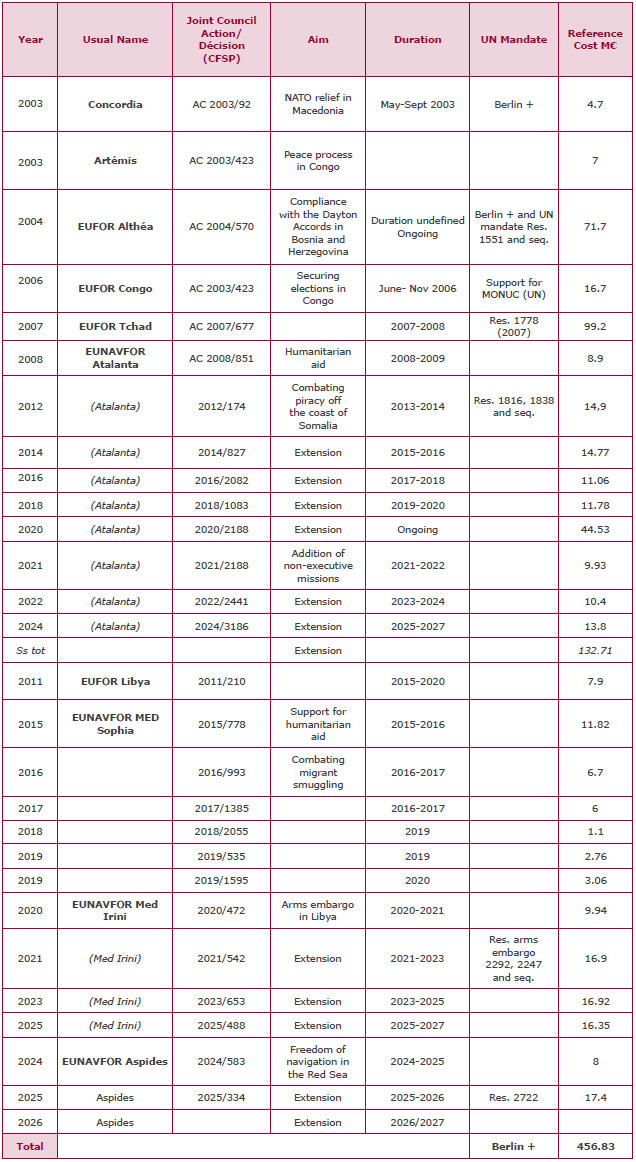
Source: Compilation by the author, Council decisions (CFSP)
[1] Launched in 2008 as an operation to combat piracy in the Indian Ocean, it was modified in 2020 (Decision (CFSP) 2020/2188) to include secondary executive operations (contributing to the arms embargo in Somalia) and non-executive missions to combat illegal fishing, timber trafficking and narcotics trafficking.
[2] There are common costs that are covered regardless of the timing (staff, recruitment of local personnel), operational costs for the preparatory phases covered by Athena (medical services, satellite imagery), and operational costs for the active phase, which are subdivided into three elements: costs always covered by Athena (medical repatriation, field hospitals), costs covered when the Council decides (transport and accommodation of forces) and the costs covered when requested by the operation command and approved by the special committee set up within Athena (accommodation, intelligence, mine clearance)
[3] Catherine Schneider, crisis management operations and missions, 6-12 March 2017
[4] MILEX 2024 in Germany, (1700 soldiers from 15 Member States) and MILEX 2025 in Hungary (5000 soldiers from 13 Member States)
[5] In 2000, The African Union replaced the Organisation of African Unity.
[6] The EPF was activated in 2021. In Mozambique to provide training and equipment assistance (19 November 2021). Then in Mali, Georgia, Moldova and Ukraine (EPF 2 December 2021).
[8] The Commission and the Council ensure that the CFSP is coherent with other Union policies (art. 21.3)
[10] EUFOR Artemis in 2003, lasting three months joint Council action (CFSP) 2003/423
[12] The EFFOR Althea stabilisation operation in Bosnia and Herzegovina is an exception. The operation is being conducted under the Berlin Plus Agreement, and the operational command is based at NATO headquarters in Mons.
Publishing Director : Pascale Joannin
To go further
Future and outlook

Pape Léon XIV
—
6 October 2026
Future and outlook

Louis Caudron
—
29 September 2026
Education and culture

Blandine Chelini-Pont
—
22 September 2026
Digital and technologies

Jean Mafart
—
15 September 2026
The Letter
Schuman
European news of the week
Unique in its genre, with its 200,000 subscribers and its editions in 6 languages (French, English, German, Spanish, Polish and Ukrainian), it has brought to you, for 15 years, a summary of European news, more needed now than ever
Versions :