
Strategy, Security and Defence
Luigi Lonardo
-

Available versions :
EN

Luigi Lonardo
Associate Professor/ Luxembourg Centre for European Law (LCEL), University of Luxembourg
In international politics, a security guarantee is a promise made to a country that there are or there will be in place arrangements that ensure its safety. In the context of the war in Ukraine, a European security guarantee is a deterrent meant to ensure that, should a peace agreement – or, more likely, at least a ceasefire – with Russia be reached, this will in fact be respected by Moscow. The condition for the provision and the nature of security guarantees for Ukraine stand as one crucial, but as yet unresolved issue, for bringing the war to an end. The ultimate rationale for the guarantee is to deter Russia from launching military actions against Ukraine again in the future if a deal is reached.
Even though the ultimate security guarantee will probably need to come from the US, European countries and Ukraine have been bargaining between themselves for what would be sufficient insurance that would persuade Ukraine that a meaningful agreement with Russia can be reached and then, most importantly, kept (also allowing Ukraine to hold new Presidential elections), while being politically feasible for Kyiv’s allies.
Zelensky has asked Europeans for three things: funding for Ukraine’s military, a NATO-style mutual defence clause, and sanctions against Russia. He has the first and the third, but is unlikely to get the second. The decisive point – but increasingly less so – for Europeans is the possible US ‘backstop’[1]. This is because EU military capabilities are unlikely to be a serious deterrent for Russia, unless they are backed by US – or at least NATO – military. To give guarantees to Ukraine, the Europeans need guarantees from the US. But, given his continuous U-turns, US President Donald Trump is not reliable in any way or in any direction, at least for the moment. In February 2026, Zelensky stated that the US proposed to security guarantees for 15 years, but that he (and investors) need those to last at least 20 years.
Who is discussing the security guarantee?
The security guarantee would come from a group of countries known as the ‘coalition of the willing’. It consists of a few dozen countries, particularly Europeans, with Canada, Australia, and Japan. The ‘coalition of the willing’ has met, in various formats, to discuss the kind of support for Ukraine if a deal with Russia is signed[2]. In January 2026, they also met with the US. These countries have not yet agreed between themselves on what to promise to Ukraine.
While Russia is very much in the picture, it is not, and must not be, a negotiating partner. The guarantees are provided to Ukraine, and their credibility hinges on being established without Russian pre-approval. A guarantee’s power is not measured by Russia's predictable public rejection: Moscow will publicly oppose any deal reached without being consulted. A credible guarantee must be one that elicits genuine Russian opposition, proving it has the substance to alter Moscow’s strategic calculus.
What kind of agreement between Ukraine and Russia?
It is important to distinguish, as the European Council Conclusions of October 2025 do, between ceasefire agreements and peace agreements. The guarantees protecting each may differ and should be scalable. The broader and more lasting a settlement is (meant to be), the stronger the guarantees need to be. As of late, the coalition has been focusing exclusively on guarantees backing a ceasefire.
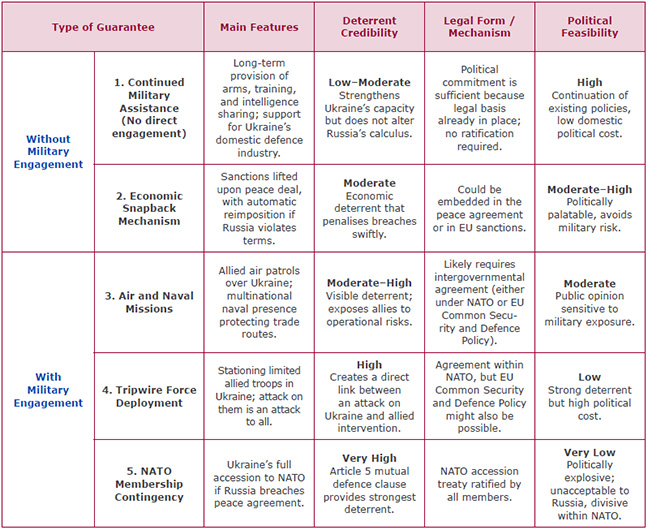
The options listed and discussed in this paper can be seen as a spectrum of measures to be activated as the situation stabilises or becomes clearer. They range from ‘softer’ political and institutional measures to ‘harder’ ones involving a greater military role. These categories are not mutually exclusive, as some options can be combined in ways that are both legally and politically feasible.
Why and when should there be a security guarantee?
The guarantee would serve as insurance against a breach of that ceasefire. Contrary to what one might assume (and to Russia’s wishes), the security guarantee is in fact a precondition of the (peace) deal, at least from Ukraine’s perspective. This was made clear by Ukrainian President Volodymyr Zelensky’s peace plan presented in November 2022.
Deterrence is also based on communication and, to some extent, on ambiguity. Being too explicit about red lines encourages adversaries to do everything that is within or close to those lines, and to test their credibility. For this reason, it may be wiser not to make public what can be offered.
What makes a guarantee strong?
The deterrent provided by other countries must be credible: sufficiently strong to coerce Russia if it violates an agreement with Ukraine. At the same time, not so overpowering that, once activated, it could not be stopped if Russia ceased its hostile actions. Although there is much theory on deterrence (developed during the Cold War), finding the concrete equilibrium is a very delicate political game.
The 1994 Budapest Memorandum offers a useful point of reference for what does not work. In exchange for relinquishing what was then the world’s third-largest nuclear arsenal, Ukraine received ‘assurances’ by Russia, the UK, and the US. These assurances included a commitment to ‘respect the independence and sovereignty and the existing borders of Ukraine’ and an obligation to ‘refrain from the threat or use of force against the territorial integrity or political independence of Ukraine’. However, these assurances completely failed to deter Russia, both in 2014 and in the full-scale invasion since 2022. The primary ‘lesson’ Ukraine has drawn from this, as stated by its Ministry of Foreign Affairs, is that the memorandum’s failure ‘set a dangerous precedent that undermined confidence in the very idea of nuclear disarmament,’ leading to a ‘catastrophic increase in security threats’.
Distrust towards Russia, nudging Ukraine
The motivations of the main actors in providing a security guarantee vary.
The primary motivation is the distrust towards Russia and of President Vladimir Putin in particular. A guarantee is necessary to make it prohibitively costly for Russia to breach any future agreement. This mistrust is one of the factors explaining Ukraine’s unwillingness to compromise and enter into an agreement that might not be honoured. The mistrust towards President Putin is entirely justified. President Putin has made it abundantly clear that he wants to eliminate Ukraine as a country, making it plausible for Ukraine to claim that the Russian president would not stop hostilities even if promised. As President Zelensky reportedly said, he had not seen ‘any signs from Russia that they want to end the war’. The European Council conclusions of October 2025 likewise state that Russian missile and drone strikes demonstrate ‘lack of real political will to end its war of aggression and to engage in meaningful peace negotiations’.
But there is also a belief that the conflict must eventually come to an end, and that Ukraine’s scepticism must somehow be overcome. One proposed way to achieve this is to assure Ukraine that, if the situation deteriorates again, European countries would finally fight alongside it. Some have even gone so far as to suggest that Ukraine should cede territory to Russia, and thus, cementing (at least de facto) Moscow’s military gains – if not (de jure) an illegal annexation of territory. The very idea that such an outcome should be seriously considered as a way to end the war is tragic. It understandably generates outrage and indignation among Ukrainians. At the same time, President Zelensky’s and European allies’ firm position that Ukraine will stop fighting once it has restored its borders as they stood at independence, including Crimea is arguably not helping to put an end to the conflict.
To balance between these somewhat contradictory pre-assurance, some are suggesting that the security guarantee should be ‘approved’ by Russia. This would be a mistake. If anything, for the guarantee to work, it must be something Russia would not approve.
The options for security guarantees
It is not only the motivations that differ, but also, and more importantly, the form of the guarantee itself. Among Europeans, the main divide is between those, such as French President Emmanuel Macron, British Prime Minister Keir Starmer and Finnish President Alexander Stubb, who have explicitly or implicitly assured that their countries would help fight against Russia if a peace agreement is breached. Belgium, Lithuania, Denmark and Sweden have also signalled readiness to deploy troops. On the other ‘side’ are Germany, Spain, Poland, Czech Republic and Italy, which remain more cautious about, or have downright rejected, military commitments.
Without military engagement
One of the primary forms of security guarantees being considered involves robust, long-term support for Ukraine without direct military commitments on its soil. This approach focuses on building a capable and self-sufficient Ukrainian defence force, able to halt and repel Russian advances (as it currently does) and of deterring future aggression by itself – but does not engage the ally, who can still maintain, at least formally, a pretence of neutrality. A large group of allies intends to formalise such guarantees by maintaining and expanding existing support mechanisms. Central to this guarantee, and to President Zelensky’s request, is the uninterrupted supply of advanced European and US-procured weaponry, providing Ukraine with the necessary means to defend itself. This material support would be coupled with ongoing intelligence sharing which was crucial already in the early stage of the conflict in giving Ukrainian forces a critical advantage in anticipating and countering enemy movements.
Another aspect of this non-military guarantee involves macro-financial assistance, and stimulating increased international investment in Ukraine’s rapidly expanding domestic defence industry. This includes drones which could be exchanged, as President Zelensky suggested to President Trump, in return for Tomahawk missiles. However, as of late 2025, the commitment to continue existing financial assistance has not extended to using frozen Russian assets for that purpose. The EU Commission has proposed to do so via a work of legal engineering that would allow the Union to borrow the cash balances linked to Russia’s assets from the financial institutions holding them (mainly Euroclear, located in Belgium), lend it to Ukraine, and be repaid by Russia once the latter makes reparations for the end of the war. This route is fraught with legal and financial uncertainties and encounters strong Belgian opposition. Aside from the thorny issue of the reparation loans, the appeal of macro-financial assistance is, for Europeans (but not Ukraine), the relatively low political costs, as it is difficult to see in what exactly this differs from the continuation of current policies. For Ukraine and others alike, the professed belief is that, as some have said, ‘a strong Ukraine looks to be by far the most realistic deterrent against further Russian aggression’. This is the position of the EU, formalised in the special European Council meeting of March 2025. The problem with this form of reassurance is that they may not amount to a sufficiently credible deterrent in the eyes of Russia.
The coalition of the willing agreed to participate in a proposed US-led ceasefire monitoring and verification mechanism. This does not exclude, in fact ‘may entail’ (as the statement of the coalition of the willing of January 2026 says), some military participation by a small minority of Member States.
Another powerful economic option – potentially combined with military measures – involves strengthening sanctions (aligning with President Zelensky’s request) or lifting them with a snapback mechanism. The adoption of its 19th package of sanctions against Russia illustrates the European Union’s continued and increasingly forceful use of this tool. They can serve as a security guarantee for Ukraine primarily by severely degrading Russia’s ability to fund and sustain its war economy. The 19th sanctions package imposes a full ban on Russian Liquefied Natural Gas imports, targets its ‘shadow fleet’ of oil tankers, and enforces full transaction bans on key state-owned oil producers like Rosneft and Gazprom Neft, which starves the Kremlin of crucial energy revenue. However, sanctions create leverage because they can be lifted. This would entail the immediate removal of most punitive economic restrictions if (and only if) Russia signs a peace agreement, as planned in the March 2025 meeting. This would give Moscow a concrete incentive to comply and signal a possible path towards normalising relations. The snapback mechanism would automatically reimpose all previously lifted sanctions, and potentially add tougher ones, if Russia violates peace terms. Its strength lies in its speed and impact: it would inflict a direct and severe economic penalty on the Russian state’s material interests.
A brief mention should be made here of the European Union’s Common Security and Defence Policy. Ukraine is in the process of acceding to the EU. If and when completed, the country could rely on the mutual assistance clause (Article 42(7) TEU). This clause provides that if a Member State is the victim of ‘armed aggression’, other Member States ‘shall have towards it an obligation of aid and assistance by all the means in their power’. However, the credibility of this clause as a security guarantee is limited. To start off, Ukraine’s accession to the European Union will take several years. Secondly, the EU’s military capabilities are still dependent on NATO. Thirdly, the clause itself has only been activated once by France (following the terrorist attacks of 2015) as it requires unanimous approval by the Member States.
With military engagement
A more robust security guarantee involves direct military engagement, a concept some leaders regard as the only truly credible deterrent. Finnish President Alexander Stubb has been explicit on this point, stating that a willingness to engage militarily with Russia ‘is the idea of security guarantees by definition’. This approach goes beyond supplying equipment and entails instead active participation in Ukraine’s defence, fundamentally altering the strategic calculation for any potential aggressor.
Several forms of direct military commitment are being considered. In September 2025, the British Ministry of Defence indicated that air and naval support is being prepared, with ‘plans to secure the skies and seas’. This follows the 2025 Joint Statement, that laid down plans to explore ‘the creation of a coalition of air, land and maritime reassurance forces that could help create confidence in any future peace and support the regeneration of Ukraine’s armed forces’.
One option involves allied air patrols over Ukrainian territory to help defend against Russian drones and missiles attacks. Such patrols would protect civilians and critical infrastructure while easing the burden on Ukraine’s own overstretched air defence systems.
Another option is the deployment of a multinational naval presence to safeguard vital maritime supply routes, ensuring that trade from Ukrainian ports – essential to the country’s economy – remains secure from Russian interference. It is not excluded that the European Union could deploy a mission to this effect, as implied in the European Council conclusions. There is, here, a role for the European Union’s Common Security and Defence Policy: the Union could assign to a group of Member States the pursuit of missions. Contrary to the mutual defence clause (Art. 42(7) TEU) mentioned above, this option is much more flexible. It would not require Ukrainian membership of the EU, and would allow participation of third countries. The European Union has already deployed two ongoing missions in support of Ukraine: the European Union Advisory Mission for Ukraine and the European Union Military Assistance Mission. The European Council conclusions of October 2025 welcomed ongoing work to revise their mandates, signalling a possible expansion of the EU’s operational role in Ukraine’s security. That being said, these missions are not, on their own, a credible deterrent.
Perhaps the most significant proposal is to deploy a ‘tripwire force’. This would involve stationing a relatively small number of troops from guaranteeing nations within Ukraine. The purpose of such a force is not to defeat an invading army, but to act as a trigger: an attack on these soldiers would be considered an attack on their home countries, automatically invoking a larger, pre-determined military response. This could be formalised in a NATO-style treaty. By putting their own troops on the line, allies would create an unambiguous red line, making the cost of renewed aggression prohibitively high. President Macron first aired the view of European troops in Ukraine in the spring of 2024. In August 2025, after a meeting of the coalition of the willing, he repeated that 26 of those countries are willing to commit to be there ‘on the ground, in the sea or in the air’. As of October 2025, countries such as Lithuania, have promised they will send troops to Ukraine whereas Latvia stated it will discuss it only if a peace agreement is reached. However, numbers are not being disclosed. In abstract terms, that is without knowing the details, this a very strong security guarantee. It would mean that Western European countries ‘have skin in the game’ (direct interests at stake). It would be politically easier for these countries to justify to their public opinion the need to intervene militarily. But the precise composition and role of these troops is unknown to the public (possibly, also because it has not been agreed upon yet). The credibility of such a deterrent varies. If the troops’ presence is merely symbolic, then it is not a serious deterrent, but if a sizeable number of European soldiers are allowed to fight back if attacked by Russia, that is a totally different story. This quasi-NATO solution would require, most likely, an international agreement that, short of NATO membership for Ukraine, would still contain a NATO-style mutual defence clause whereby an attack to one is an attack to all.
Legal caveats
A key question concerns the legal form that any security commitment would take. This inevitably raises technical issues. If the guarantee were set out in a treaty (whether bilateral or multilateral) it would likely require ratification (for example, by national parliaments) which may generate political costs that are difficult to predict. Anything short of a treaty, such as a political declaration or a Memorandum of Understanding similar to the 1994 Budapest Memorandum, would avoid this lengthy approval process but would also weaken the perceived seriousness of such a non-legally-binding commitment.
Legal challenges would also arise in implementing any such guarantees, whatever its form – most notably in determining precisely when the deterrent begins to take effect. A mechanism will need to overcome the difficulty of monitoring and impartially verifying a violation sufficient to trigger it. Decisions on how to supervise compliance will also likely form part of the final structure of the ceasefire/peace agreement and the associated guarantees. Russia could not, of course, be given any role in this process, as that would undermine the entire purpose of the guarantee. One option would be to establish an independent verification body, possibly under a UN mandate. Another would be a hybrid arrangement: a small joint commission composed of representatives from the guaranteeing states, Ukraine, and a neutral group of technical experts. This commission could issue initial findings subject to confirmation by a majority vote of the guaranteeing countries, preventing either Russia or Ukraine from exercising a unilateral veto. Such arrangements, however, raise complex legal questions. It is unlikely that a security commitment would contain detailed provisions on the precise conditions for activation.
One more option
There is one more scenario that deserves consideration. It is closely aligned to one of President Zelensky’s hopes, and was proposed by Poland. It is to grant Ukraine full NATO membership if Russia fails to respect the terms of a future peace agreement. As the Ukrainian minister of foreign affairs put it, ‘we are convinced that the only real guarantee of security for Ukraine, as well as a deterrent to further Russian aggression against Ukraine and other states, is Ukraine’s full membership in NATO’. Polish Prime Minister Donald Tusk also stated that ‘there is no better form of full security guarantee for Ukraine than NATO membership’.
This is, of course, something President Putin will never accept. One of the main goals of his war has been to prevent such membership. Yet, the situation could be reframed: a political commitment could be made not to admit Ukraine into NATO for a defined period if a peace agreement is reached and upheld. If Russia violates the agreement, however, Ukraine’s accession could proceed immediately.
Such an arrangement would give President Putin a limited symbolic victory, as it would temporarily restrict Ukraine’s foreign policy choices. In the meantime, it would not prevent Ukraine from joining NATO in the future, and it would establish a powerful deterrent. Article 5 of NATO is a powerful mutual defence clause for all members of the alliance (it was defined as ‘the ultimate security guarantee underpinning the defence of the so-called “Euro-Atlantic area”’).
NATO membership would also be a natural option. The alliance was founded as a defensive organisation to deter threats to European security and has repeatedly demonstrated its operational capacity in various missions, including combat operations. Additionally, since 2022 European countries have quickly deployed additional military units and capabilities to protect the most exposed allies along the eastern flank, thus doubling down on the NATO enhanced Forward Presence (la présence avancée). This increased military presence, for example in the Baltics, could be replicated in Ukraine to reassure critics who believe that few thousand troops are an insufficient deterrent.
However, even NATO membership is not an absolute guarantee. Article 5 is not an automatic response, but instead, requires a political decision. The country which is the victim of an attack needs to consent to being helped (and the Unites States after 9/11 did hesitate somewhat). More importantly, it is non-committal for any NATO ally, which are merely obliged to take, as Article 5 reads, ‘such action as it deems necessary, including the use of armed force’. We are back to square one. Every security guarantee – whether economic or military – ultimately relies on the resolve (and the credibility) of those who give it.
Conclusion
It is likely that any future peace or ceasefire agreement between Russia and Ukraine will stand or fall on the credibility of the guarantees that support it. The experience of the 1994 Budapest Memorandum has shown that political assurances without binding or enforceable mechanisms are insufficient. For Ukraine, and for Europe, credible deterrence must therefore lie at the core of any settlement.
The spectrum of possible guarantees illustrates the balance that must be struck between feasibility and resolve. Or as always in politics, between what is desirable and what is possible. The ‘softer’ forms of support, such as sanctions or continued military assistance without direct engagement, can reinforce Ukraine’s capacity to defend itself but cannot alone ensure compliance by Russia. More robust options, including direct military involvement or NATO membership, carry greater deterrent value but also higher political and legal risks.
Each of these approaches faces practical and legal constraints: (parliamentary) ratifications, monitoring mechanisms, and the difficulty of defining when deterrence should activate. Above all, they share two inescapable and inextricably linked limitations. One is that European countries ultimately still depend on the US, for their miliary needs at the moment. The other is that the effectiveness of any guarantee ultimately depends on political will of Europe’s readiness to act as a genuine security provider.
One thing that is now abundantly clear is that European security can no longer rely on borrowed guarantees. Any lasting peace will require Europe to transform its resolve into building up real capabilities and assume full responsibility for defending the rules-based international order it upholds.
[1] In February 2025, British Prime Minister Keir Starmer subordinated any security guarantee to US backing, but he has not done so more recently.
[2] Meetings have taken place in London in March, July and October 2025, in Paris in March and August 2025 and January 2026, in Belgium in April and in Ukraine in May 2025.
Publishing Director : Pascale Joannin
To go further
Budget and Taxation

Valérie Plagnol
—
13 October 2026
Future and outlook

Pape Léon XIV
—
6 October 2026
Future and outlook

Louis Caudron
—
29 September 2026
Education and culture

Blandine Chelini-Pont
—
22 September 2026
The Letter
Schuman
European news of the week
Unique in its genre, with its 200,000 subscribers and its editions in 6 languages (French, English, German, Spanish, Polish and Ukrainian), it has brought to you, for 15 years, a summary of European news, more needed now than ever
Versions :