Geography
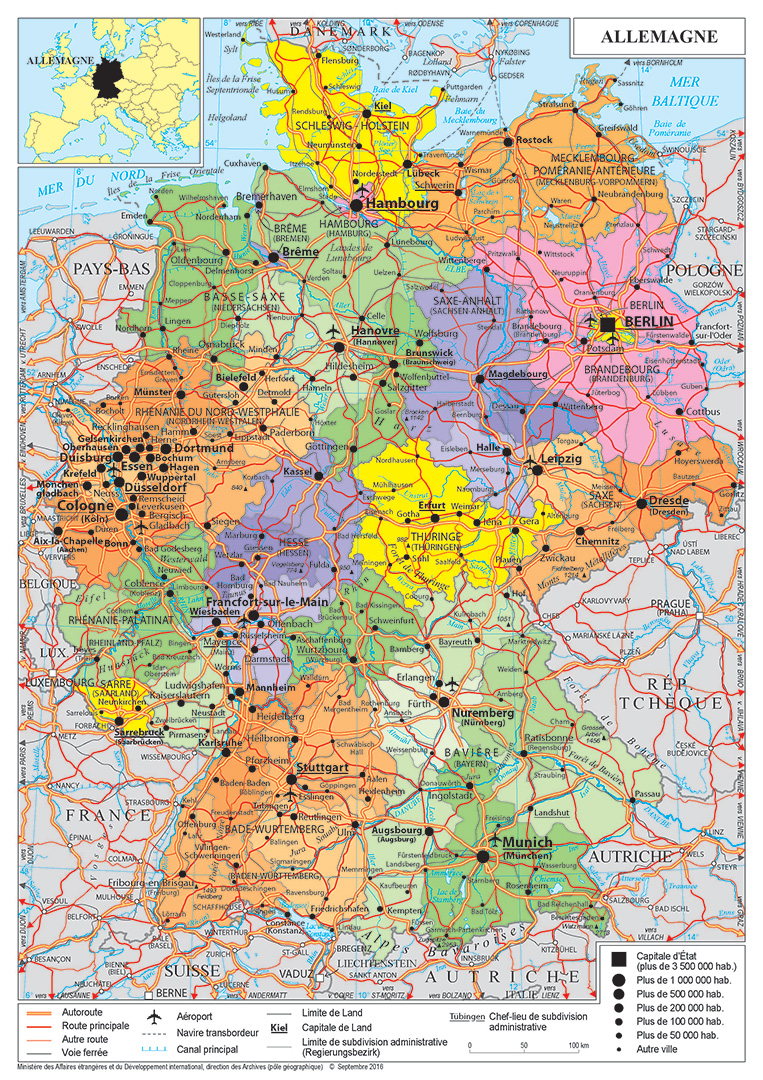
Area : 357,022 km²
Borders : 3,621 km; Austria: 784 km, Belgium: 167 km, Czech Republic: 646 km, Denmark: 68 km, France: 451 km, Luxembourg: 138 km, Netherlands: 577 km, Poland: 456 km, Switzerland: 334 km
Coastline : 2,389 km
Capital : Berlin
Official language : German
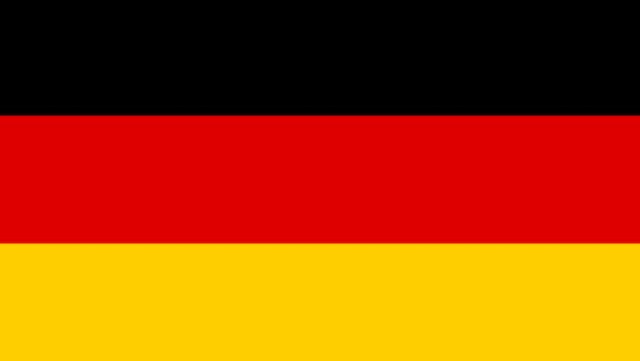
Flag
Population
Population : 83 740 733 (03/2026 est.)
Crude natural change rate : - 4‰ (2025)
Population repartition: 13.8% under 15 years old, 23.7% over 65 years old (2024 est.)
Foreign residents: EU nationals 5.2%, non-EU nationals 7.0% (2019)
Crude net migration rate: - 1,8‰ (est. 2025)
First time asylum applicants: 113,236 (2025)
Life expectancy: men 79.6 years, women 84.1 years (2025 est.)
Religions: Roman Catholic 26%, Protestant 23.7%, Muslim 3.6%, other 4.8%, none 41.9% (2021 est.)
Ethnic groups: German 86.3%, Turkish 1.8%, Polish 1%, Syrian 1%, Romanian 1%, other/stateless/unspecified 8.9% (est. 2021)
Source : Eurostat, World Fact Book
Economy
Currency: Euro
GDP: € 4,469.910 billion (2025)
GDP per capita (PPS): € 53 520 (2024)
GDP growth : 0,4% (Q4 2025)
Inflation: 2.1% (Jan 2026)
Public debt: 66% of GDP (Q1 2025)
Unemployment: 6.3% (Jan 2026)
Stock of foreign direct investment from the entire world: 26.4% of GDP (2022)
Budget balance: -3.8% of GDP (2025)
Source : Eurostat, OECD, European Commission, FMI, Trading Economic
Political system
Federal Republic, representative parliamentary democracy.
Head of state: Frank-Walter Steinmeier, was elected on 12th February 2017, and was reelected on February 13th 2022.
Chancellor: Friedrich Merz, following the elections of February 23th 2025, has been leading a CDU/CSU ans SPD coalition since May 5th, 2025.
Bicameral parliamentary system: The Bundesrat (Federal council or Senate): comprises 69 representatives from Germany's 16 länders. The number of representatives allocated to each Land is determined according to its population. The Bundestag (Federal chamber): comprises 630 members of parliament elected for a four-year term by direct federal universal suffrage. Each voter has two votes, the first being a single-member constituency vote, the second being a party-list vote at the Länder level. The Bundestag has a minimum of 598 seats, although additional seats (currently 32) may be allocated under the Saint-Lägue method.
Political representation
Composition of the Bundestag (since March 2025):
- 208 seats CDU-CSU (Christian Democratic Union/ Christian-Social Union)
- 150 seats AfD (Alternative for Germany)
- 120 seats SPD (Social-Democratic Party)
- 85 seats The Greens
- 64 seats Die Linke (Left Party)
- 3 seats unassociated
Composition of the Bundesrat :
- SPD: present in 12 states
- CDU: present in 9 states
- Greens (Grüne): present in 6 states
- Die Linke: present in 2 states
- BSW (Bündnis Sahra Wagenknecht): present in 2 states
- CSU: present in 1 state (Bavaria only, the CDU's Bavarian sister party)
- FDP: present in 1 state (Saxony-Anhalt's caretaker government)
- Free Voters (Freie Wähler): present in 1 state (Bavaria, in coalition with the CSU)
Women's representations
- in government: 8/18
- in the Bundestag: 205/630
- in the Bundesrat: 23/69
Next Elections:
On The Same Theme
Country Sheet
Country Sheet
Country Sheet
Country Sheet
Country Sheet
Country Sheet
Country Sheet
Country Sheet