
Strategy, Security and Defence
Nicolas-Jean Brehon
-

Available versions :
EN

Nicolas-Jean Brehon
Honorary Advisor to the Senate
II - Evaluation of external missions and operations
2.1 From a diplomatic point of view.
The stakes involved in these military operations are enormous. Military operations form part of the international landscape, and an external operation is political before it is military. Failure would have spelled the end of the CSDP, and Europe would have had to abandon all international ambitions. By resorting to the use of force, it is employing tools that are usually reserved for states. Even a modest European operation helps to transcend the logic of ‘national defence’ and marks a heightened awareness of shared interests. There is a symbolic power in European military operations that goes beyond the action itself.
Military operations form part of a range of diplomatic tools falling under the CFSP and broaden the scope of possible actions. It is often deployed in conjunction with (civil-military operations such as in Darfur) or following, or preceding, civilian missions in the fields of justice or policing. There is a continuum between military operations, civilian actions, and economic and financial partnerships. “This versatility is sometimes envied by other organisations, including NATO, which occasionally likes to dream of a ‘reverse Berlin+.”[1]
Through its military operations, the European Union gains operational credibility amongst international actors. They can step in following recognised international forces. This was the case in 2003 (Concordia) and, in 2004, when Althéa succeeded SFOR, the NATO-led Stabilisation Force, which itself followed on from IFOR, the NATO force implementing the Dayton/Paris Peace Agreement, which in turn succeeded UNPROFOR. A logical progression, but one that entails a binding responsibility.
All European Union military operations have been linked to the UN. This basis, whilst not strictly necessary, proves very useful in achieving unanimity. States with a tradition of multilateralism or neutrality are, as a matter of principle, reluctant to accept any external military intervention. In the eyes of public opinion, UN endorsement lends legitimacy to the military operation and makes it acceptable. European operations provide an opportunity to participate in security operations outside the major military alliances. Note, for example, the presence of Austrian and Swiss contingents (Althea) or Irish contingents (EUFOR Chad).
2.2 The military significance of European operations
The aim is not to compete with the forces of major international alliances; any such comparisons would prove devastating. Europe is a military ‘dwarf’ – the epithets are well-known and far from flattering. This overlooks the fact that crisis management forces are neither displays of force, nor intervention forces, nor a fortiori military operations. EUFOR is not the International Security Assistance Force in Afghanistan (45 states, 130,000 troops)! Having established this premise, European operations can be analysed from several angles: military effectiveness, multinational experience and lessons learnt on the ground.
The success of operations varies. A distinction must be made between the military impact of an operation and that of an executive operation or a non-executive mission. Some operations have been ongoing for 20 years (Althea), whilst others were scrapped and cancelled before they could even begin[2]. From a strictly military perspective, the naval operations are regarded as successes by all observers. Although it is reasonable to assume that a comparable outcome might have been achieved within a less cumbersome bilateral framework than the European one. Opinions are more divided when it comes to the deployment of ground forces and training activities. The first military operations in the former Yugoslavia (Concordia and Althea) were targeted peace support. In Bosnia and Herzegovina, the situation remains fragile. Every village flies its own flag. The fire smoulders beneath the ashes, but the war has not resumed. In Africa, European operations have yielded mixed results. EUFOR Mali, the longest-running and most costly military operation in Africa, has faced translation issues, a lack of personnel supervision, financial arrangements at the discretion of local authorities, etc.; common difficulties for military operations in Africa.
Not to mention the possibility of unintended consequences. “The EPF, an extra-budgetary instrument, was initially created to train armies, mainly in Africa, and not to purchase weapons. This shortcoming has facilitated the expansion of Russia’s presence in Africa through arms sales, particularly in the Central African Republic”[3]. As for Mali, what has become of the 16,000 soldiers trained by EUTM Mali? It is not known how many have gone over to the side of Islamic terrorism. Following a European training programme before joining Wagner?
Multinational experience
European military operations are international ventures involving the deployment of combat forces. The funding of common costs is shared, but participation is voluntary. Levels of participation vary by country and by mission (France has only a small contingent in Bosnia and Herzegovina but maintains a significant presence in EUFOR missions in Africa). EUFOR Chad comprised 3,300 military personnel, more than half of whom (1,640) were French. Spain and Italy also frequently participate in European operations. The specific cases of Ireland (EUFOR Chad) and Austria (Althea) have been mentioned. Institutional constraints (parliamentary approval) explain why Germany often has only a modest presence within operations. EUFOR Congo in 2006 was Germany’s first significant participation in a European operation. Germany was then designated as the lead nation. These cooperative efforts are not mere juxtapositions but genuine multilateral cooperation, whereby one state’s resources may be made available to another (French units on board Italian aircraft, for example).
European military operations provide an irreplaceable experience in international force command. Planning and conducting an operation involving forces from 20 or 30 states, even with symbolic contingents, is a military challenge. The planning headquarters (in Europe) and the field headquarters are under the authority of commanders of different nationalities. The designation of a state as the lead nation has significant implications for material contributions and command responsibility. Rapid rotations (every six months) enable a large number of countries to exercise international military responsibilities. The Deputy Operation Commander of Atalanta has been Spanish, Italian, British, Portuguese and Greek.
On the ground, feedback has been more mixed
European operations involve a large number of units with varying levels of experience. The challenge is to demonstrate the ability to work together. For smaller armed forces, and particularly for special forces which have few opportunities for overseas deployment, this provides an unrivalled training opportunity. EUFOR missions have even served as a catalyst for innovation. For example, one of the first uses of surveillance drones by a Belgian unit, during EUFOR Congo in 2006. European operations also provide an opportunity to understand the considerable logistical challenges of any international operation, particularly in Africa (cargo aircraft, water). For some, this combination represents the beginnings of a European army through the cooperation of units from several countries.
Nevertheless, European operations cannot be regarded as genuine military training. This is because they have two shortcomings. The issue of ammunition supply, which is crucial in high-intensity conflicts, does not arise. Real combat experience is lacking. EUFOR missions do involve gunfire, but only on a very sporadic basis and without large-scale engagement[4]. Military experience without ammunition or exposure to fire can only be partial. These limitations also highlight underlying problems.
2.3 Common technical and budgetary challenges
The coordination of military operations
All international operations face difficulties in coordinating with the various actors on the ground. The proliferation of international non-governmental organisations and, in particular, humanitarian organisations—which are always keen to preserve their independence—does not make military missions any easier. However, European operations face additional difficulties when they overlap with national military operations (EUFOR Chad and the French-led Operation Épervier), or even with multinational operations led by the African Union or the UN. Coordination with the United Nations is sometimes problematic[5]. Coordination may be required at European level when missions combine civilian and military operations, or when missions overlap, as is the case in Bosnia and Herzegovina with a military mission, a police mission and a pre-accession mission. A European military operation is also an exercise in diplomacy.
Comments on the budget
The Council’s decisions provide for a budget based on a reference amount intended to finance common costs. The cost is then allocated among the Member States in proportion to their share of GNI. Defining common costs is particularly complex. However, the assessment of costs alone also gives rise to many misunderstandings[6]. Common costs account for only a small fraction of the total cost of the operation. The current estimate is between 10 and 15 per cent. European operations are overwhelmingly funded through national budgets. Participation in European military operations represents a financial burden for Member States. It comprises two elements: the contribution to the EDF, which finances the common costs, and the cost that remains the responsibility of the Member State. The total cost of an operation is therefore virtually impossible to determine, as each Member State finances its own share separately. The breakdown has sometimes been provided by Member State and by operation[7]. In France, the contribution is partly funded from the defence budget and partly (insofar as it relates to non-lethal assistance measures) from the foreign affairs budget. Whether at European or national level, European military operations involve a demanding budgetary process.
Based on a total reference amount of €352 million for the 10 operations, the total cost of European military operations (stricto sensu) is in the region of €2.3 billion.
This budgetary framework is just one aspect of the procedural complexity. A European operation begins with an administrative obstacle course punctuated by countless meetings. This is a feature that is not unique to defence policy or to the Commission, as the Athena and EPF decisions are Council decisions (the same criticism is often levelled at the common agricultural policy), but it is exacerbated by the dual nature of the operation being both military and international. From an administrative and budgetary perspective, the European military operation is a nightmare. How is it possible that such a good idea has resulted in so much complexity? The procedural complexity is indicative of the differences between Member States. The paragraph added at the last minute to a regulation is often the condition for unanimity.
III - The impact of military operations on the functioning of the Union
Military operations and missions are highly political undertakings that have a significant impact on the functioning of the European Union.
3.1 Debates between Member States
The inclusion of a military dimension in European Union missions, in the form of interventions involving combat forces, has not been without its difficulties within the Union. Three issues can be highlighted.
The first is the principle of military operations and assistance. This approach may be accepted when it involves contributing to stability in the Western Balkans or combating piracy, which is clearly in the collective interest. It poses more of a problem when it comes to assistance operations in Africa (via the African Peace Facility). It must be said that using European defence funds to finance security in Africa is not self-evident. Responses to this development have often been starkly divided. On the one hand, there are the countries that support European military assistance, which have experience or a direct interest in security in Africa (France, Spain, Italy, Portugal, Germany). On the other, there are those States that hold back. A French parliamentary report states: “Certain Northern European States have a principled reluctance towards military interventions and are resisting any move towards the militarisation of the EU, which they deem contrary to the ideals of peace that underpinned its foundation”. Not to mention the position of the United Kingdom, already mentioned.
The tension centred mainly on the provision of lethal weapons. The debate lasted two years. A debate of principle on a subject that, moreover, lacks relevance, given that non-lethal equipment can prove decisive in the advance of armies.
The second issue is the democratic oversight of operations. Unanimity requires a great deal of compromise, which is first reflected in the texts. Operations and military assistance involving lethal weapons are governed by rules of conditionality and control. The Council decides on a case-by-case basis what type of assistance and equipment may be provided. EPF assistance measures are based on risk analyses. The Council assesses safeguards, respect for human rights and international humanitarian law, and the prevention of the diversion of weapons. “No assistance measure may be used for the supply of items that would be incompatible with the Union’s international law or obligations”[8]. For example, landmines are banned. The Council may also suspend European aid.
The third issue concerns the mission mandate, as defined by the Council Decision. Here too, the requirement for unanimity means that adjustments must be made to accommodate Member States’ requests. “A number of Northern European states have requested that training for Malian soldiers on gender equality be included in the EUTM Mali mandate. Whilst laudable in itself and certainly justified in principle, such training may not be the priority given the situation in the country.”[9]
Even though it has increased the number of its operations and missions, “the EU has remained a cautious international actor that tends to avoid the use of force”[10]. The absolute taboo is risk to life. Executive missions are designed to avoid any risk of confrontation. Non-executive missions exclude any exposure to combat. A European military operation cannot return with coffins in the holds of C-130s or, worse still – given the media coverage that would follow – have hostages in the hands of rebel groups. ‘Died for the Union’? Unthinkable. These various constraints have forced Europe to set limits on its actions.
Can peacetime military operations serve as a basis for experience in wartime? The fundamental issue is the relationship between the principles, virtues and values upheld by the European Union and military assistance. Restricting the supply of lethal weapons, including ill-suited clauses, and avoiding any exposure to risk are peacetime niceties. We came very close to seeing arms deliveries curtailed for environmental reasons (given the enormous consumption of military equipment). The Union takes its standards – its values – to the point of caricature. The war in Ukraine has swept all of this away. In March 2022, Denmark renounced its opt-out and, consequently, its constructive abstention. Must the EU also undergo this transformation? The EU’s guiding principles can no longer remain the same. Just as there is a war economy with its constraints, there are also wartime values that require adaptation.
3.2 Institutional rivalry between the Council and the Commission
There is a form of institutional rivalry between the European Council and the Commission on military matters, although the term ‘rivalry’ should be qualified: it is more a case of tension between the two institutions, putting the Council under pressure.
A breakthrough by the Commission in the military sphere
The war in Ukraine has changed Europe. The military challenge is clear. Yet the drive to build up military capabilities, although first mentioned in the Treaty of Nice in 2001, remained marginal for a long time. The war has shifted priorities but also altered the way institutions operate. The Commission’s breakthrough in the military sphere is undeniable. Institutional deadlocks have been circumvented. The ESDP falls under the Council’s remit. So be it. Support for the defence industry falls under industrial policy and competitiveness (Article 173 TEU) and the internal market (Article 114 TEU). The Commission therefore regains its power of initiative. Not a year goes by without the Commission proposing new funding instruments: on support for the arms industry (European Defence Fund, EDF), on ammunition manufacturing capabilities (ASAP), on aid for joint equipment procurement (EDIRPA), on support for military equipment (EDIP), and on military mobility. When the EU budget is insufficient, the Commission proposes that funding be provided through borrowing (SAFE). These are all initiatives indirectly aimed at increasing the EU’s defence capabilities, but which above all mark the Commission’s – which holds the initiative – assumption of power over military matters.
The question arises first and foremost in terms of principles. The Commission’s ability to draw on non-military expertise (industry, competitiveness, the internal market) is matched by its obvious duplicity. In response to a reasoned opinion issued by the Senate[11] considering that the draft EDIP regulation did not comply with the principle of subsidiarity, the Commission chose to dismiss the argument: ‘none of the objectives or components of the Commission’s proposal relate to the common security and defence policy’. But the dispute is primarily with the Council.
A Council under pression
The timeline speaks volumes. The European Peace Facility (EPF) and the European Defence Fund (EDF) were both established within a month of each other in March and April 2021. This coincidence is surely no accident. “The EEAS saw this as a way of institutionally competing with the European Commission, which in the process of launching the European Defence Fund”[12]. This pattern has been ongoing for three years. Every initiative taken by one is followed by an initiative from the other. Since the start of the war in Ukraine, the Council has adopted more than 70 decisions on military assistance. In 2024, the Council established a ‘facility for Ukraine’ funded by the EPF, and in 2025, the Commission launched a ‘support fund for Ukraine’.
The two tables below show the Council’s and the Commission’s legal and budgetary initiatives in the military sphere. How can one fail to be struck by the coordination between the two? Admittedly, urgency dictates, but is it only about urgency?
Comparison of budgetary commitments made by the EU (Commission initiative) and by the Council in the military sector (€ million)

Source : Council Decision (CFSP) 2024/890, Annex 1. Commission, annual budgets, Title 13 (in commitment appropriations)
Commission and Conseil Initiatives in terms of Defence 2021/2025
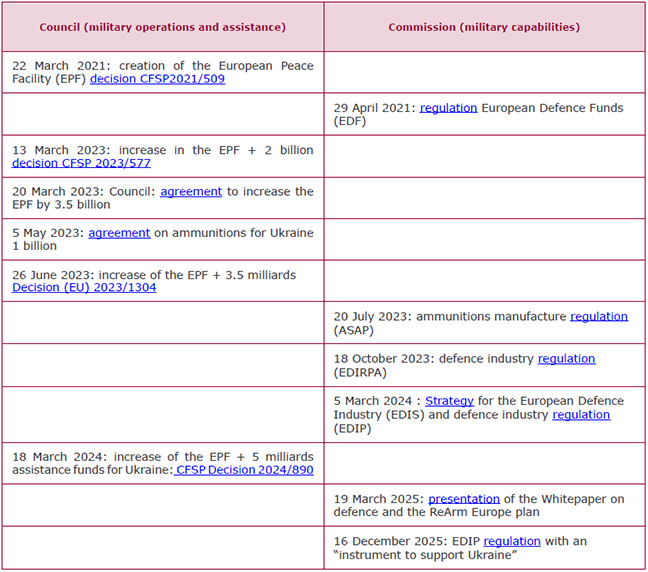
Source : Legislation and CFSP decisions; author’s note
Matter of power
The EPF and the EDF/EDIP: same fight? Or rather, the same fight but against each other? In any case, two mirror-image instruments. Or pitted against one another.
At first glance, the dividing line is clear: capacity-building via general regulations and the EU budget; operations and assistance via Council decisions and a fund financed by national contributions. In other words, the EPF belongs to the Member States, the EDF (and the EDIP) to the Union. Two different instruments serving different objectives but, above all, falling under different spheres of competence – and power.
Can the EPF become a Community fund? It is worth noting that the former European Development Fund (EDF), financed by extra-budgetary national contributions, was absorbed into the Union budget. The battle lasted 20 years. It ended in victory for the Commission, which, it is true, already managed the EDF, whereas this is not the case with the EPF.
The budgetary implications are minor. The difference between funding via the EPF based on national contributions proportional to GNI and budgetary funding via the budget amounts to a minor discrepancy of less than 0.5% (for France, 16.20% versus 16.55%).
On the other hand, the political stakes are significant. The decision-making procedures reflect the respective powers of each body (the Council and the Commission). Military operations and assistance missions (EPF) fall solely within the remit of the Council, acting unanimously on a proposal from the High Representative and ‘with the support of the Commission’. Whereas capability-building instruments (EDF and EDIP) fall under the Union’s ordinary law, with the Commission taking the initiative and adoption by the legislator (European Parliament and Council). Thus, the power of initiative lies with the Commission and, once the regulatory framework has been adopted, decisions on the implementation of the EDF and the EDIP are taken by the Commission, following a procedure specific to each instrument.
Two paths are open: the path of integration, placing the Commission at the centre of the process. Despite the Council’s activity via the EPF (60 decisions on assistance in three years), the momentum lies with the Commission. But if the decision had depended on a Commission initiative, would the military operations have taken place? Or the path of intergovernmental cooperation centred on small-scale national coalitions, modelled on the structured cooperation arrangements envisaged for capabilities. This possibility is provided for in Articles 43 and 44 TEU. ‘The Council may entrust the implementation of a mission to a group of Member States which wish to do so and possess the necessary capabilities for such a mission’. A dilemma between integration and national cooperation that is the hallmark of European history.
An analysis by the EPF reveals an (unhealthy?) competition between the two institutions. This tension cannot be sustained indefinitely. Any change will have major consequences. Initiative, funding, decision-making processes and unanimity are all at stake.
Annex 4 - List of military missions (non executive mandate) - training
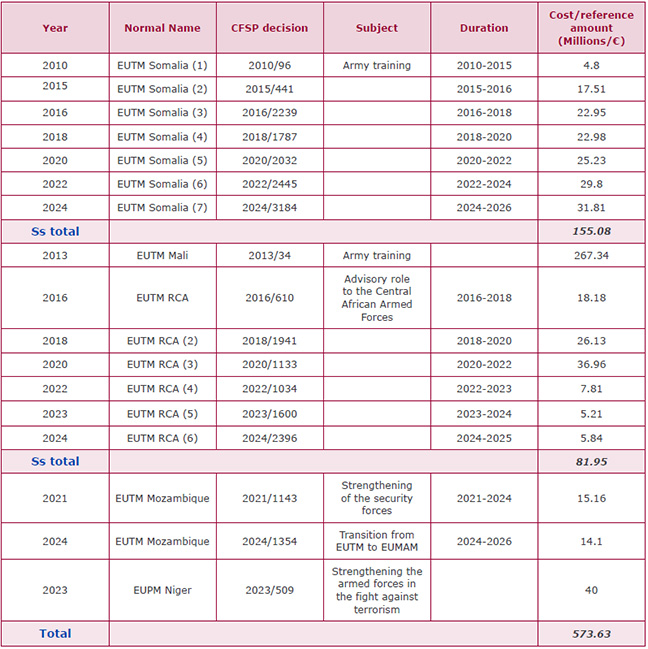
Source: Author’s compilation of CFSP decisions
Annex 5 - EPF funding for military assistance
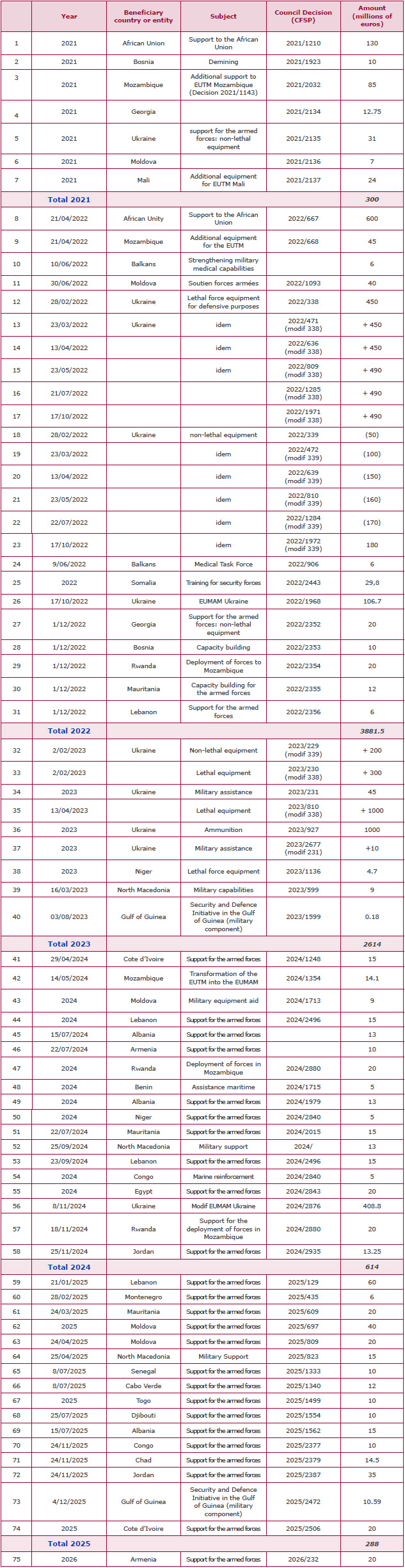
Military aid to Ukraine through funding from the European Peace Facility (EPF)
- Supply of equipment capable of inflicting lethal force.
Council CFSP Decision 2022/338 of 23 March 2022. Amended by CFSP Decisions 2022/471, 636, 809, 1285, 1971 and CFSP Decisions 2023/230, 810
Total: 4,120 million €
- Funding for equipment not intended for lethal force (fuel, protective equipment).
Council CFSP Decision 2022/339 of 23 March 2022, as amended by CFSP Decisions 2022/472, 637, 810, 1284, 1972, and CFSP Decision 2023/229
Total: 380 million €
- Ammunition.
CFSP Decision 2023/927
Total: 1000 million €
- EUMAM military assistance mission (military training).
CFSP decision 2022/1986 modified by CFSP decision 2024/2876
Total: 515.5 million €
- Additional military assistance.
CFSP decision 2023/231 modified by CFSP decision 2023/2677
Total: 50 million €
Making a total of €6.07 billion.
On 18 March 2024, the Council decided to increase the EPF ceiling by a further €5 billion, a sum earmarked for Ukraine.
These amounts are to be supplemented by funding from the implementation of the ASAP (support for ammunition production) and EDIRPA (support for joint equipment procurement) regulations, which may also involve Ukraine.
[1] Catherine Schneider: EU crisis management operations and missions: key instruments of the CSDP, University of Grenoble, 6–12 March 2017
[2] EUFOR Libya was called off before the first troops could be deployed. The operation had been intended to support the United Nations’ humanitarian efforts. However, the deployments were contingent upon the approval of the United Nations office … which was never granted.
[3] Seminar on the EPF, Military Academy Research Institute, 9 June 2025.
[4] In 2006, soldiers from EUFOR Congo intervened to protect the opposition leader, who was under siege in his residence by soldiers from the presidential guard.
[5] This was the case with EUFOR Chad. Following the deterioration of the situation in Darfur, the EU decided to deploy a European security force for refugees. The mandate was due to end a year later. MINURCAT (the United Nations mission) was supposed to take over. Except that MINURCAT failed to materialise. See also Louis Gisard d’Estaing and Françoise Olivier Coupeau, report on the cost of external operations, National Assembly, 2009 (in French)
[6] For example, a government may cover – prior to reimbursement by the EPF – the transport costs for a partner’s units, and vice versa on the return journey. However, one party will invoice the variable cost for the outward journey, whilst the other will factor in depreciation. This difference is comparable to that which exists in France between fuel costs and mileage allowance. The difference in valuation for the same service can vary from 1 to 3.
[7] For EUFOR Chad, the reference cost was 119 million. France covered 15.57%, or 18.5 million, to which 130 million from the national budget was added. Op. cit.
[8] Art 49 §5 of the Council’s decision
[11] Reasoned opinions adopted by the chambers of national parliaments and forwarded to the Commission reflect concerns regarding compliance with the powers conferred by the Treaty
Publishing Director : Pascale Joannin
To go further
Budget and Taxation

Valérie Plagnol
—
13 October 2026
Future and outlook

Pape Léon XIV
—
6 October 2026
Future and outlook

Louis Caudron
—
29 September 2026
Education and culture

Blandine Chelini-Pont
—
22 September 2026
The Letter
Schuman
European news of the week
Unique in its genre, with its 200,000 subscribers and its editions in 6 languages (French, English, German, Spanish, Polish and Ukrainian), it has brought to you, for 15 years, a summary of European news, more needed now than ever
Versions :