Europeans caught between trust and the need for protection: the paradox of a Union that is "necessary but distant"
Member states
Nando Pagnoncelli
-
23 June 2026

Available versions :
FR
EN

Nando Pagnoncelli
Chairman of Ipsos Italy, member of the Board of the Robert Schuman Foundation
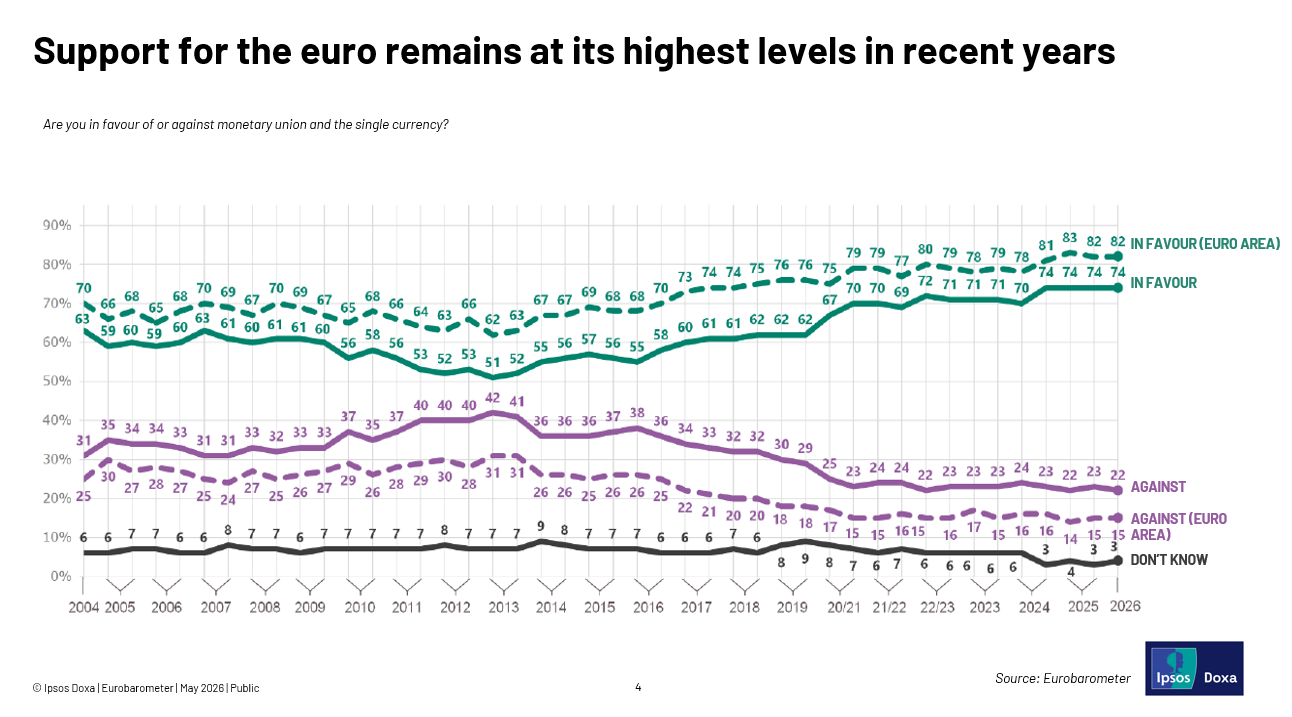
Ipsos’s analysis, based on data from the Spring 2026 Eurobarometer survey, paints a picture of a Europe which, faced with persistent shocks – the pandemic, the war in Ukraine, instability in the Middle East and rising prices – is once again turning to the EU for stability. Average confidence in the European Union is on the rise and support for the euro remains at its highest level in recent years. But the picture is not cut and dried: there is both a growing demand for Europe to deliver on security, energy, health and migration, and a persistent perception of a bureaucratic Union that wastes money and struggles to control its borders. It is a ‘love-hate’ relationship; people want it to be stronger where necessary, but criticise it when it fails to meet immediate expectations or when decisions seem remote.
1) Confidence is on the rise, but varies significantly from country to country: the ‘case of France’
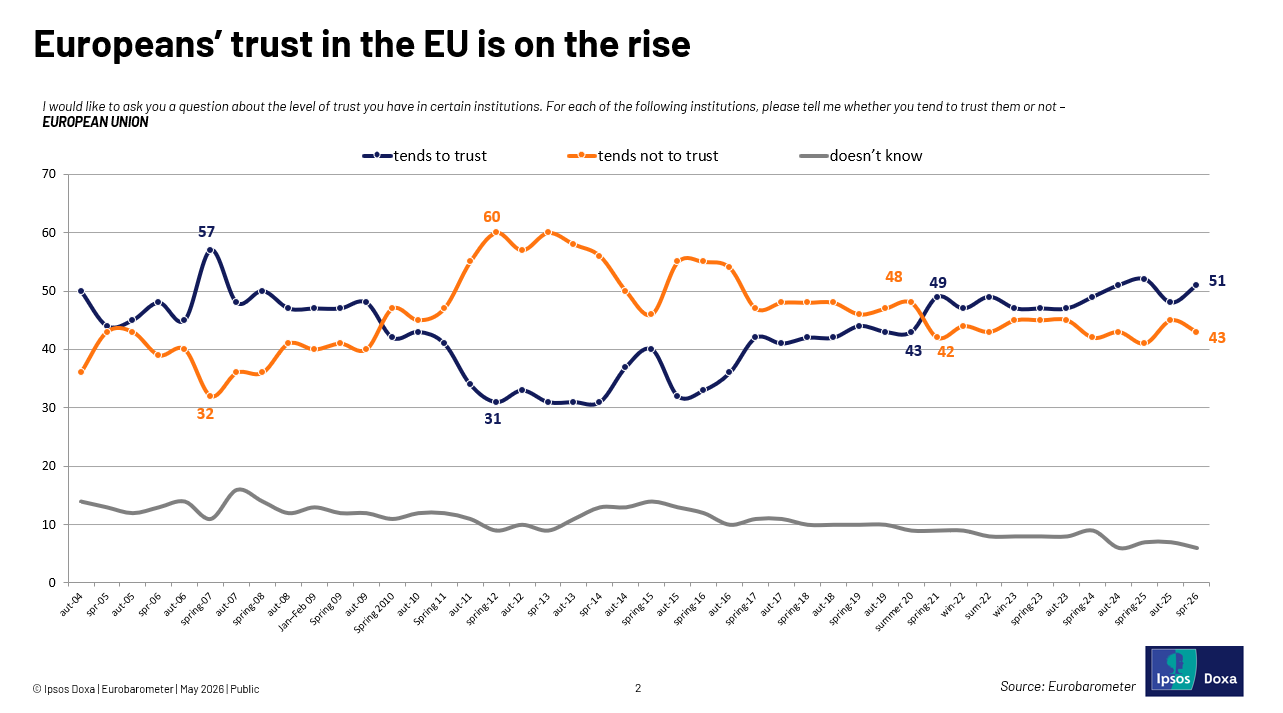
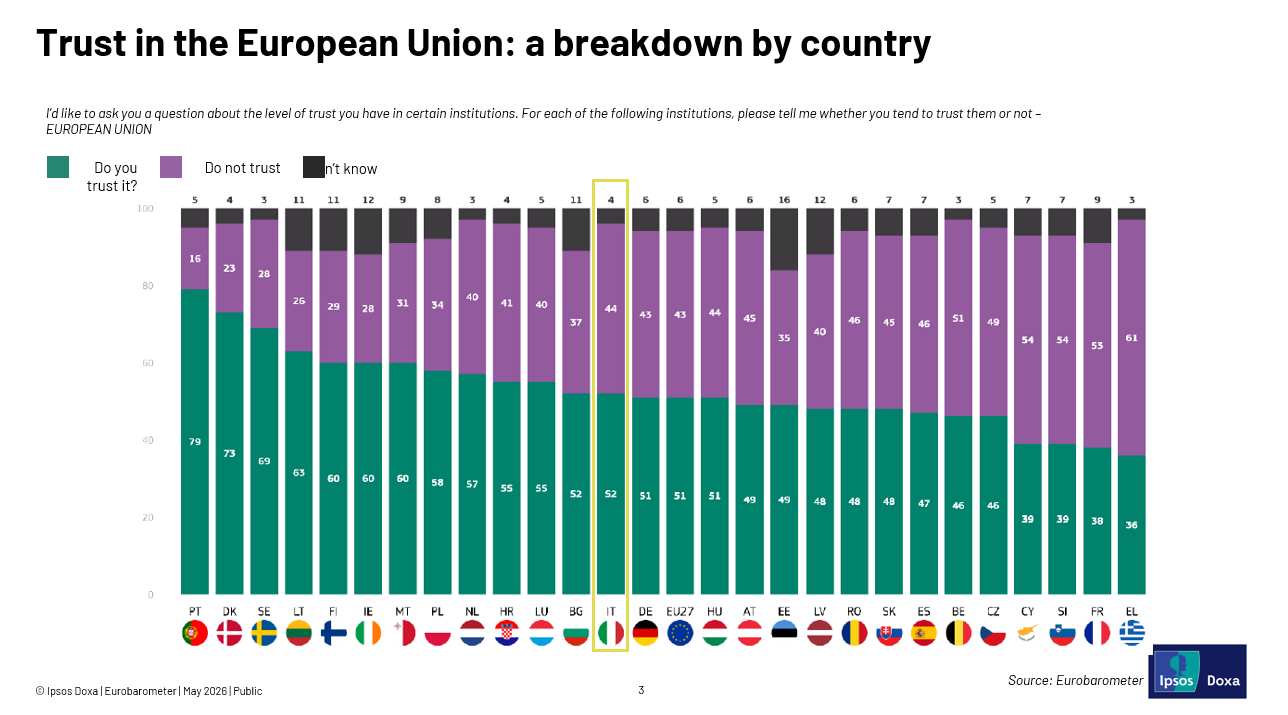
The key finding is clear: ‘Europeans’ confidence in the EU is growing’. On average, those who ‘tend to have confidence’ outnumber those who ‘tend not to have confidence’, indicating a positive balance compared with previous six-month periods. However, a breakdown by country reveals a patchy picture across Europe. Where the political and economic contexts are relatively stable and where the European Union is perceived as a shield (geopolitical, energy-related, regulatory), confidence clearly prevails. Elsewhere, the public narrative of Europe as a ‘constraint’ or ‘bureaucracy’ dominates.
In this context, France stands out: a founding member of the European project which, in the latest surveys, shows levels of confidence below the European average. This is significant, as it refutes the notion that scepticism is the sole preserve of ‘peripheral’ or ‘Mediterranean’ countries in difficulty: here, a complex interplay of factors – high expectations of the Union, internal social tensions, political polarisation – fuels the perception of a ‘demanding but largely absent Europe’. The political message could have serious repercussions: if a major founding democracy struggles to recognise the ‘added value’ of the EU, the entire European narrative suffers from a lack of relevance and a failure to deliver perceived results.
2) European Citizenship: the ‘yes, but not exactly’
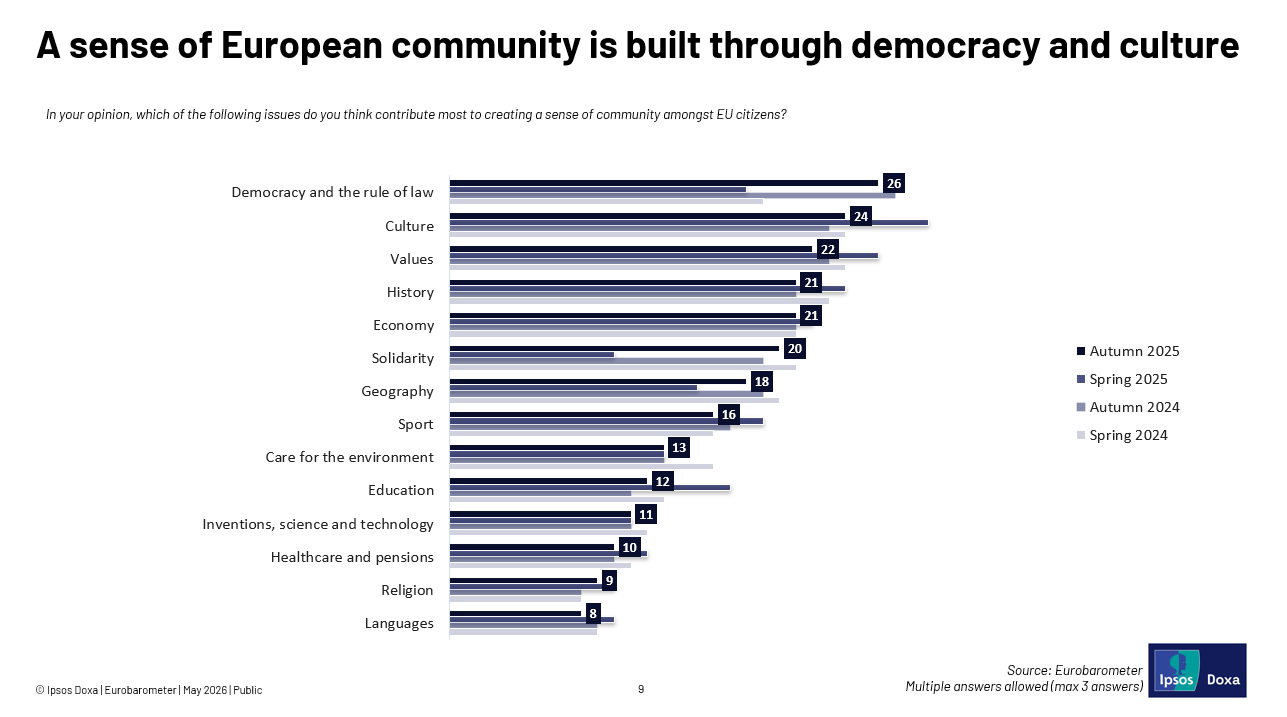
When it comes to the question of identity, the picture is consistent with this ambivalence. The share of those who feel they are citizens of the Union remains high, but those who say ‘yes, I definitely feel like a European citizen’ are in the minority almost everywhere, whilst the majority respond ‘yes, to a large extent’. The emotional connection to the EU is more often described as ‘somewhat’, and less often as ‘very’. And when asked whether ‘their voice is heard in Europe’, the proportion of those who are convinced remains limited. Europe, therefore, exists and is useful, but it is perceived as distant at times when citizens seek recognition, a listening ear and swift action.Yet Europeans know what unites them: when asked what creates a European community, ‘democracy and the rule of law’ (26 per cent) and ‘culture’ (24 per cent) top the list, followed by ‘values’ (22 per cent), ‘history’ (21 per cent) and ‘the economy’ (21 per cent). This provides valuable insight for building a new founding narrative: not merely the sum of material interests, but a coherent narrative of shared principles, history and creativity.
3) Europe’s request is clear and pragmatic
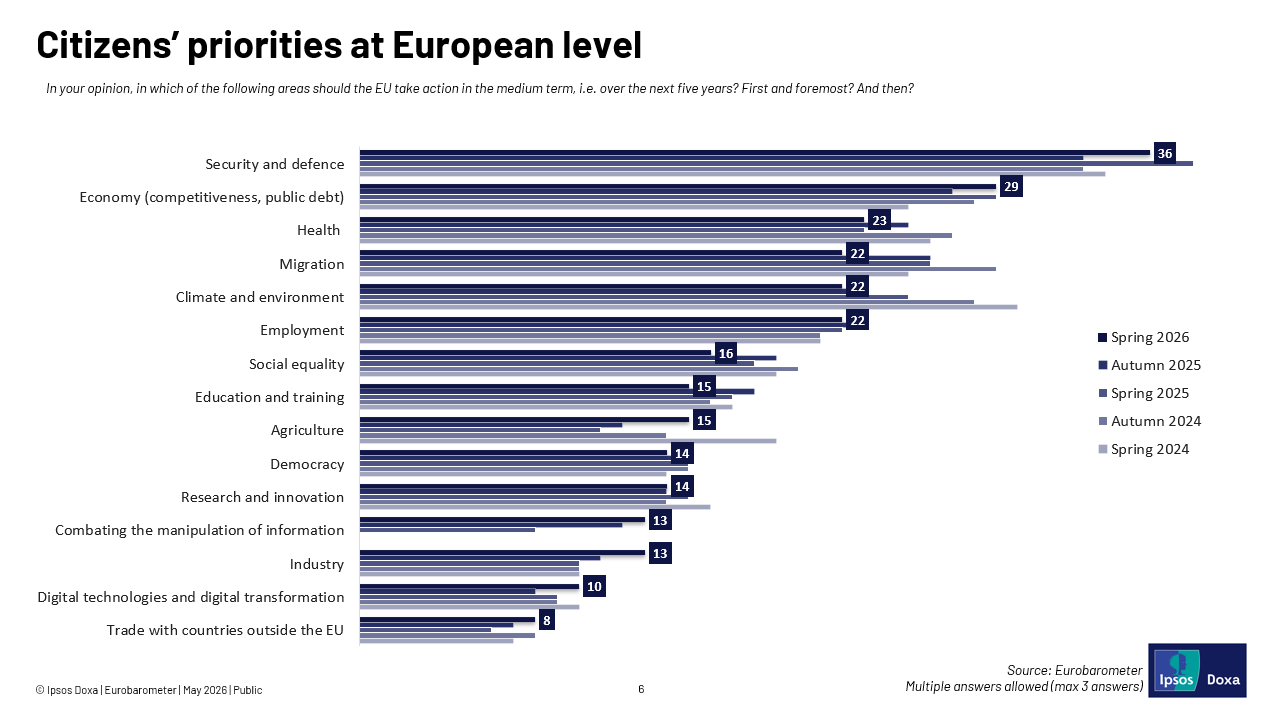
The clearest part of the survey concerns what citizens want from the European Union in the coming years. The priorities at European level for the next five years are as follows:
• Security and defence (36%)
• Economy/competitiveness (29%)
• Health (23%)
• Migration (22%)
• Climate and the environment (22%)
• Employment (22%)
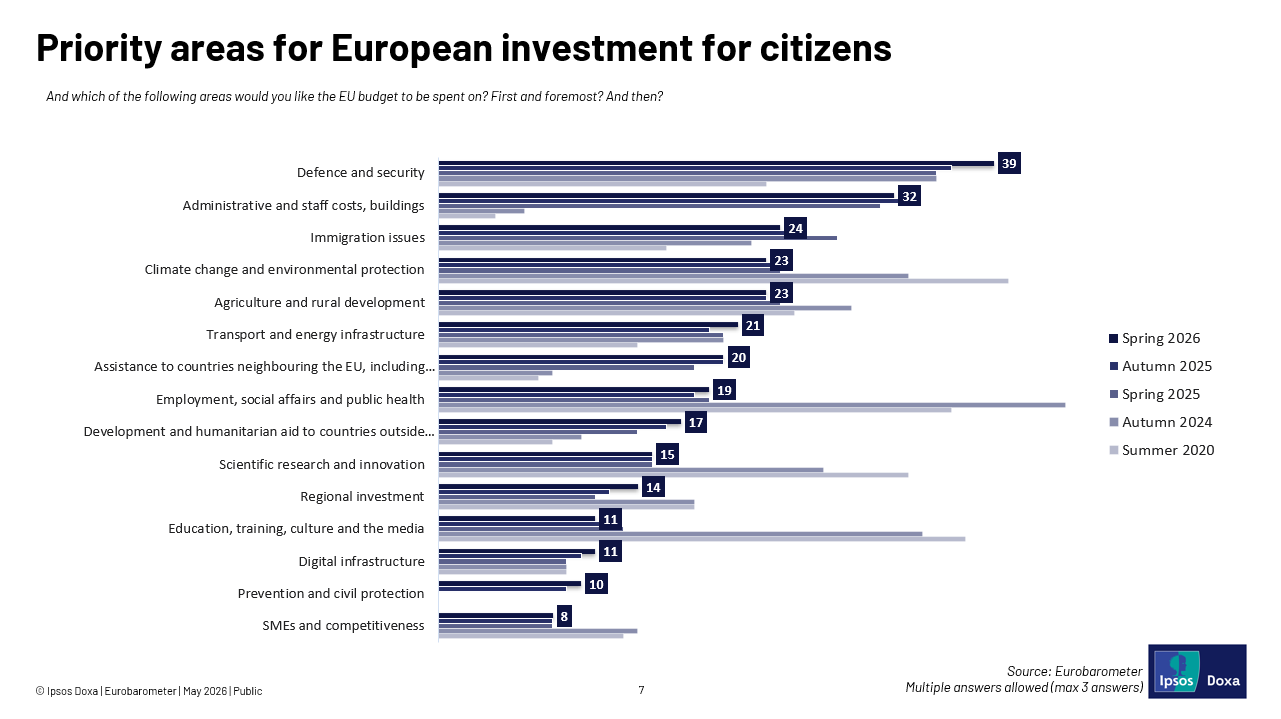
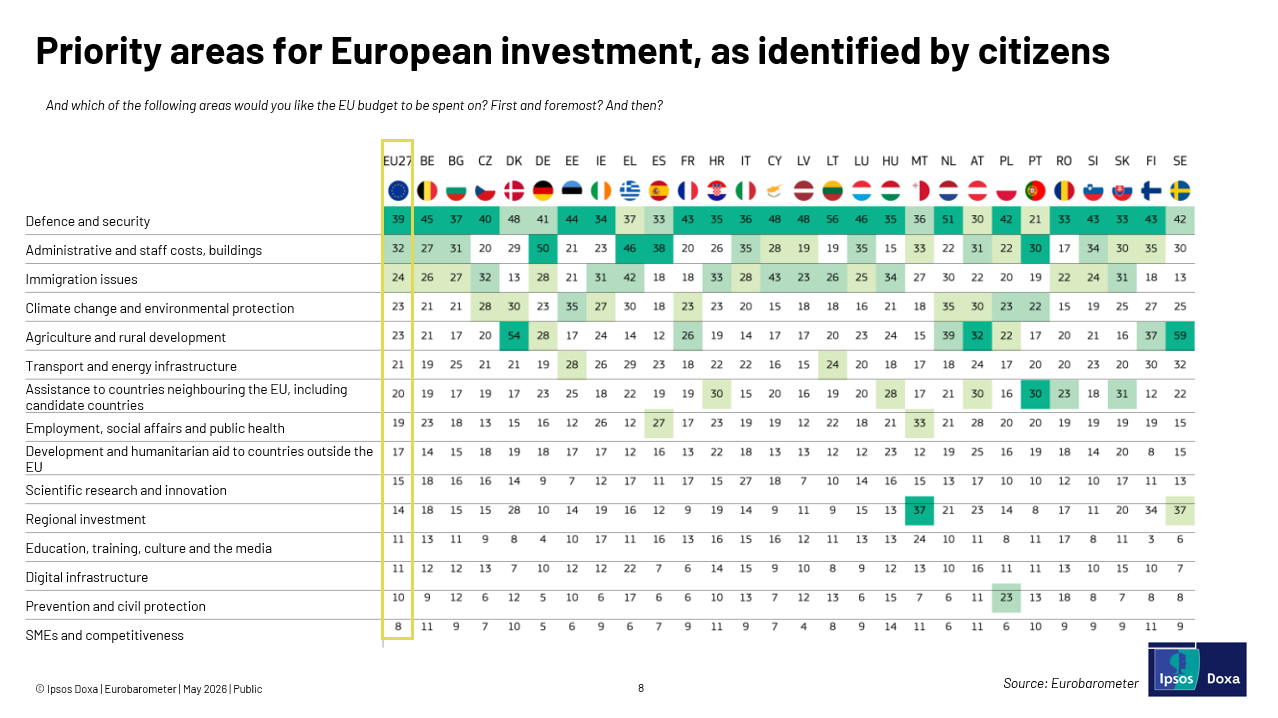
This picture is borne out by the areas of expenditure in the EU budget that citizens consider to be priorities:
• Defence and security (39%)
• Immigration (24%)
• Climate/environment (23%)
• Agriculture and rural development (23%)
• Transport and energy infrastructure (21%)
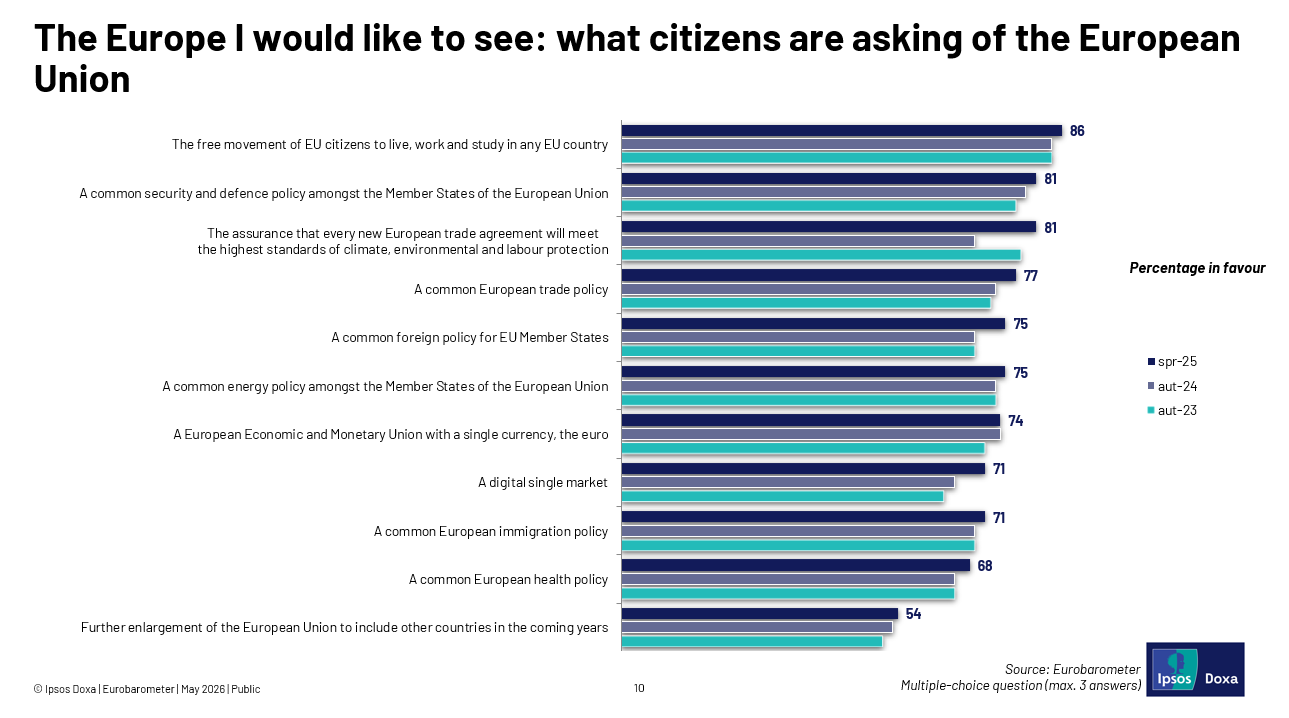
Despite a lukewarm attitude towards Europe, European citizens would like to see common policies on various issues:
• Common security and defence policy (81%)
• Trade agreements with the highest social and environmental standards (81%)
• Common trade policy (77%) and common foreign policy (75%)
• Common energy policy (75%)
• Economic and Monetary Union with the euro (74%)
• Digital Single Market (71%)
• Common immigration policy (71%)
• Common health policy (68%)
This is a reassuring attitude at a time when ‘sovereignist’ political forces appear to be enjoying greater support than in the past. The data indeed paint a picture of European public opinion calling for greater integration precisely in those areas where individual states are structurally less effective (defence, energy, migration, health), with the realisation that, on many issues (not just cross-border ones), ‘useful sovereignty’ is best exercised collectively.
At the same time, the list of immediate concerns (the ‘challenges for Europe’) is dominated by:
• Conflict in the Middle East (25%)
• The international situation (23%)
• The war in Ukraine (20%)
• The cost of living (17%)
• Security and defence (15%)
• Energy supply (15%)
• Immigration (14%)
• Climate (8%)
Europe’s priorities are therefore selective and specific: defence, energy, migration, health and competitiveness. It is an agenda focused on ‘protecting freedoms’ in an increasingly complex world.
4) Why do the negative aspects dominate the narrative?
Three mechanisms explain the paradox between benefits that are often ‘invisible’ and highly visible criticisms.
• Visibility bias: European benefits are diffuse, everyday and taken for granted (free movement, consumer protection, environmental standards, etc.); the costs or constraints are concentrated and make the headlines (infringement proceedings, rules on national budgets, criteria and deadlines for the allocation of funds). What makes a noise outweighs what underpins the system.
• Selective attribution and buck-passing: when things go well, the credit goes to national or local authorities; when things go wrong, ‘it’s Brussels’ fault’. This is a tactic used by political actors facing difficulties or under pressure to secure support within their own country, which has a negative impact on the legitimacy of the European Union.
• Procedural distance: the European Union makes decisions following lengthy, multi-level processes. Without a ‘face’ or deadlines perceived as swift, the legitimacy of the outcome (output) struggles to offset the perception of weak legitimacy at the input stage, that is, the perception that each country has little say in the matter.
5) What new founding narrative can ‘warm people’s hearts’?
It is clear that Europe must set itself the goal of presenting itself in a different light so that it is perceived as being closer to its citizens, capable of translating its vision into emotion, as Bono, the lead singer of U2, said in 2018.
The historic ‘three Ps’ – peace, protection and prosperity – are not outdated: they must be adapted to the era of competition between major powers and the twin green and digital transitions. The evidence suggests a narrative that unites security, freedom and sustainability.
However, we need to reflect on what the guiding principle of the new narrative might be – for example, Europe as a community that protects freedoms (of movement, enterprise and expression) by making them resilient in an unstable world, and which passes them on intact to future generations through the green transition and innovation. These themes are consistent with the findings of the Eurobarometer:
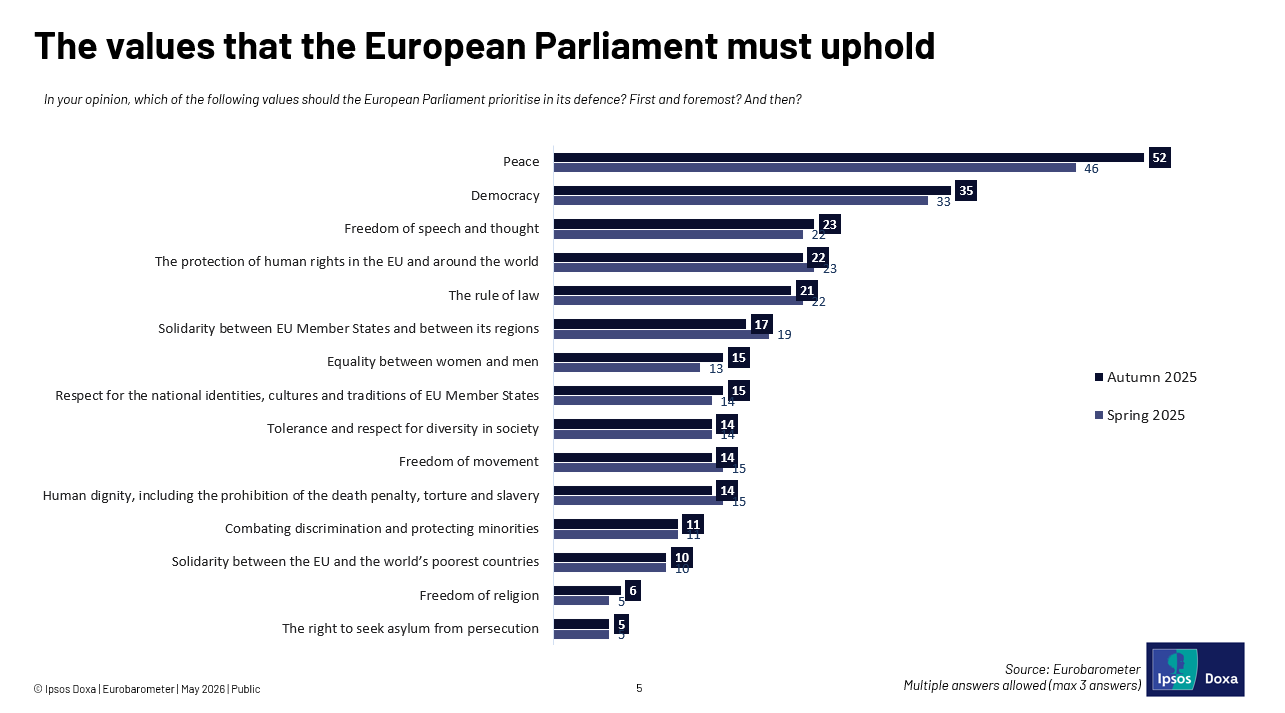
• Peace, democracy and the rule of law: citizens cite these as the primary ‘cornerstones’ of their identity. Common defence aims to preserve peace, not to militarise the Union.
• Common security and defence: at the top of the list of priorities and desired spending.
• Clean energy sovereignty: energy as a source of economic and geopolitical security, combined with climate and environmental considerations.
• Fair and competitive well-being: an economy that innovates and creates high-quality jobs.
• Caring for people: common health and a humane and effective management of migration, as a concrete expression of European solidarity.
This can be summarised as follows :
• Preserving freedoms (peace, rights, the rule of law).
• Empowering people (health, education, employment, mobility).
• Transforming our model (energy, climate, digital) to prosper without leaving anyone behind.
6) How can we ‘present’ Europe in such a way that the benefits outweigh the drawbacks?
We need practical, measurable proposals that are relevant to everyday life, translating principles into concrete experience. There could be a wide range of actions, for example:
• For every new European measure, clearly set out the timelines, benefits and safeguards for citizens or businesses, with concrete examples from everyday life.
• Identification and traceability of funds: a visible ‘EU label’ on infrastructure, services and projects; publicly available, up-to-date maps showing construction sites and results; real-time trackers of local benefits (kilometres of network upgraded, students on exchange programmes, exporting businesses supported, etc.).
• Shared responsibility, but also shared credit: for every significant result, joint communication between the European Union, national government, regions and mayors. For every delay, a catch-up plan naming the person responsible and setting deadlines.
• Communication with citizens as a strategic lever: listening, participation and feedback (“we have changed X because you told us Y”).
• Measurable simplification: for example, targets for reducing processing times and administrative burdens when accessing funds; a single digital point of contact from the EU for SMEs and the third sector; public indicators showing ‘days saved’ per application.
• Creation of ‘local ambassadors’: networks of schools, GPs, chambers of commerce and the third sector, acting as ‘storytellers’ of European value, using simple resource packs, local data and regular micro-events.
• Highlighting the ‘European dividend’ through a personalised annual report entitled ‘Your Year with the EU’: rights exercised, estimated savings, and opportunities unlocked in your local area.
***
The latest Eurobarometer survey conveys three clear political messages.
• Average confidence in the European Union is rising, but it remains fragile and highly uneven: the significant decline in confidence recorded in France is not a mere detail, but a warning about the central importance of recognition and results.
• The demand for Europe is strong and tangible: citizens want more of the EU, particularly where challenges transcend borders, and are prepared to support it if they see it as safeguarding freedoms and providing opportunities.
• The new founding narrative will not emerge from a slogan, but from the alignment of unifying values (peace, democracy, the rule of law, culture) with policies that protect and empower (common defence, clean energy sovereignty, health, orderly management of migration, sustainable competitiveness).
If the European Union can present itself as a ‘home of secure freedoms’ – protecting its citizens and strengthening, rather than undermining their freedoms – mistrust may diminish. And Europeans’ ambivalence towards it, rather than being an obstacle, will become a driving force: that of a continent which, true to its motto ‘in varietate concordia’, when put to the test, rediscovers its raison d’être in the fulfilled promise of peace, protection and prosperity, updated for the century of resilience and sustainability.
Publishing Director : Pascale Joannin
To go further
Information and disinformation

Constance Le Grip
—
20 October 2026
There are wars we did not see coming. The information war being waged against us is one example[1]. The countries of the European Union are now operating in a profoundly transformed...
Budget and Taxation

Valérie Plagnol
—
13 October 2026
In the wake of the subprime crisis, the markets grouped under the acronym ‘PIIGs’ the so-called ‘Club Med’ countries of Southern Europe together with Ireland. Having managed...
Future and outlook

Pape Léon XIV
—
6 October 2026
During his apostolic journey to Metz on September 28, Pope Leo XIV paid a strong tribute to Robert Schuman, father of Europe, in a speech of which we reproduce here the full text.
I am pleased to be...
Future and outlook

Louis Caudron
—
29 September 2026
Putin, Trump and Netanyahu have undermined the system of international relations that we have known for decades. Putin’s war of aggression in Ukraine, Trump’s claims over Greenland or...
The Letter
Schuman
European news of the week
Unique in its genre, with its 200,000 subscribers and its editions in 6 languages (French, English, German, Spanish, Polish and Ukrainian), it has brought to you, for 15 years, a summary of European news, more needed now than ever
Versions :