
Budget and Taxation
Valérie Plagnol
-

Available versions :
EN

Valérie Plagnol
Economist, member of the Foundation’s scientific committee
In the wake of the subprime crisis, the markets grouped under the acronym ‘PIIGs’ the so-called ‘Club Med’ countries of Southern Europe together with Ireland. Having managed to avoid the property crisis and still enjoying some room for manoeuvre, France managed to look on at a distance and, although it was hit hard by the euro crisis in the years that followed, its credit rating remained strong and its credibility intact.
According to Eurostat, Ireland has definitively left the PIIGs, with gross debt falling to 37% of its GDP in the first quarter of 2026. Portugal has reduced its debt to 91% of GDP. France, on the other hand, has joined the club of ‘100 % and above’ countries (117.6%). Belgium (109.1%) and Italy (138.9%) have been long-standing members. Spain joined this group in the wake of its property bubble bursting and is struggling to fall back below the 100 % threshold (101.6%). Greece’s public debt still stands at 143.5% of its GDP, illustrating just how painful it is to stabilise and furthermore reduce its debt. However, as the chart below shows, the debt-reduction efforts undertaken in Greece, Portugal and even Italy stand in stark contrast to France’s persisting deterioration.
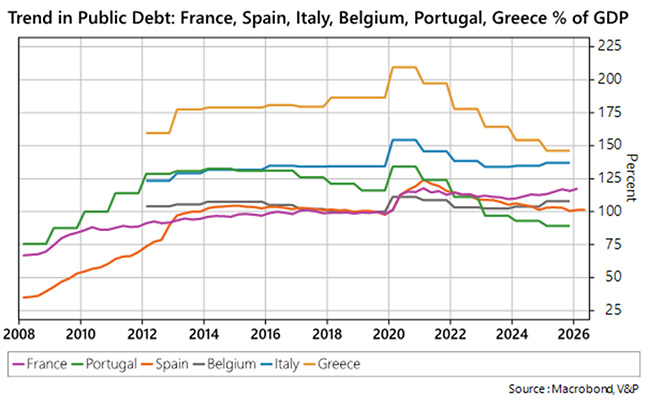
“Risky France”
From the perspective of international markets, France has indeed become a problem for Europe. And is there a risk that this could spread? Indeed, the yield on the 10-year OAT is approaching 5% (4.89%), representing a spread of more than 130 basis points (bp) over the German Bund – a level not seen since the euro crisis. Not only is French debt trading at higher yields than that of Italy or Greece, but against a backdrop of widespread pressure on global interest rates, it could end up dragging other countries down with it and undermining the efforts currently underway.
Creditor’s confidence
Admittedly a state is not a household: it does not die, it levies taxes, and its debt is rolled over far more often than it is repaid. Consequently, many people have for too long claimed that states could not be subject to budgetary discipline. However, this leeway comes at a price: it is valid only for as long as its creditors place their trust in it.
And it would appear that in France, we have reached a point where this issue has become sufficiently pressing to demand that we tackle it with courage and determination. Is there any need to emphasise the urgency of the situation? On the eve of the budget’s presentation to Parliament, Agence France Trésor announced that it will need to raise nearly €340 billion (339.7) on the markets next year, based on a deficit of 5% of GDP as set out in the draft Finance Bill for 2027. The bulk of the additional €28 billion (19.4) to be raised compared with last year is due to higher amortisation: securities issued during the years of ultra-low interest rates are gradually maturing and must be refinanced on far less favourable terms. The average yield on medium- and long-term emissions rose from 3.14 % in 2025 to 3.55 % in 2026. The government’s debt service costs are therefore expected to surge from €62.6 billion to €72.9 billion in 2027: an additional €10 billion in a single year, which is more than the projected increase in the defence budget.
With debt estimated at 119.3% of GDP by the end of 2026, rising to 121.7% by the end of 2027, France is returning to levels not seen since the immediate post-war period. It was not alone in this situation at the time, but the circumstances were very different. Subject to rationing until 1949 and rampant inflation, and with the support of substantial aid from the Marshall Plan between 1948 and 1952, France was able to begin its reconstruction and reduce its debt, despite the cost of the colonial wars. Moreover, there was severe ‘financial repression’[1]. In other words, it was primarily inflation and captive savings that ‘paid off’ the post-war debt.
Five solutions, nothing more, nothing less
As many experts have reminded us, there are not many ways to stabilise and then reduce public debt. Following the subprime crisis in 2013, Carmen Reinhart and Kenneth Rogoff sounded the alarm, noting that the current level of public debt in advanced economies is approaching the highest levels seen in two centuries. Let’s take a look at them, from the most encouraging to the most painful.
1. Economic Growth
It all comes down to the gap between the apparent interest rate on the debt and the rate of nominal growth[2]. The apparent rate represents the sum of interest paid divided by the total outstanding debt. It is estimated at 2.1% in 2026, above the nominal growth expected this year, increasing by 1.4 % and 1.7% respectively, based on volume growth of 0.4% When the apparent rate exceeds growth, the debt feeds on itself: this is the famous ‘snowball effect’. However, as refinancing takes place, this apparent rate can only converge towards market rates, with the 10-year OAT now trading above 4.9%. Growth remains the least painful solution, but it cannot be imposed: it requires investment, productivity gains and reforms, the benefits of which can only be reaped in the medium term.
2. Fiscal adjustment
Reducing debt begins when we stop contributing to it. To achieve this, public administrations must ensure that at least their primary balance – that is, excluding interest payments – is in balance, and even in surplus once the apparent rate exceeds growth. With a deficit of 5% of GDP and interest payments of over €72 billion, our primary deficit will still be around 2.5% of GDP; the effort still required therefore far exceeds the €54 billion in savings announced for 2027. Others have achieved this: Canada and Sweden in the 1990s, and more recently Portugal, Cyprus and Greece, whose debt-to-GDP ratios fell by between 20 and 30% of the GDP between 2022 and 2025. Experience shows that these adjustments are even more successful when they focus on expenditure, are implemented over the long term and are accompanied by growth-friendly reforms.
3. Financial repression, accompanied by a steady dose of inflation
This involves channelling domestic savings – voluntarily or under regulatory constraint – towards government financing at rates below the rate of inflation: bonds issued directly to the public, caps on interest payments, prudential rules requiring banks and insurers to hold public debt, targeted tax incentives, and even restrictions on capital outflows. According to Carmen Reinhart and Belén Sbrancia, this mechanism helped the United States and the United Kingdom to ‘write off’ the equivalent of 3 to 4% of GDP in debt per year during the post-war decades. In the eurozone, where monetary policy is the responsibility of the ECB and capital flows freely, its more drastic forms are ruled out. Its milder forms, however, remain possible: any ‘channelling’ of savings deserves to be examined in this light. Through euro-denominated life insurance funds, French savers are already among the government’s leading creditors. They would therefore also be the first to be exposed to returns that are consistently below inflation.
4. An inflationary surprise, that is to say, an unexpected surge in inflation
The price spike of 2022–2023 provided a recent illustration of this: by inflating nominal GDP, it caused France’s debt-to-GDP ratio to fall by nearly 2% in a year. However, this is a one-off, achieved at the expense of savers holding fixed-rate assets, and the markets subsequently make them pay for it through a higher risk premium.
5. Explicit default or debt restructuring
This is a last resort. Greece tried it in 2012, forcing its private creditors to accept a write-down of more than half the face value of their bonds, at the cost of deep recession and prolonged exclusion from the markets.
A reputation shaped by history
Let us take a long-term view. France has not formally defaulted on its domestic debt since 1797 and the ‘two-thirds bankruptcy’ – a measure to restore public finances carried out by the Directory at the end of the Reign of Terror and before the Consulate. Building on this experience, Louis XVIII, upon his return to the throne, had Article 70 of the Charter of 1814 stipulate that: “The public debt is guaranteed. Any commitment entered into by the State with its creditors is inviolable.” This commitment laid the foundations for the reputation of France’s creditworthiness. It reaped the benefits of this in 1871–1872: the loans issued by Adolphe Thiers to pay the indemnity of 5 billion francs demanded by Prussia were massively oversubscribed, and the debt was settled before it fell due.
This creditworthiness was put to the test in the aftermath of the First World War. The interwar period illustrates the reduction of domestic debt through inflation and devaluation: the 1928 Poincaré franc was worth no more than one-fifth of the Germinal franc, cementing what Keynes called ‘the euthanasia of the rentier’. As for the external debt owed to the Allies, it was partly written off. France was counting on German reparations to meet these obligations. But Weimar Germany, ruined by the hyperinflation of 1923, was unable to honour its commitments, and France in turn suspended its repayments to the United States at the end of 1932.
A distinction must therefore be drawn between domestic and external debt. The latter, denominated in foreign currency – often a hard currency – requires the debtor to increase their exports at the expense of domestic consumption in order to accumulate foreign exchange reserves. Inflation and devaluation therefore only serve to undermine its ability to meet these obligations. The debt crises in emerging economies during the 1980s and 1990s – from Latin America to Asia and Russia – amply demonstrated this, necessitating severe austerity measures comprising tax hikes, financial crackdowns and restructuring.
The so-called advanced economies are therefore not about to give up this hard-won credibility, which allows them to borrow in their own currency. France, like the 21 members of the euro area, thus occupies a unique position: it borrows in euro, a currency it shares but does not issue on its own. The sovereign debt crisis of 2010–2012 served as a reminder that a eurozone member state can find itself at the mercy of market sentiment. It incurs debt in a currency it does not issue, and the treaties rule out any solidarity regarding national debts: Article 125 of the TFEU proscribes both the Union and other Member States from assuming the liabilities of a Member State (the ‘no bail-out’ clause), and Article 123 prohibits the ECB from directly financing Member States. This principle is a corollary of the Member States’ fiscal sovereignty. It was coupled with convergence criteria relating to deficits, debt, inflation and interest rates. Far from being arbitrary, these criteria sought to prevent the emergence of centrifugal forces in an area where capital circulates freely.
The crisis forced further action to supplement this framework. In 2012, the European Stability Mechanism (ESM) was established to lend to Member States in difficulty, in exchange for an adjustment programme. In the same year, Mario Draghi’s ‘whatever it takes’ was followed by the announcement of Outright Monetary Transactions (OMTs). This programme was never activated, but it was enough on its own to stem speculation against Italian debt. It remains, however, conditional upon an ESM programme.
Later, massive purchases of government bonds effectively acted as a buffer: the Public Sector Purchase Programme (PSPP) from 2015, followed by the Pandemic Emergency Purchase Programme (PEPP) in 2020, with flexibility in the allocation of funds across countries. In 2020, the NextGenerationEU recovery plan led, for the first time, to large-scale joint borrowing, on an exceptional and temporary basis. Finally, following the tensions over yield spreads in 2022, the ECB introduced the Transmission Protection Instrument (TPI). This gives it the power to purchase, without any pre-set limit, the securities of a country whose yield spreads were to widen in an unjustified, disorderly manner and without any link to its fundamentals. This safety net is, however, subject to conditions. To qualify, a Member State must comply with the European fiscal framework (it must not have failed to take effective corrective measures under an excessive deficit procedure), have sustainable debt and not exhibit serious macroeconomic imbalances.
The ECB’s protection is therefore not a blank cheque. It remains linked to fiscal discipline, and this link is by no means insignificant for France, which has been subject to an excessive deficit procedure since July 2024.
Trust demands accountability
Pegged on the euro, France still enjoys a high degree of market confidence. Proof of this can be seen in the medium- and long-term bond tenders, which have been oversubscribed by an average of two and a half times this year. But this trust is as much an obligation as it is a blessing. Are we perhaps testing its limits? On the one hand, French debt is feeling the effects of growing competition: firstly, within the euro area, where Germany – having relaxed its debt brake to finance a vast investment and defence programme – is returning to the markets on a larger scale; then from British and American debt, both public and private. On the other hand, domestic political instability is taking its toll: the government, having lost its majority, faces opposition that is even less inclined to compromise as the presidential election in spring 2027 looms. Consequently, the yield spread between the 10-year OAT and the German Bund exceeded 100 basis points on 18 September last, for the first time since 2012. France is now borrowing at higher rates than Italy. In another sign of uncertainty, demand for our debt has eroded slightly compared with last year.
A 2027 budget under pressure
The draft Finance Bill presented by the French government sets a deficit target of 5% of GDP, following an estimated 5.2 % to 5.4% for this year[3]. If nothing is done, it could reach 6.5%. To achieve this, the government has announced a ‘package’ worth €54 billion, which relies more on slowing the rate of increase in expenditure than on reducing it: a freeze on the value of central government appropriations (excluding defence), a freeze on the indexation rate, partial under-indexation of pensions and a reduction in the tax allowance for pensioners. The draft Social Security Financing Bill also aims to reduce the deficit of the statutory schemes from around €22 billion this year to €12 or €13 billion by 2027. However, nothing is certain, given the lack of a majority in the National Assembly and the deep divisions over how to contain the debt. The High Council for Public Finances will also have to rule on the realism of the 1% growth assumption adopted for 2027, which is slightly higher than that of the Banque de France (0.9%). Above all, even if achieved, a deficit of 5% would not be sufficient to stabilise our debt. With nominal growth of around 2.5%, the deficit required to stabilise the debt ratio stands at around 3% of GDP. The target of falling below this threshold in 2029 would require reducing the deficit by more than 2% in two years – a pace that France has never maintained outside of post-crisis recovery periods.
Two blind alleys
In light of this, two opposing arguments are emerging. The first promises a programme of massive savings, achieved through a reduction in the civil service workforce, a unilateral cap on France’s contribution to the European Union budget and a reduction in immigration, whilst also raising the state pension age. Deemed both overly optimistic and unrealistic, this plan implies significant exceptions to the European treaties to which we are bound – and it is hard to imagine that we could be exempted from them without consequences. The second plan envisages the cancellation or freezing of French debt held by the ECB, or even by non-resident investors, as well as increased taxation of the ‘ultra-rich’, all accompanied by ever-increasing expenditure. This has immediately spooked the markets, and with good reason: the European treaties prohibit the ECB from financing Member States, and more than half of our marketable debt is held by non-residents on whom we rely for financing.
***
Must we resign ourselves to an alternative whose consequences – whether more or less openly acknowledged – would amount to ‘taxing’ domestic savings, cutting us off from European support and worsening our financial situation, without actually improving the lot of our citizens? I do not believe so. Between the illusion of cost-free debt and the temptation to default, there is a narrow but viable path: a credible multi-year strategy, agreed upon beyond electoral cycles, which prioritises the quality of public spending, safeguards investment and does not make savers the adjustment variable. It is on this condition that France will retain the confidence of its creditors, foremost among whom are its own savers. We have no choice but to persevere, because... Out of debt... out of danger.
[1] Reference to the definition given by Carmen Reinhart and M. Belén Sbrancia: financial repression encompasses loans to the government from captive domestic investors (pension funds and other savings products, which may benefit from tax incentives), explicit or implicit caps on interest rates, restrictions on cross-border capital flows and, more generally, a closer link between the government and the banks.
[2] The debt dynamics equation is expressed as: Δd ≈ (r − g) × d − sp, where d is debt as a percentage of GDP, r is the apparent interest rate, g is nominal GDP growth and sp is the primary balance as a percentage of GDP (the budget balance excluding interest payments). Thus, if g > r, the debt ratio falls when the primary balance is zero; if r > g, a primary surplus is required to stabilise it.
[3] Estimates from the Treasury (5.4 %, September 2026) and the Banque de France (5.2 %; June 2026, assuming no change in policy).
Publishing Director : Pascale Joannin
To go further
Future and outlook

Pape Léon XIV
—
6 October 2026
Future and outlook

Louis Caudron
—
29 September 2026
Education and culture

Blandine Chelini-Pont
—
22 September 2026
Digital and technologies

Jean Mafart
—
15 September 2026

The Letter
Schuman
European news of the week
Unique in its genre, with its 200,000 subscribers and its editions in 6 languages (French, English, German, Spanish, Polish and Ukrainian), it has brought to you, for 15 years, a summary of European news, more needed now than ever
Versions :