Budget and Taxation
Nicolas-Jean Brehon
-

Available versions :
EN

Nicolas-Jean Brehon
Honorary Adviser to the Senate, responsible for coordinating the work of the parliamentary committee on the 2007–2013 Multiannual Financial Framework
Negotiations over the Multiannual Financial Framework (MFF) – the European Union’s major budgetary event held every seven years – invariably spark intense discussions among Member States. This tension is resolved at extraordinary meetings of the European Council[1]. The seventh MFF, covering the period 2028–2034, is no exception to the rule. However, the scale of the disagreements appears to be particularly worrying this time round.
1 - The negotiations over the MFF: an inevitable source of tension between Member States
1.1 – Due to budgetary reasons
- The total amount of the budget
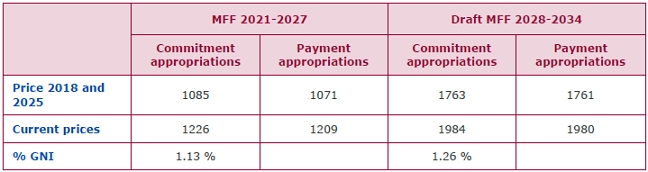
The MFFs outline ’an orderly progression of expenditure’ at European level over a seven-year period. Although it does not have the legal attributes of a budget (since the MFF merely sets expenditure ceilings), this framework constitutes a form of budgetary planning that results in significant commitments for the European Union. “The next MFF will be the most ambitious ever proposed,” said the Commission President on 16 July 2025 when presenting a draft regulation that set out a programme of nearly 2,000 billion euros over seven years (in current euros), representing an annual budget of 282 billion. Although this figure may seem modest compared with total public expenditure across the Union as a whole (less than 2 per cent) or in relation to the debt levels of certain Member States, year after year, programming period after programming period[2], the EU’s budgetary impact is no longer marginal. This is particularly true given that the 1,000 billion budget allocation under the 2021–2027 MFF was supplemented by 750 billion from the NextGenerationEU recovery plan, which is debt-financed.
Table 1
Total budget for the 2020–2027 and 2028–2034 MFF (€ billion)[3].
Source: MFF 2020 2027 after amendment: MFF 2028-2034 Commission proposal
Current prices after accounting for an annual deflator of 2 per cent (estimated inflation rate)
- Gross contributions
The MFF provides Member States with a clear picture of their national contributions. Although the Treaty refers to funding from ‘own resources’, the bulk of the budget is in fact financed by contributions from the Member States[4]. An increase in the budget leads ipso facto to an increase in Member States’ contributions. The amount of payment appropriations[5] determines the amount of the contribution (known as the gross contribution) made by Member States towards the European budget. For Germany and France, for example, which are the two largest contributors to the EU budget, the annual contribution is estimated to average €47.5 billion and €37.5 billion respectively (at 2025 prices). In some years, the contribution would approach €60 billion and €44 billion respectively (at current prices)[6].
- Net contributions
Whilst Member States pay close attention to their gross contributions, they pay even closer attention to their net contributions – that is, their contributions after deduction of EU expenditure, or the returns they receive from the EU budget. The distinction between net contributors and net beneficiaries is a source of division amongst Member States[7]. The budget is a powerful instrument of European solidarity. The scale of redistribution is considerable. Cohesion funds are the main vehicle for this redistribution, but all expenditure contributes to this major budgetary process. Each year, between €35 and €40 billion flows from 10 net contributors to 17 net recipients.
Table 2
Main net contributors to/recipients from the EU budget
(three-year average for 2023–2025: € billion and % of GNI)
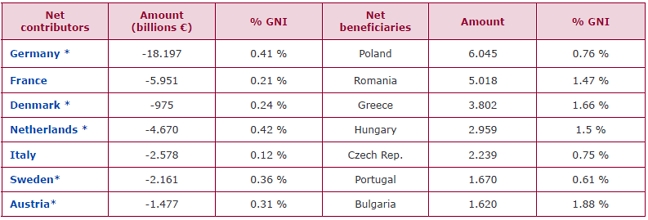
Source: 2027 Draft Finance Bill, document ‘Financial relations with the EU’ (Part 5), author’s calculations. Countries marked with * are eligible for a discount on their contribution. The net balances are shown after the discount has been applied.
Nota: Net contributions are assessed using the so-called ‘Commission method’, which excludes external expenditure and administrative expenditure and allocates transfer payments between Member States. This is the method that enjoys the broadest consensus. The so-called ‘accounting method’ takes account of all revenue and expenditure.
1.2 - For legal reasons
Initiated by the Commission, which was then chaired by Jacques Delors, budgetary planning took the form in 1988 of ‘financial perspectives’, agreed upon in an interinstitutional agreement between the Council, the European Parliament and the Commission. The procedure became part of the Union’s institutional framework under the name ‘multiannual financial framework’ with the Treaty of Lisbon in 2007[8]. The adoption of the MFF follows a special legislative procedure characterised by two provisions.
- The MFF is finalised by a Council regulation
Whilst not denying the importance of the Commission’s proposal and the European Parliament’s role in giving final approval, the budget is a matter for negotiation between Member States. The Commission’s proposal is merely a working basis – essential for establishing the structure by heading – but the overall amount, as well as the amounts allocated to each heading, are set by the Member States. Parliament gives its approval by a majority of its members, making only minor adjustments to the budgetary figures. It has influence over procedures – for example, by requiring flexibility between headings – but has no power to amend the MFF allocations. Only the threat of refusing to endorse the MFF gives it any leverage. However, its room for manoeuvre is limited. It is difficult for Parliament to renege on an agreement that has often required nearly two years of negotiations between Member States.
- Furthermore, the MFF is adopted unanimously
It is one of the few EU texts that requires unanimity in the Council. Any opposition blocks the adoption process. This gives each Member State considerable power. Some are known to be rather unwilling to make concessions, which makes negotiations difficult. Deadlocks are resolved at the last minute through budgetary concessions – some might call them ‘gifts’. This practice has existed since the very beginning.
1.3 - For political reasons
The assertiveness of states during the negotiation phase is based on four factors.
- A political analysis of the national contribution to the EU budget
The budget is not a bill to be paid, but a political choice. Nevertheless, when it comes to negotiations, every Member State is acutely aware of its budgetary interests. The gross contribution and, even more so, the net contribution to the Union’s budget are the primary factors determining the Member States’ positions in the negotiations. Some may feel that, despite European solidarity, their contribution is excessive[9]. According to Daniel Strasser, one of the Union’s first budget directors, “an excessive contribution is one that is regarded as excessive by a Member State”.
There is, in fact, a threshold beyond which the net contribution ceases to be a purely budgetary matter and becomes part of the national debate and a domestic political issue. The flat-rate reductions, commonly referred to as ‘rebates’, are intended to reduce the net contribution of the largest contributor countries. In some Member States, there is a consensus on the position the state should adopt in the negotiations (as in Germany or the Netherlands, two countries for which rebates are legitimate). For others, the European contribution is a source of division. For all Member States, budget negotiations begin with one imperative: to preserve what has already been achieved. Inertia is the main driving force behind budget negotiations, and it takes a great deal of effort to overcome it. Budget negotiations are a kind of defensive war of position.
- The power of collective action
Although unanimity gives each Member State the power to block decisions, the experience of life within the EU shows that an isolated position is not sustainable and that strength comes above all from collective action. The priority, therefore, is to seek out allies. Budgetary negotiations provide an opportunity for alliances of convenience: northern Member States versus southern ones; countries that support the Common Agricultural Policy (CAP) versus those that do not; the same applies to cohesion policy; ‘frugal’ versus ‘big spenders’, and so on. Solidarity takes the form of a solidarity of interests. The coalition that has existed since the preparation of the 2007–2013 financial perspective is that of the main net contributors. Often vilified as the camp of the ‘stingy ones’ or the ‘frugal ones’, six net contributor states have once again come together in the budgetary alliance of the ‘modernisers’ in favour of a budget reduction: the five countries benefiting from budget rebates based on GNI – Germany, the Netherlands, Denmark, Sweden and Austria – joined this year by Finland. The country, which was part of a similar coalition during the negotiations for the 2014–2020 MFF, is thus reunited with its former ‘friends of fiscal discipline’, as they were known at the time.
- The red lines specific to each state
Every Member State has its own non-negotiable priorities. For some, the priority is to reduce their contribution. Others have specific audiences to defend and are therefore sensitive to the funding earmarked for them. The Common Agricultural Policy (CAP) has always been France’s priority, and in particular CAP funding. In the past, a good Minister for Agriculture was one who secured good prices. As there is no longer any European price support (since the 1992 reform), a good minister is now one who secures a good budget. Reform is not impossible provided that the budgetary returns are more or less equivalent. In 1992, the fundamental reform of the CAP – involving a complete overhaul of the support system – went ahead without too much trouble because the amount paid to farmers, starting with French producers, remained virtually the same. These priorities are non-negotiable. At least initially. Unless there is no alternative. When that is the case – and it will be the case this time – the focus of the negotiations shifts from budgetary to political issues. The aim then is less about limiting the reduction in funding than about knowing how to communicate internally.
The triumphant press releases from the French Ministry of Agriculture are an illustration of this.
- Germany’s decisive influence
Whilst the power to veto is shared, certain Member States carry such weight in negotiations that they cannot be ignored. This is the case with Germany, the largest contributor… both in gross and net terms. Until 1992, its net contribution was, in a sense, a means of redemption that involved keeping a low profile within the Communities. Reunification transformed the country; Germany became the driving force behind Europe, and the enlargements have multiplied its influence. Net contributions were of little concern to it, as a large proportion of the subsidies to new Member States flowed back to Germany in the form of contracts for public infrastructure. Finally, more recently, the budget has become an instrument of influence and has cemented the country’s leadership. For the 2028–2034 MFF, Germany has demanded a unanimous commitment from Member States towards Ukraine. On budgetary matters, nothing is decided without Berlin’s express consent.
The negotiations on the 2028–2034 MFF have brought these traditional divisions back to the fore. However, several factors are complicating matters, making the negotiations even more difficult.
2 - The challenges specific to the MFF 2028/2034
2.1 - The limits of innovative ambition
The Commission is proposing a radical overhaul of the MFF’s structure. This is only to be expected. First of all, there is no reason to maintain expenditure where the need is not as clear-cut as it once was. There is no doubt that the Cohesion Fund has contributed to the development of certain countries or regions and has helped them catch up with the EU average in terms of living standards[10]. But for how much longer should this regional aid be extended? Furthermore, the international context demands a rethink. The Russian war in Ukraine, competition from China and the technological race are disrupting preparations for the MFF. The European Union is on the verge of ‘structural decline’[11]. Incidentally, the Commission has relied on a public consultation launched in 2024. Unsurprisingly, the expectations expressed by the public bear no relation to the Union’s areas of competence (health, the environment, defence, etc.), but they do call for change. Is the European Union not therefore obliged to innovate?
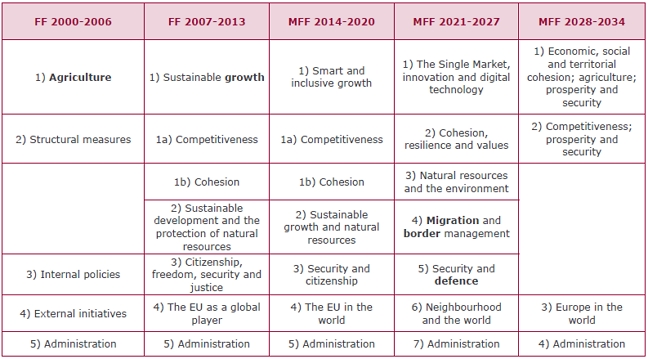
The Commission has made its choice. The headings of the MFF correspond to the ‘key policy areas’ that the Union will fund. Each MFF brings its own new features. Changes to the order and wording of the headings signal a shift in priorities[12]. The reduction in agricultural spending and the emphasis on cohesion and competitiveness (2007–2013), the emphasis on growth (2014–2020), and the introduction of a security and defence heading (2021–2027) are all political signals[13]. The same applies this time, with a restructuring of the budget, in particular the following headings:
Heading 1: Economic, social and territorial cohesion, agriculture, rural affairs, fisheries and maritime affairs, prosperity and security.
Heading 2: Competitiveness, prosperity and security.
Heading 3: Global Europe.
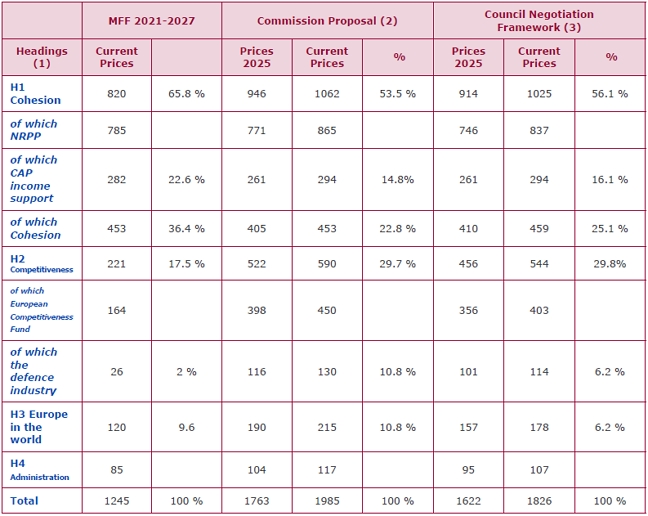
Changes in the scope of the figures make comparisons difficult[14]. But note that CAP funding would decrease by between 15 and 30 per cent, depending on the figures; that funding allocated to cohesion, refocused on the poorest countries (with a GNI per capita of less than 75 per cent of the EU average), would fall by 12 per cent; and that, conversely, funding allocated to competitiveness via the European Competitiveness Fund would triple, with, in particular, a fourfold increase in funding for the defence and security industries.
This new structure represents a profound change. The innovative ambition – described as ‘strategic’ by the Commission President – is undeniable; yet it is bound to provoke resistance from many Member States. The MFF for 2028–2034 brings together the main traditional and flagship policies: agriculture and cohesion[15]. Thus, for the first time since 1962, the CAP no longer has dedicated funding. For the first time since 1988, cohesion funds are no longer clearly identified. Both allocations are combined within ‘National and Regional Partnership Plans (PPNR)’, which bring the two areas of expenditure together. This grouping begs questions. The Commission’s argument that this is a move towards simplification is somewhat dubious[16]. The Commission is no stranger to this practice, regularly citing simplification as a justification whilst in reality making things ever more complicated. Internal flexibility between the two sub-headings will complicate the allocation process. What is the rationale behind such artificial groupings? Apart from that of creating a distinction between ‘the old Union’ – which corresponds to the competences set out in the Treaties (Heading 1) – and ‘the new Union’ (Heading 2), which is supposed to be more dynamic and corresponds to an expansive interpretation of those competences? ‘Fusion confusion’, as the Senate remarked. Are we to expect traditional policies to be relegated to second place in the MFF 2035–2042?
The negotiations over the MFF 2028–2034 are a test of the European Union’s ability to adapt. Experience shows that budgetary reforms are only accepted by Member States if the benefits they receive are more or less the same as before. Cuts, yes, but… not in my backyard. The NIMBY syndrome – not in my back yard – has its budgetary counterpart. The demand for renewal, which is perfectly justified, comes up against political reality. As long as the budget is decided by the Member States, any changes can only be gradual.
2.2 Financial constraints
Negotiations on the 2028–2034 MFF are also under pressure from a series of financial constraints.
- The issue of loans
The EU budget is disbursed to Member States through grants. For the past twenty years, the question has been raised as to whether this is the right approach. In 2014, the Juncker Plan introduced a new element. Instead of subsidising industrial players, the European Union guaranteed their loans. The second step came in 2020/2021 with the NextGenerationEU mechanism, a tool of the recovery plan following the economic crisis linked to the Covid-19 pandemic. This initiative ran counter to the austerity doctrine that Germany had managed to impose in the EU’s budgetary rules from the very outset of European integration. The Commission was then allowed to borrow on the financial markets (€750 billion at 2018 prices, or €807 billion at current prices) to redistribute the funds to Member States in the form of loans (€291 billion) or grants (€357 billion). Repayment was deferred until 2028 and spread over thirty years. The 2028–2034 MFF therefore provides for the start of repayment of this loan. The amount is set at €149.3 billion (€21 billion per year), earmarked in the MFF. The question of a new major collective loan has been raised. France and Italy in particular (with debts of €3,600 billion and €3,300 billion respectively at the end of 2026) have expressed support for a common borrowing facility through Eurobonds to finance strategic investments in defence, energy and technology. Unsurprisingly, the coalition of ‘frugal’ states, led by Germany, is opposed to the idea of a new large-scale joint loan.
So, no new major borrowing, but loans are still included in the Medium-Term Financial Plan (MTFP). Either as planned or carried over from previous periods. The MFF provides for a loan guarantee scheme designed to support regional aid[17]. The European Union must also take into account the loans it has granted abroad, particularly to Ukraine. In December 2025, the Member States approved a loan of €90 billion to Ukraine for the period 2026–2028, and a further loan of €45 billion was announced on 18 November. However, repayment is conditional upon Russia paying war reparations… Some countries, including Germany, are considering drawing on frozen Russian assets in Europe. Failing that, repayment would then fall to the Union via an increase in Member States’ contributions. This is an initiative that will undoubtedly be necessary from a political standpoint but highly imprudent from a budgetary one. As is the case with another major initiative by the Commission.
- The issue of new own resources
MFF proposals almost always include a ‘revenue’ component aimed at increasing the Union’s resources. This is once again the case this time with five proposals for new resources based on the European carbon market, the carbon border adjustment mechanism, non-recycled electronic waste, a levy on companies’ turnover, and revenue from excise duties on tobacco. These five resources are expected to generate 58.5 billion per year.
This initiative must be viewed with considerable scepticism. The precedent set by the plastic levy introduced in 2021 in the wake of the 2021–2027 Multiannual Financial Framework (MFF) calls for caution. Based on the volume of non-recycled plastic waste (at a rate of €800 per tonne), the levy was intended to diversify the EU’s sources of revenue and encourage recycling. In reality, the initiative encountered numerous difficulties. Seventeen Member States initially requested – and obtained – flat-rate reductions. According to the European Court of Auditors, each Member State has managed to pay as little as possible. Furthermore, this resource is neither a ‘plastic resource’ – as it is not paid for by industry or consumers – nor is it a new resource at all; rather, it constitutes a new method of calculating national contributions! The so-called ‘plastic resource’, which is simply added to the GNI resource, is drawn from general tax revenues.
Whilst there is no doubt that new European resources should be created, it is highly questionable, ultimately, to raise them from national taxes. Only by recognising the Union’s genuine fiscal powers could this budgetary hypocrisy be overcome. Furthermore, these proposals face opposition from many Member States, which consider that they hamper competitiveness. In short, the own resources initiative appears doomed to failure. In the absence of new resources, national contributions will have to increase.
- The issue of rebates
Whilst it is unlikely that there will be any new own resources, it is, on the other hand, almost certain that the rebate system is set to continue. The UK rebate was long regarded by the other Member States as something of a source of shame. Yet it must be acknowledged that the arrangement – which did not disappear with Brexit – has become established and even widespread. For the 2021–2027 MFF, twenty-two Member States benefit in one way or another from a reduction in their theoretical contribution; seventeen of these receive a reduction of a few million under the ‘plastic resource’[18], and five (Germany, Denmark, the Netherlands, Austria and Sweden) amounting to several hundred million in reductions to the GNI resource[19]. Given the expected increases in national contributions, it is certain that the agreement on the MFF for 2028–2034 would once again include this type of provision. It remains to be seen whether the provision will be extended to other Member States.
2.3 - Europe’s dilemma regarding the situation in France
France’s contribution to the EU budget has become a topic of political debate. In some countries, there is a consensus on the issue. This is not the case in France, where the issue is, on the contrary, a source of division. On the one hand, there is a staunchly pro-European president who refuses under any circumstances to accept the logic of ‘fair return’. On the other, opposition groups on the ‘extremes’ of the political spectrum are calling for a reduction in France’s contribution, through the application of rebates similar to those enjoyed by other net contributor countries.
The call for a French rebate is not without foundation. Its starting point is the net contribution. France is a net contributor; its net contribution is close to that of other Member States benefiting from rebates, amounting to nearly 6 billion per year, or 0.21 per cent of GNI as an annual average over three years[20]. Above all, however, two new factors support a claim for a rebate. Firstly, its net contribution is set to increase. The net contribution is directly linked to the amount spent on the CAP and the returns from it. Agricultural returns amount to nearly €9.5 billion for France, representing a return rate of 17 per cent (that is, 17 per cent of CAP expenditure goes to French farmers). 60 per cent of expenditure in France is on the CAP. With a reduction in the CAP’s share of the EU budget (which would fall from 31 per cent to 15 per cent under the Commission’s proposal), agricultural returns to France will inevitably decrease and the net contribution will consequently rise. With a contribution of around €37.5 billion and returns reduced to around €19 billion (with CAP returns halved), the net contribution would be between €15 billion and €20 billion. A significant increase in expenditure on the defence industry, from which France receives very high rates of return, would help to reduce this net contribution.
Furthermore, whilst it is perfectly legitimate, in the spirit of solidarity, for ‘rich’ countries to contribute to the development of ‘poor’ countries and to find themselves in the position of being net contributors, France is no longer a country that can be described as rich. Since 2022, GDP per capita – the standard indicator of a country’s wealth – has been below the European average: with an average level set at 100, France stands at 98, whilst the Member States receiving rebates stand at 120.
But the demand for rebates is accompanied by approximations, not to say misrepresentation. A rebate has never had the effect of cancelling out the net contribution, but only of limiting its size. This has been the case since the 1984 Fontainebleau Agreement. Despite the rebates – and Margaret Thatcher’s famous phrase ‘I want my money back’ – the five states receiving rebates have always remained net contributors, including the United Kingdom whilst it was a member of the Union. The savings resulting from any rebate will never amount to the 6 billion of its net contribution. If the rate applied to Germany (i.e. 4.7 per cent of its contribution) were applied to France, any rebate would be in the region of €1.5 billion. This is a far cry from the savings announced and anticipated.
The fact remains, however, that this claim is causing embarrassment to several of France’s partners… who have found a solution.
3 - The battle over the calendar
3.1 - The budget negotiation process
Budget negotiations, from the Commission’s presentation to the Council’s adoption of the regulation following Parliament’s approval, take an average of two years (with the exception of the first financial perspective initiated by Jacques Delors)[21]. The negotiation process takes place in several stages. It begins with the Commission’s proposal. This is followed by a lengthy period of technical discussions between departments, during which positions are set out, sticking points identified and potential alliances explored. The Council’s six-month presidencies strive to find compromises by preparing ‘negotiation boxes’. Unsurprisingly, these ‘nego-box’ proposals scale back the Commission’s initial ambitions. This stage is important but not decisive. An extraordinary European Council meeting is the crucial juncture in the negotiations, tasked with resolving deadlocks. Unanimity is required. Tension is at its peak at this stage, but the European Council always manages to find compromise solutions, even if this comes at the cost of last-minute concessions – budgetary ‘gifts’. The budgetary negotiations between Member States will have lasted eighteen months. Once political agreement has been reached, there remain six months for approval by the European Parliament, followed by the legal finalisation of the agreement.
During the negotiations, the figures are adjusted following a ‘damped sine wave’ pattern, which takes the following form: starting from a Commission proposal at 100, the Council makes a counterproposal at 85 and the Parliament at 105. The Member States holding the presidency prepare ‘negotiation packages’ on the points still to be discussed. The Council finalises an agreement at 87 or 88, and the Parliament makes its approval conditional on an increase. The final MFF is concluded at 89 or 90.
3.2 - An agreement within the Council before the end of 2026?
2027 will be an election year in several Member States, including Italy, Poland, Greece, Finland, Estonia, Slovakia and France. To avoid any clash between the budget discussions that started in July 2025 and the announced electoral processes, negotiations must therefore be accelerated to reach an agreement in the Council before 2027. France and Germany appear to agree on this point and are keen to reach an agreement before the end of 2026.
This deadline imposes a specific schedule on the 2028–2034 MFF. The Commission presented its proposal on 16 July 2025. The Cypriot (1st half of 2026) and Irish (2nd half of 2026) presidencies have put forward compromises and other negotiating packages. The Irish proposal of 12 October[22] includes a reduction in overall appropriations (a cut of €141 billion from the Commission’s proposal), resulting in a multiannual budget of €1,620 billion, to be taken from competitiveness expenditure. Agricultural and competitiveness expenditure would be ring-fenced pending a likely challenge from the Parliament on these two items. It is on this basis that the Council will take a decision. An extraordinary European Council meeting is scheduled for 26 and 27 November, with a view to formally finalising the agreement at the Council meeting on 17 and 18 December.
Given that the MFF is a seven-year commitment, it would not have been unthinkable to wait for guidance from a new government. But this is precisely what the current government wishes to avoid. Hence the rush to reach a political agreement before the end of 2026. The matter seems settled. Except that this political agreement in the Council would constitute only the first round of negotiations. There would be a second.
3.3 - Round two: the own resources decision
The Own Resources Decision (ORD) is an essential complement to the MFF; it is the ‘revenue component’ of the MFF’s expenditure section. Agreement on the MFF has always been – and will always be – reached at the cost of adjustments to Member States’ contributions. Twenty-two Member States benefit from rebates on the plastic resource and the GNI resource. Furthermore, the Commission is proposing new resources and adjustments to customs duty collection rights… all these provisions will be formalised in an ORD.
However, the ORD is only adopted following a special legislative procedure (Article 311 TFEU), which requires unanimity amongst the Member States following consultation with the Parliament and approval by the Member States in accordance with their constitutional rules. The ORD only enters into force after a lengthy parliamentary process within the Member States. Consequently, even if an agreement is reached in the Council in December 2026 and the text is finalised by May 2027, the procedure for adopting the future ORD – given the requirement for unanimity both in the Council and at the parliamentary stage, including authorisation for ratification – will not be completed before the end of 2027.
The current ORD has no expiry date and may therefore remain in force until it is repealed by a new one. Only by retaining the current ORD without introducing any new own resources or making any adjustments to Member States’ contributions could a protracted and drawn-out battle be avoided. Otherwise, a new ORD would provide an opportunity for a direct confrontation between a country that has established an executive with little or no European orientation and its EU partners. The current MFF has never been so contentious.
Such has been the nature of the European Union since its inception, with its crises and solutions. The current budget negotiations will be a moment of crisis. Conflicts are inevitable. The budget negotiations are a moment of truth that tests the Member States’ ability to move forward together. But there are nuances. For, to paraphrase a legendary football analogy, it is also a kind of sport played by 27, and in the end, it is Germany that decides.
Annex
Annex 1
Commission Proposal (16 July 2025)
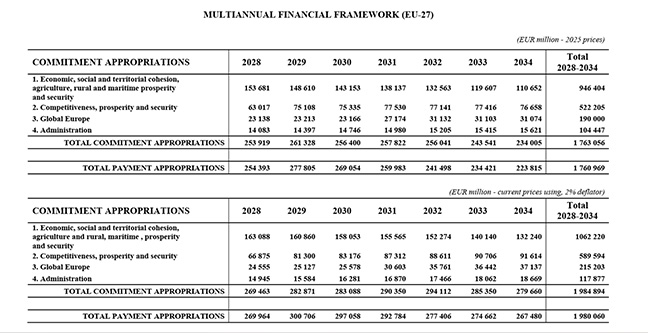
Source: Annex of the proposal establishing the multiannual financial framework for the years 2028 to 2034
Annex 2
Estimate of future annual contributions from the main contributors to the EU budget according to the Commission’s proposal (billions of euros, 2025)
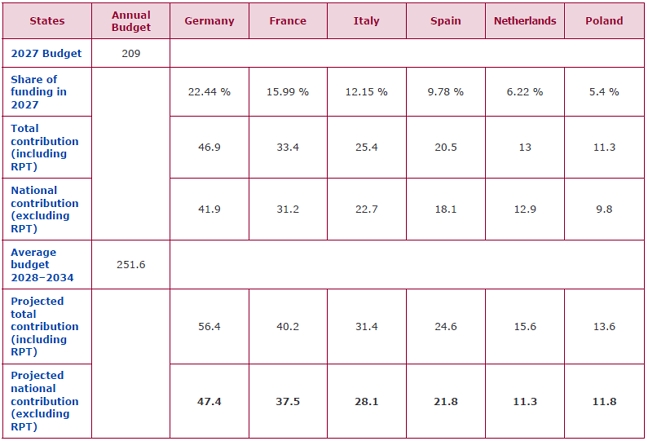
Source: lines 1 to 5, Commission, draft EU budget for 2027, general statement of revenue, Table 6; lines 6 to 8, draft MFF 2028–2034 and the author’s calculations ((total amount of commitment appropriations divided by seven) × (the Member States’ share of funding) × (the share of national contributions to funding)).
Example for France: 1,761 / 7 = 251.6; 251.6 × 0.1599 = 40.2; 40.2 × (31.2 / 33.4) = 37.5
Annex 3
Formal presentation and headings of the sections in the MFF
Annex 4
The MFF negotiations: a timeline
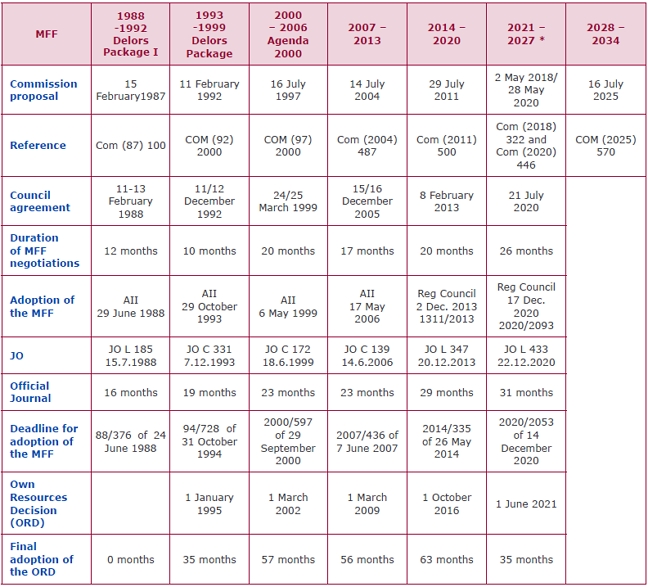
* In 2020, the committee’s original 2018 proposal was revised to take account of the Covid crisis and the EU’s new initiative
Annex 5
MFF 2028–2034: comparison of the Commission’s proposal (July 2025) and the Irish Council Presidency’s negotiating framework (October 2026)
Billions of euros (figures rounded) and % (selection of headings)
Source:
1) Full titles
Heading 1: economic, social and territorial cohesion, agriculture and rural development, maritime affairs, prosperity and security
Heading 2: competitiveness, prosperity and security
2) Source: Commission, 16 July 2025.
3) Source: Council, 12 October 2026
[1] Scheduled for the 26 and 27 November 2026
[3] Commitment appropriations (CA) are the expenditure that the EU may commit to, even if the disbursements are spread out over time. Payment appropriations (PA) correspond to the actual payments made in a given year.
[4] The budget is financed by national contributions drawn from Member States’ tax revenues (88 per cent of the EU budget in 2027) and traditional own resources (TOR), primarily customs duties, which are the EU’s genuine own resources (12 per cent of the budget).
[5] Although commitment appropriations (CA) are a good indicator of the EU’s budgetary activity, what matters most to Member States is the amount of payment appropriations (PA), as it is the PA that translate into national contributions
[6] See annex 2 contributions from the main contributing states
[7] Situations are not set in stone. For example, Ireland became a net contributor rather than a net recipient from 2023 onwards. The same applies to Spain from 2025 onwards.
[8] The procedure is set in article 312 TFEU
[9] The most common criterion for assessing this degree of importance is the proportion of the net contribution expressed as a percentage of GNI.
[10] For example, the total amount of Structural Funds allocated to Poland exceeds €250 billion over 20 years (€67 billion for the 2007–2013 programming period, €89 billion for 2014–2020 and €90 billion for 2021–2027).
[11] Reports by Enrico Letta (Much More Than A Market) and Mario Draghi (The Future of European Competitiveness), April and September 2024.
[14] A comparison of the MFFs 2021-2027 and 2028-2034 feature in annex 1.
[15] This consolidation within the MFF has national implications, as the Member States are required to submit a single document – a national-regional partnership plan (PPNR) – bringing together funding from 14 different funds.
[16] It is worth noting, for example, that the ‘prosperity and security’ initiative appears in both Headings 1 and 2!
[17] Loans via the Catalyst Europe mechanism estimated at 150 billion €
[18] See Commission, draft budget 2027, General Statement of Revenue, table 3
[19] See Commission, draft budget 2027, General Statement of Revenue, table 5
Publishing Director : Pascale Joannin
On the same theme
To go further
Democracy and citizenship

Mattias Guyomar
—
17 November 2026
The EU and Globalisation

Lukas Schaupp
—
10 November 2026
Strategy, Security and Defence

Laurent Bechcler
—
3 November 2026
The EU and Globalisation

André Gattolin
—
27 October 2026
The Letter
Schuman
European news of the week
Unique in its genre, with its 200,000 subscribers and its editions in 6 languages (French, English, German, Spanish, Polish and Ukrainian), it has brought to you, for 15 years, a summary of European news, more needed now than ever
Versions :