
Results
News
Corinne Deloy,
Helen Levy,
Fondation Robert Schuman
-

Available versions :
EN

Corinne Deloy

Helen Levy
Researcher at the Robert Schuman Foundation
Fondation Robert Schuman
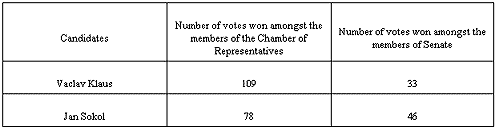
During the third round of the third presidential election in Czechia on 28th February (the two previous elections were held on 15th and 24th January), Vaclav Klaus was finally elected President of the Republic by a very narrow majority (142 votes against the necessary 141). Vaclav Havel was himself elected by one majority vote in his time. The most persistent candidate - Vaclav Klaus is the only one to have stood in all three elections - witnesses the fruits of his effort and accomplishes his dream of succeeding in the wake of his major political rival Vaclav Havel in the Castle of Prague. The new President insisted however on paying tribute to his predecessor during a TV interview: "Vaclav Havel's qualities are evident, the last thirteen years have been distinguished by his presidency and I believe these years were good ones for our country", declared Vaclav Klaus.
With "the other Vaclav" as he has sometimes been nicknamed, the Czech presidency will undergo total change, to the point that the former and new Presidents have nothing else in common but their name. Vaclav Klaus who is 61 years old is a liberal economist who became Finance Minister after the fall of the Communist regime in December 1989. As such he initially led Czechoslovakia then Czechia on the road towards the market economy. In 1992, he rose to the position of Prime Minister, a post that he was re-appointed to in 1996 after the his party's victory in the general elections. He had to resign in 1997 following financial scandals within his party and then became president of the Senate, a position he left after his party's defeat in the general elections on 14th-15th June 2002. He was the founder of the Civic Democratic Party (ODS) in 1991, and has been its honorary president since his resignation from the head of the party in December 2002. Vaclav Klaus who is often qualified as a Eurosceptic, defines himself as a "Euro-realist". "There is no alternative to our participation in integrating Europe; the essential thing is to know which Europe we want and so we then have to engage in a serious debate", declared the new President during his first TV debate after his election. Vaclav Klaus indicated that he would call for a vote in favour of Czechia joining the EU during the referendum on 15th-16th June. Vaclav Klaus also presented his presidential priorities: "The four countries neighbouring Czechia are my most obvious priority", he declared, also mentioning "the country's membership to the EU, transatlantic co-operation, and the opening up of Czechia to the world."
Vaclav Klaus owes his election to the votes cast in his favour by the parliamentary members of the Communist Party of Bohemia and Moravia (KSCM) and to the non-respect of the voting discipline by the MPs and Senators who are members of the government coalition. The day before the election the Communists announced they would not support the government coalition's candidate Jan Sokol, accusing him of being a former signatory of the Charter 77 and especially of having defended reconciliation with Germany, 65 years after the Sudetenland crisis (Jan Sokol qualified the expulsion of 2.5 million Sudeten Germans after 1945 as "disgraceful"). "The Social Democrat Party is imposing a candidate on us who does not deserve to be president", declared Miroslav Grebenicek, leader of the Communist Party, adding "We want to prevent any attempt to revise the results of the Second World War, the President clearly has to realise that the legal and property situations of the after-war period are untouchable and unchangeable". The Communists who were ostracised by Vaclav Havel, venged themselves by enabling his main political rival, Vaclav Klaus, to reach the highest role in the State.
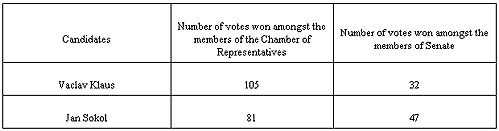
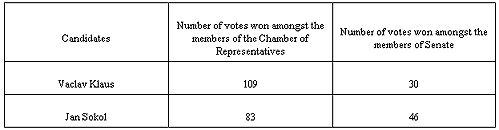
"If Social-Democracy does not betray Jan Sokol, he will be President" read the headlines the day before the election. The Social Democrat Party, the Union of Freedom - Democratic Union (US-DEU) and the Christian Democrat Union - Czech People's Party (KDU-CSL) comprise 101 MP's, of whom 97 officially approved Jan Sokol's candidature. However he only won 81, 83 and 78 votes amongst the Chamber of Representatives in the three respective rounds of the election. However, Vaclav Klaus won about 60 additional votes than the number of MP's in the Civic Democratic Party in the Chamber of Representatives (58) and between 4 to 7 additional votes than the number of Senators in his movement (26). Vaclav Klaus's election has therefore cast another blow to the already precarious authority of Prime Minister Vladimir Spilda, who is president of the Social Democrat Party. The latter will now have the difficult task of defending his position during the next party congress at the end of March when a new leadership is due to be elected.
Since the President of Czechia is head of the Army the increasing threat of military intervention against Iraq probably encouraged some MP's and Senators to put an end to the never-ending-story of the presidential elections. The important number of rounds of voting that were necessary to appoint the successor to Vaclav Havel will also have contributed to rekindling the debate amongst the country's political spheres on the election of the President of the Republic by universal suffrage.
Vaclav Klaus, the new President of Czechia will be sworn in on 7th March next.
Results of the first round of the presidential election on 28th February :
 Source: Agence France Presse
Results of the second round of the presidential election on 28th February :
 Source: Agence France Presse
Results of the third round of the presidential election on 28th February :
 Source: Agence France Presse
On the same theme
To go further
Elections in Europe

Helen Levy
—
13 October 2026
Elections in Europe

Helen Levy
—
6 October 2026
Elections in Europe

Helen Levy
—
15 September 2026
Elections in Europe
Helen Levy
—
15 September 2026
The Letter
Schuman
European news of the week
Unique in its genre, with its 200,000 subscribers and its editions in 6 languages (French, English, German, Spanish, Polish and Ukrainian), it has brought to you, for 15 years, a summary of European news, more needed now than ever
Versions :