
Analysis
Elections in Europe
Helen Levy
-

Available versions :
EN

Helen Levy
Researcher at the Robert Schuman Foundation
On 25 October, around 6.5 million Bulgarians are set to go to the polls for the first round of the presidential election. If no candidate manages to secure more than 50% +1 of the vote, a second round will take place on 1 November.
Following a turbulent election year, marked by the resignation of the outgoing president, Rumen Radev, in January 2026, and his subsequent appointment as Prime Minister in May following the victory of his new party, ‘Progressive Bulgaria’ in the general elections on 19 April, this presidential election could well herald the decline of GERB (centre-right, EPP) on the political scene and, by extension, that of its leader, Boyko Borissov, who has dominated Bulgarian politics for the past twenty years. Indeed, in early September, the party leadership decided to withdraw from the presidential race for the first time in its history. Boyko Borissov stated that he had confidence in GERB’s electorate and that he did not wish to endorse any particular candidate.
The presidential election is taking place against a backdrop of geopolitical tension: Bulgaria, a member of the European Union and NATO, is a Black Sea coastal state at the heart of the conflict between Russia and Ukraine, whilst also having to contend with corruption scandals and issues relating to respect for the rule of law.
The outgoing president, Iliana Iotova – who has been in office since January last after succeeding Rumen Radev as she was his vice-president – is standing with Kiril Valchev, director-general of the Bulgarian News Agency (BTA), as her running mate. Her candidacy was submitted by an initiative committee rather than by a political party. However, “Progressive Bulgaria”, Rumen Radev’s party, in which she served as vice-president, supports her candidacy, as do the VMRO (far right), the Socialist Party (BSP, left) and the pro-Russian left-wing party (ABV).
Iliana Iotova is the first woman to hold this post in Bulgaria.
The election campaign began on 25 September and will run until midnight on 23 October.
According to the Alpha Research poll published on 5 October, Iliana Iotova could win 44.5% of the vote, followed by Andrey Gyurov with 26.1%, who has the support of the ‘We Continue the Change’ and ‘Democratic Bulgaria’ parties. Kostadin Kostadinov, of the Vuzrazhdane party, is expected to come third with 10.5% of the vote.
By the end of September, 18,340 Bulgarians living abroad had registered to vote in 66 countries. 11,778 polling stations will be open, all equipped with electronic ballot boxes, except for those where fewer than 300 people are registered on the electoral roll – or those where there were fewer than 300 voters in the last presidential election in 2021.
The turnout, which is notoriously low, may not exceed the 2021 figure of 38%. Bulgarians are undoubtedly suffering from a certain degree of electoral fatigue, having lost confidence in their political leaders. Indeed, since 2021, they have been called upon to vote eight times to elect a new government.
The candidates
27 candidacies have been registered for this election. There were 23 in 2021.
According to the electoral commission, the following pairs (president and vice-president) are running:
- Georgi Dimov and Dimitar Shivikov
- Rosen Milenov and Ivan Ivanov
- Ivanka Tsvetanova-Petkova and Panayot Kyuchukov
- Andrey Gyurov and Georgi Kandev
- Yordan Maldzhanski and Valentin Hristov
- Kamen Taskov and Galya Ivanova
- Nako Stefanov and Nina Lambova
- Metodi Bachvarov and Lenin Stanoev
- Ivaylo Simeonov and Kosyo Stoychev
- Maria Koleva, ‘The Right’ (Pravoto) and Valeri Velkovski
- Kostadin Kostadinov, ‘Vazrazhdane’ (Renaissance) and Petar Volgin
- Aleksandar Tomov, Social Democracy (Euroleft) and Sergey Indzhov
- Boris Anzov and Branimir Michev
- Rumyana Chenalova and Georgi Georgiev
- Lachezar Avramov and Ivaylo Atanasov
- Ivo Lulchev and Stefan Popov
- Radostin Vasilev (MECh) and Krasimir Manov
- Ivan Hristanov and Stoyanka Cherkezova
- Ivelin Mihaylov Velichie (Greatness) and Yuliana Mateeva
- Velichka Georgieva and Rosen Ivanov
- Volen Siderov and Slavcho Velkov
- Nikolay Nenchev, National Agrarian Union (BZNS), and Tsveta Kirilova
- Iskra Nedeva and Stoyan Georgiev
- Plamen Paskov and Svetozar Saev
- Iliana Iotova and Kiril Valchev
- Boyan Stankov-Rasate and Yordan Manasiev
- Ventsislav Angelov, ‘The Truth and Nothing but the Truth’ People’s Party, and Atanas Stefanov
The presidential election
The President of the Republic of Bulgaria (and the Vice-President, with whom he forms a ticket) is elected for a five-year term, renewable once. Candidates for the highest office may be nominated by political parties, electoral alliances or committees of electors. The presidential role is essentially ceremonial in Bulgaria, but the Head of State has the right of veto, allowing them to return a bill to the National Assembly, which obliges MPs to reopen the debate. Since 2016, voters have been able to tick the ‘None of the above’ box on their ballot paper if they do not approve of any of the candidates standing for election.
The President of the Republic is the head of the armed forces, concludes international treaties and represents the country abroad.
The Constitution prohibits the head of state from belonging to a political party. Furthermore, the President and the Vice-President cannot be members of the same party.
The winner of the election will be sworn in in January 2027.
Results of the presidential election held on 14 and 21 November 2021 in Bulgaria
Turnout: 38.64 % (1st round) and 33.70 % (2nd round)
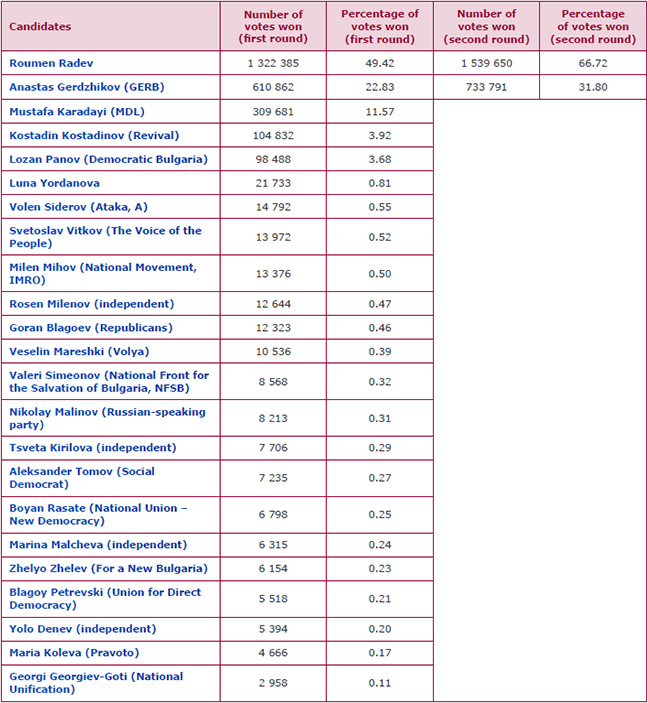
Source : https://results.cik.bg/pvrns2021/tur2/rezultati/index.html
On the same theme
To go further
Elections in Europe

Helen Levy
—
6 October 2026
Elections in Europe

Helen Levy
—
15 September 2026
Elections in Europe
Helen Levy
—
15 September 2026
Elections in Europe
Helen Levy
—
8 September 2026
The Letter
Schuman
European news of the week
Unique in its genre, with its 200,000 subscribers and its editions in 6 languages (French, English, German, Spanish, Polish and Ukrainian), it has brought to you, for 15 years, a summary of European news, more needed now than ever
Versions :