
Results
Elections in Europe
Corinne Deloy
-

Available versions :
EN

Corinne Deloy
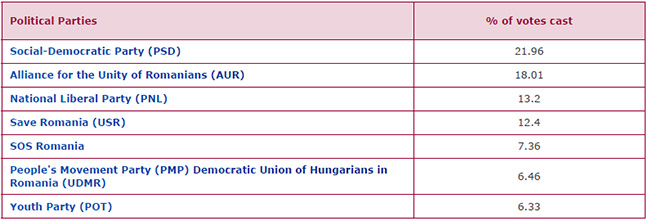
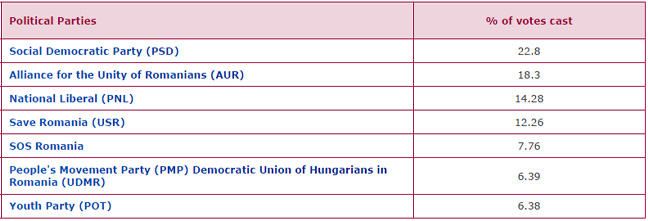
The Social Democratic Party (PSD) of outgoing Prime Minister Ion-Marcel Ciolacu came out ahead in the parliamentary elections held in Romania on 1 December, which was also a bank holiday. It won 21.96% of the vote in the Chamber of Deputies (Camera deputatilor) and 22.8% in the Senate (Senatul). The Alliance for the Unity of Romanians (AUR), a far-right party chaired by George Simion, took 2nd place with 18.01% in the lower house and 18.3% in the upper house. The National Liberal Party (PNL), led by Nicolae-Ionel Ciuca and partner of the Social Democratic Party in the outgoing government coalition, won 13.20% in the Chamber of Deputies and 14.28% in the Senate. Save Romania (USR), a liberal party led by Elena-Valeria Lasconi, a candidate qualified for the 2nd round of the presidential election on 8 December, won 12.4% in the lower house and 11.26% in the Senate.
SOS Romania, led by Diana Sosoaca, and the new Youth Party (Partidul Oamenilor Tineri, POT), which supports Calin Georgescu, the far-right candidate who will oppose the liberal leader in the 2nd round of the presidential election, led by Anamaria Gavrila, won respectively 7.36% in the lower house and 7.76% in the Senate, and 6.46% in the lower house and 6.39% in the Senate respectively. Finally, the Democratic Union of Hungarians in Romania (UDMR), led by Hunor Kelemen, won 6.33% of the vote in the Chamber of Deputies and 6.38% in the upper house.
The parliamentary elections took place in particular circumstances, since the Constitutional Court has decided to carry out a recount of the 9.4 million ballot papers cast in the 1st round of the presidential election due to suspicions about the integrity of the election. Calin Georgescu (independent), who arrived ahead on 24 November with 22.94% of the vote, is accused of having benefited from ‘massive exposure’ on TikTok in ‘violation of electoral legislation’, i.e. without having been labelled as a political candidate, accusations that the online platform rejects. ‘One of the candidates benefited from massive exposure due to preferential treatment granted by the TikTok platform. In this context, the members of the Council have asked the authorities responsible for national security and the judicial police to take the necessary measures as a matter of urgency’, stated the country's Supreme Defence Council (CSAT).
Several members of the opposition have spoken out against this decision. ‘Romania is undergoing a veritable coup d'état fomented indirectly by the Social Democratic Party in the hope of replaying the 1st round so as to bring their candidate back to the final,’ declared Ludovic Orban (Force of the Right, FD), Elena Lasconi and George Simion. ‘They are not listening to the voice of the Romanian people, and they want to replay the match to get the results they want’.
Turnout was 52%, the highest in some twenty years.
Results of the parliamentary elections in Romania on 1st December 2024
Chamber of Deputies
Turnout : 52 %
Source : https://prezenta.roaep.ro/parlamentare01122024/pv/romania/results/
Senate
Turnout : 52 %
Source : https://prezenta.roaep.ro/parlamentare01122024/pv/romania/results/
Social Democrat leader Marcel Ciolacu welcomed his party's results. However, the outgoing Prime Minister warned that ‘Romanians have sent an important signal to the political class’, saying that it wanted to continue along the European path ‘but also to protect our national identity and values’.
Together, the far-right parties won more than 30% of the vote. They oppose Romania's support for Ukraine, advocate ‘peace’, and want to defend the country's ‘Christian values. ‘These parties, which are likely to account for at least 25% of the parliament, are hostile to European values and disseminate many Russian-inspired narratives, which contribute to disinformation campaigns,’ said George Scutaru of the New Strategy Center think-tank before the elections.
‘The Romanian people have voted for the sovereignist forces’, said George Simion. ‘This is the beginning of a new era in which Romanians are reclaiming the right to decide their own destiny’.
Claudiu Tufis, professor of political science at the University of Bucharest, pointed out that the decision by the two main parties - the Social Democratic Party and the National Liberal Party - to govern together for the past 3 years had only ‘accentuated voters’ mistrust and reinforced the impression that they are united against the people. For many Romanians, voting for Calin Georgescu was not just a question of ideology but also of frustration. The two parties are also involved in a number of corruption scandals and, for many Romanians, are symbols of a sclerotic political system.
The results of the parliamentary elections show a fragmented parliament. Negotiations to form the future government could be long and difficult. The National Liberal Party repeated throughout the election campaign that it would not take part in a coalition government with the Social Democratic Party. For his part, Marcel Ciolacu has ruled out any form of alliance with the Alliance for the Unity of Romanians.
On the same theme
To go further
Elections in Europe

Helen Levy
—
13 October 2026
Elections in Europe

Helen Levy
—
6 October 2026
Elections in Europe

Helen Levy
—
15 September 2026
Elections in Europe
Helen Levy
—
15 September 2026

The Letter
Schuman
European news of the week
Unique in its genre, with its 200,000 subscribers and its editions in 6 languages (French, English, German, Spanish, Polish and Ukrainian), it has brought to you, for 15 years, a summary of European news, more needed now than ever
Versions :