
Geography
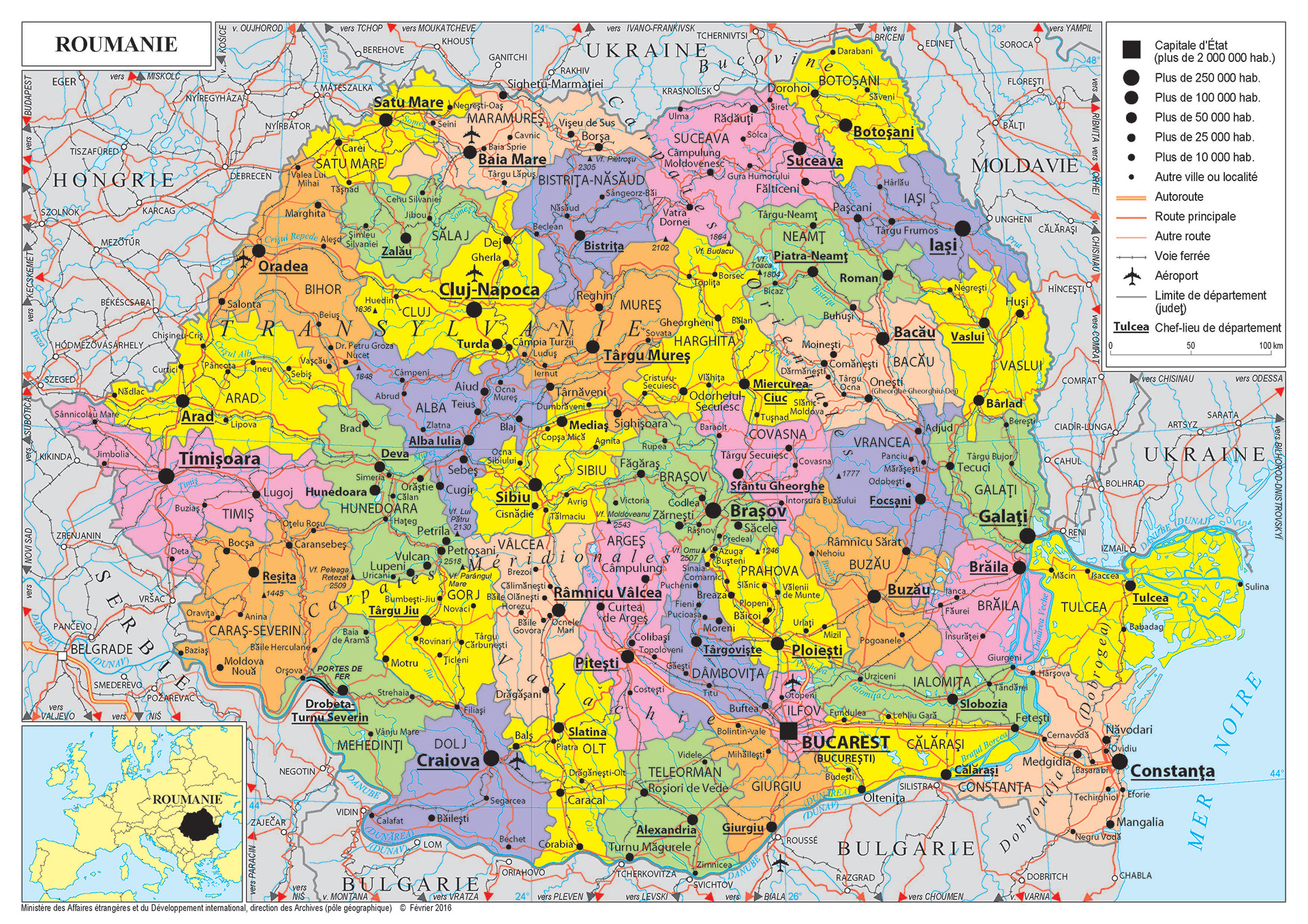
Area : 237,500 km²
Borders : 2,508 km; Bulgaria 608 km, Hungary 443 km, Moldova 450 km, Serbia 476 km, Ukraine (north) 362 km, Ukraine (east) 169 km
Coastline : 225 km
Capital : Bucharest
Official language : Romanian
Flag

Population
Population : 19,043,151 (2025)
Crude natural change rate : -7.4‰ (2022)
Population repartition: 15,4% under 15 years old, 20.3% of the total population (2024 est.)
Foreign residents: EU nationals 0.3%, non-EU nationals 0.3% (2019)
Crude net migration rate: 4.0Å 2024 est.
First time asylum applicants: 1 190 (2025)
Life expectancy: men 76.9 years, women 80.5 years (2024 est.)
Religions: Romanian Orthodox 85.3%, Roman Catholic 4.5%, Reformed 3%, Pentecostal 2.5%, other 4.7% (2021 est.)
Ethnic groups: Romanian 89.3%, Hungarian 6%, Roma 3.1%, Ukrainian 0.3%, German 0.1%, other 0.9% (2021 est.)
Source : Eurostat, CIA World Factbook, National institute of Statistics
Economy
Currency: the leu (RON) (exchange rate December 2025: 1€ = 5.08 RON)
GDP: € 380.058 billion (2024)
GDP per capita (PPS): € 13,130 (2024)
GDP growth : 0.7% (2024)
Inflation: 6.1 % (March 2026)
Public debt: 59.30% of GDP (December 2024)
Unemployment: 9.9 % (March 2026)
Budget balance: -7.90% of GDP (2025)
Source : Eurostat, European Commission, National Bank of Romania, Trading Economics
Political system
Republic, semi-presidential regime (Constitution passed by referendum December 8th 1991).
Head of State: Nicușor Dan (proeuropean centrist) won the presidential election on 18 May 2025 and took office on 26 May. The president is elected by diurect universal suffrage for 5 years, renewable once.
Prime Minister: Ilie Bolojan (caretaker government).
Romania is a bicameral parliamentary system which includes a House of Deputies (Camera Deputatilor) and a Senate: Deputies (330 seats) and senators (136 seats) are elected for four years by direct universal suffrage according to proportional representation. A 5% threshold must be reached.
Political representation
Composition of the Chamber of Deputies (since December 2024):
- 91 seats PSD (Social Democratic Party)
- 62 seats AUR (Alliance for the Unity of Romanians)
- 54 seats PNL (National Liberal Party)
- 40 seats USR (Save Romania Union)
- 21 seats UDMR (Democratic Alliance of Hungarians in Romania)
- 17 seats reserved for ethnic minorities
- 17 seats UPR (Union for Romania)
- 15 seats non-attached
- 13 seats S.O.S Romania (far-right)
Composition of the Senate (in December 2024):
- 38 seats PSD (Social Democratic Party)
- 28 seats AUR (Alliance for the unity of Romanians)
- 22 seats PNL (National Liberal Party)
- 19 seats USR (Save Romania Union)
- 11 seats PEACE - Romania First
- 10 seats S.O.S Romania (far-right)
- 10 seats UDMR (Democratic Alliance of Hungarians in Romania
- 6 seats Non-attached
- 2 seats vacant
Women's representations
- in the government: 3/13
- in the House of Deputies: 75/331
- in the Senate: 28/133
Next Elections:
On The Same Theme
Country Sheet
Country Sheet
Country Sheet
Country Sheet
Country Sheet

Country Sheet
Country Sheet

Country Sheet