News
Corinne Deloy,
Helen Levy,
Fondation Robert Schuman
-

Available versions :
EN

Corinne Deloy

Helen Levy
Researcher at the Robert Schuman Foundation
Fondation Robert Schuman
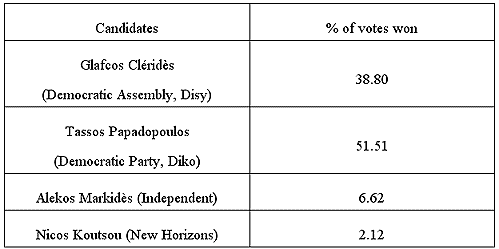
The leader of Diko, who was declared favourite by the opinion polls and had the support of the three opposition parties; Akel (Progressive Workers Party), Diko (Democratic Party) and Kisos (Social Democrat Party), asserted himself during the first round of the presidential election in Cyprus winning 51.51% of the vote. Tassos Papadopoulos took the lead over the outgoing President Glafcos Cléridès (Democratic Assembly, Disy) who won 38.80% of the vote; this was a result that was slightly higher than the one forecast by the pre-election opinion polls. Alekos Markidès, who is a public prosecutor, the outgoing President's right-hand man and a Disy member, but who stood as an independent candidate, came third winning 6.62% of the vote; the leader of New Horizons, Nicos Koutsou, won 2.12% of the vote. The seven other candidates included a lawyer, a farmer, a draughtsman, a businessman and a defender of the free love did not manage to transcend the 1% mark.
"Cypriots have told us what they want. They voted for change and have given me a mandate. I would like to ensure that this government will be one of union," declared the new President on the announcement of the results, adding that he wanted to be the "President for all Cypriots". The leader of the Democratic Party had focussed his campaign on the island's domestic problems, accusing the outgoing President of only being interested in the country's reunification of the island. Glafcos Cléridès immediately acknowledged his defeat and call Tassos Papadopoulos to wish him "good luck". The outgoing President also published a press release in which he gave the Democratic Party leader permission to assume his functions officially on 1st March and to take up the torch in the negotiations for the UN peace plan with the Turkish Cypriots.
Tassos Papadopoulos, a 69 year old lawyer was one of the four MP's (on the Greek Cypriot side) who wrote the draft Constitution for a future reunified Cyprus. Previously he was Home Secretary, as well as Finance, Health and Agriculture Minister for several governments. He is thought of as being more intransigent than Glafcos Cléridès in terms of reunification but Tassos Papadopoulos wanted to be reassuring : "I would like to send a message to the Turkish Cypriots for them not to believe my critics who say that I am in favour of inequality and division," adding that he did indeed want to modify the UN peace plan in order to resolve the island's division, his aim being to "lead a united island within Europe and to negotiate a better plan that would be feasible and functional." The Democratic Party leader would like a greater number of Greek Cypriots to be able to return to the Turkish part of the island. He is also in favour of a freer movement between the two parts of the island. But to date Rauf Denktash is still against the present UN plan demanding the diplomatic recognition of the Turkish part of the island (officially recognised by Turkey only) as a preliminary condition to the establishment of a federation between the two parts of the country.
Because of the divergent vote on the right, Glafcos Cléridès has ended his political career in personal failure. The election of Tassos Papadopoulos to the Presidency of the Republic of Cyprus was greeted with pessimism by the Turkish Cypriot authorities: "It is the intransigent position of the Greek Cypriot population that has won," declared Rauf Denktash. Just one week before Kofi Annan, Secretary General to the UN visits the island and just two weeks before the UN deadline for the acceptance of the peace plan (28th February), the perspective of seeing the island of Cyprus reunited before integrating the EU still appears to be as difficult as ever.
Results of the first round of the presidential election 16th February:
It is obligatory to vote in Cyprus
 Source AFP
Seven other candidates did not manage to go beyond the 1% mark and are not featured in the results.
On the same theme
To go further
Elections in Europe

Helen Levy
—
13 October 2026
Elections in Europe

Helen Levy
—
6 October 2026
Elections in Europe

Helen Levy
—
15 September 2026
Elections in Europe
Helen Levy
—
15 September 2026
The Letter
Schuman
European news of the week
Unique in its genre, with its 200,000 subscribers and its editions in 6 languages (French, English, German, Spanish, Polish and Ukrainian), it has brought to you, for 15 years, a summary of European news, more needed now than ever
Versions :