
Results
News
Corinne Deloy,
Helen Levy
-

Available versions :
EN

Corinne Deloy

Helen Levy
Researcher at the Robert Schuman Foundation
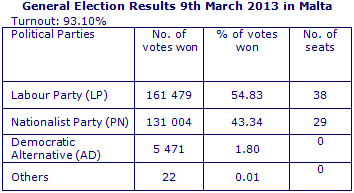
The Labour Party (LP), led by Joseph Muscat, achieved a landslide victory in the general elections that took place on 9th March in Malta. It won 54.83% of the vote and 38 seats in the Chamber of Representatives (Il-Kamra Tad-Deputati), the only chamber in Parliament (ie +4 in comparison with the previous election on 8th March 2008). This is the biggest majority ever won by a party since the country's independence in 1964. It came out ahead of the Nationalist Party (PN) of outgoing Prime Minister, Lawrence Gonzi which won 43.34% of the vote and 29 seats (- 6).
Democratic Alternative (AD), an ecologist party led by Michael Briguglio, which put nine candidates forward in the general elections, won 1.8% of the vote, the highest score ever achieved by the party but not enough to be represented in Parliament.
Turnout, which is high in Malta, lay at 93.10%, which was almost the same as the rate recorded in the last general election in March 2008 (0.20 points less).
"I was not expecting such an overwhelming victory for the Labour Party," declared the Labour leader, Joseph Muscat when the results were released. "The sun did not just rise on one half of Malta but over the entire archipelago, for those who voted for change and for those who didn't," he added after demanding during his entire campaign for the end of "tribal politics" - taking up the slogan Malta Taghna Llkoll (Malte for All).
"The Maltese chose to reject the policy of the past. It is the message that they have sent and that we have to bear in mind. Our goal is to show that there is another way of life," said Joseph Muscat. During his campaign he promised to reduce electricity tariffs by 25% and those set on water by 5% as of 1st March 2014 (the prices of both of these utilities are then to be set for the next ten years) and to build a new gas power station with the use of private capital to a total of 425 million €. Joseph Muscat has said that he will resign if he does not manage to implement these two measures over the next two years. He has also promised to reduce income tax and to counter corruption.
Lawrence Gonzi, who as running for a third mandate as the head of government, acknowledged defeat. "I personally take all the blame for this result and I shall not try to be re-elected when the party chooses to take a new direction," he indicated.
Aged 39 years and from Pieta, Joseph Muscat will become the second youngest Prime Minister in Malta's history. A graduate of public policy, European studies and literature he started his career as a journalist on the radio and then in the written press. Elected MEP during the June 2004 elections he left his seat four years later after being elected to lead the Labour Party following the defeat of his party in the general elections in March 2008 (with 66% of the vote he ran ahead of George Abela, who is now the President of the Republic of Malta). In 2008 Joseph Muscat replaced Joseph Cuschieri in Parliament and became the opposition leader. "The most important moment is the approval of the budget. We shall work together with the opposition and with those who did not vote for our party because it is in the interest of our country," stressed the future Prime Minister.
On the same theme
To go further
Elections in Europe

Helen Levy
—
6 October 2026
Elections in Europe

Helen Levy
—
15 September 2026
Elections in Europe
Helen Levy
—
15 September 2026
Elections in Europe
Helen Levy
—
8 September 2026

The Letter
Schuman
European news of the week
Unique in its genre, with its 200,000 subscribers and its editions in 6 languages (French, English, German, Spanish, Polish and Ukrainian), it has brought to you, for 15 years, a summary of European news, more needed now than ever
Versions :