Results
Democracy and citizenship
Corinne Deloy
-

Available versions :
EN

Corinne Deloy
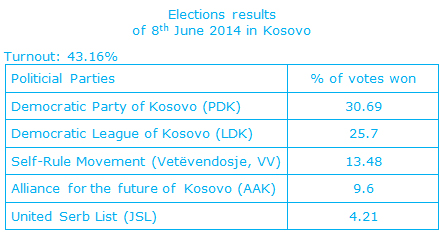
The Democratic Party led by outgoing Prime Minister Hashim Thaçi won the early elections on 8th June in Kosovo. It won 30.69% of the vote just a few points ahead of the Democratic league (LDK) led by former Mayor of Pristina (2007-2014), Isa Mustafa, which won 25.7% of the vote.
With 13.48% of the vote the Self-Rule Movement (Vetëvendosja, VV), a left-wing party led by Albin Kurti, failed to disrupt the country's political system as it had promised to do. It came out ahead of the Alliance for the Future of Kosovo (AAK), led by former Prime Minister (2004-2005) and former leader of the Kosovo Liberation Army (UCK) Ramush Haradinaj (who is at present in prison in the Hague and under prosecution for war crimes by the International Criminal Tribunal for Former Yugoslavia (ICTY) - it won 9.6% of the vote.
Representing the Serb minority of Kosovo (10 000 out of a total population of 1.8 million), the United Serb List (JLS) won 4.21% of the vote.
Turnout totalled 43.16%, ie -5.5 points in comparison with the previous general elections on 12th December 2010.
The Serb authorities had called on Kosovo Serbs to go and vote. "Voting in the elections is a patriotic duty for each Serb citizen living in Kosovo," declared the government in Belgrade. "Voting on the part of the Serb community is important and this will have a positive impact on the implementation of the Brussels agreement," indicated Behlul Beqaj, political science professor in Pristina - he believes that the minorities' representatives (Serbs and others) may find themselves popular after the elections amongst the leaders of the main parties who will be looking for allies in order to form a majority.
The Brussels agreement was signed by Pristina and Belgrade on 13th April 2013. It marks the start of a rapprochement between the two countries. It should be noted that the Serb authorities have not yet acknowledged Kosovo's independence.
"Tonight Kosovo won. Tomorrow we shall start work; we shall show the world that gaining independence was just the beginning of our history," declared outgoing head of government Hashim Thaçi when the results were announced. "People and parties in our country have shown that democracy is a reality in Kosovo," he stressed adding: "We shall continue to work for the country's development."
The Democratic Party will need to find partners if it wants to continue governing the country. The other parties however have ruled out any agreement with the outgoing Prime Minister. Again the MPs representing the national minorities may be especially popular, notably the United Serb List (JSL). Some analysts have spoken of a possible grand coalition between the Democratic Party and the Democratic League led by Hashim Daçi and Isa Mustafa respectively.
Whoever the participants the future Kosovar government will have a great many challenges to overcome within the next four years. The country is facing a serious economic crisis. Unemployment totals 35% and poverty affects 47% of the population. The executive will also have to overcome - quickly and effectively - corruption and organised crime which is undermining society.
On the same theme
To go further
Elections in Europe

Helen Levy
—
6 October 2026
Elections in Europe

Helen Levy
—
15 September 2026
Elections in Europe
Helen Levy
—
15 September 2026
Elections in Europe
Helen Levy
—
8 September 2026

The Letter
Schuman
European news of the week
Unique in its genre, with its 200,000 subscribers and its editions in 6 languages (French, English, German, Spanish, Polish and Ukrainian), it has brought to you, for 15 years, a summary of European news, more needed now than ever
Versions :