
Results
Elections in Europe
Corinne Deloy
-

Available versions :
EN

Corinne Deloy
Former Prime Minister (2011-2016) Zoran Milanovic (Social Democratic Party, SDP), supported by the Labour Party, the Istrian Democratic Party (IDS) and the Liberal Civil Alliance (GLAS), came out ahead in the first round of the presidential election held on 22nd December in Croatia. He won 29.55% of the vote and beat outgoing President Kolinda Grabar-Kitarovic, who was standing as an independent candidate but is supported by the Croatian Democratic Union (HDZ). She obtained 26.65% of the vote.
The two candidates will therefore face each other in a second round of voting on 5th January 2020.
Croats living abroad, who could fulfil their civic duty in 47 countries, voted in favour of the outgoing Head of State by granting her 53.43% of the votes. In this community, Miroslav Skoro (independent), a singer supported by populist right-wing groups, took second place with 35.18% of the vote, while Zoran Milanovic received only 5.78%.
Miroslav Skoro came third with 24.45% of the vote. Although he did not succeed in his wager to reach the second round, he nevertheless achieved a high result which demonstrates the strength, if not the thrust, of the populist discourse in Croatia.
Mislav Kolakusic (independent), a former judge and MEP, received 5.87% of the vote and Milan Bandic (Bandic Milan 365-Party of Labour and Solidarity), received 4.61% of the votes.
The other six candidates in this election each received less than 3% of the votes.
Turnout was higher than in the first round of the previous presidential election on 28th December 2014 (+4.08 points). Turnout was 51.2%.
Results of the first round of the Croatian presidential election of 22nd December 2019
Turnout: 51.20%
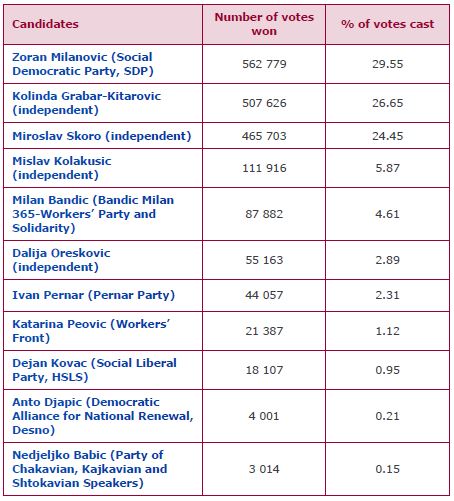
Source : https://www.izbori.hr/pre2019/rezultati/1
Patriotism, the defence of traditional family values and a strong Croatia at the heart of Europe are the three main points of Kolinda Grabar-Kitarovic's programme. The outgoing Head of State started with a strong lead in opinion polls on the launch of the election campaign but, as the weeks went by, she lost a lot of ground and was finally edged out by Zoran Milanovic in the ballot on 22nd December. Indeed, she tried to rally the most moderate members of her party as well as the most fervent nationalists, an almost impossible task. During her campaign, she paid tribute to General Slobodan Praljak, who committed suicide on 29 November 2017 by taking poison on his conviction by the International Criminal Tribunal for the former Yugoslavia (ICTY) for war crimes and crimes against humanity during the war in Bosnia-Herzegovina. Kolinda Grabar-Kitarovic also said that if re-elected as head of the country, she would grant a pardon to General Tomislav Mercep, under whose command 43 civilians, mostly Serbs, were killed in 1991. The military leader was sentenced to five and a half years' imprisonment for this crime. In February 2017, on appeal by the prosecutor's office, the Supreme Court of Croatia extended his prison sentence to seven years.
For his part, Zoran Milanovic gathered together supporters on the left. He pledged to make Croatia a "normal country" with an independent judiciary that respects minorities.
The votes cast for Miroslav Skoro are therefore now at stake in the second round of voting. Defeat for Kolinda Grabar-Kitarovic on 5th January would be bad news for Prime Minister Andrej Plenkovic (HDZ), who will no doubt lead his party's list in the next parliamentary elections scheduled for autumn 2020.
"Unlike Zoran Milanovic, I had an associate candidate. Now we must all unite and win," the outgoing head of State was quick to say after the announcement of the results of the first round, referring to Miroslav Skoro.
"Croatia is moving to the right, we see it in this presidential election. As elsewhere in Europe, the radical right is showing its strength in the country. We will see if it is able to repeat this performance in the next parliamentary elections," said Tihomir Cipek, professor of political science at the University of the capital Zagreb.
On the same theme
To go further
Elections in Europe

Helen Levy
—
13 October 2026
Elections in Europe

Helen Levy
—
6 October 2026
Elections in Europe

Helen Levy
—
15 September 2026
Elections in Europe
Helen Levy
—
15 September 2026

The Letter
Schuman
European news of the week
Unique in its genre, with its 200,000 subscribers and its editions in 6 languages (French, English, German, Spanish, Polish and Ukrainian), it has brought to you, for 15 years, a summary of European news, more needed now than ever
Versions :