
Results
Elections in Europe
Helen Levy
-

Available versions :
EN

Helen Levy
Researcher at the Robert Schuman Foundation
In the first round of the Bulgarian presidential election on 25 October, the incumbent president, Iliana Iotova – who has held office since January last following the resignation of Rumen Radev, who became Prime Minister – narrowly took the lead with 34.76% of the vote, ahead of the former Prime Minister (February–May 2026) Andrey Gyurov, who secured 31.95%. This lead is significantly smaller than pre-election polls had predicted. A second round pitting these two candidates will take place on 1 November, and the contest is set to be much closer than anticipated.
This result reflects two different approaches to relations with Russia, support for Ukraine and the drone attacks on merchant ships in the Black Sea. Iliana Iotova, aged 62, advocates closer dialogue with Russia and the pursuit of a peaceful, diplomatic resolution to the conflict in Ukraine. However, neither Radev nor Iotova has so far accused Russia of being responsible for the repeated attacks on merchant ships in the Black Sea, even as the fighting appears to be spreading beyond the borders of Russia and Ukraine and bringing the war closer to the Bulgarian coast.
Andrey Gyurov, aged 50, backed by a trio of reformist parties – Democrats for a Strong Bulgaria, Yes Bulgaria and We Continue the Change – stands out for his approach to the war between Russia and Ukraine, aligning more closely with the position of his European partners by demanding that Ukraine’s borders be restored to their pre-2022 status.
During his brief tenure as Prime Minister, he signed a cooperation agreement with Kyiv. Andrey Gyurov has clearly condemned the attacks on ships in the Black Sea. It appears that his aim is to assert Bulgaria’s position as a stable European country, where the presidency is more impartial and transparent, and which protects the interests of the population. Andrey Gyurov wants “a Bulgaria looking to the future, a free and proud European country, where incomes are sufficiently high, where we feel secure about the future, and where the state functions as it should.”
GERB, the main opposition party led by Boyko Borisov, has decided not to field a candidate in this election and is refusing to issue instructions to voters for the second round, stating that everyone is free to form their own opinion. However, the absence of a candidate from this party could explain the extremely low turnout: 22 per cent, in other words, 1,521,039 voters. Could this also reflect the public’s rejection of the political class and their lack of confidence in the democratic system?
Will the second round on 1 November succeed in attracting new voters, given the diplomatic and economic challenges facing the country? The two candidates have less than a week to convince Bulgarians of the country’s political and European direction.
Results of the first round of the Bulgarian presidential election on 25 October 2026
Turnout: 22%
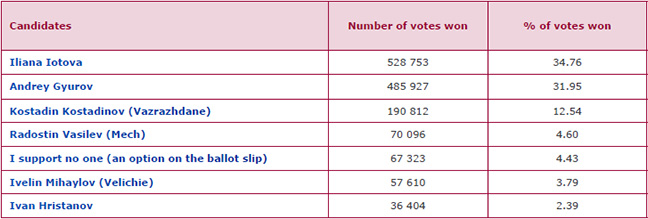
Source : https://results.cik.bg/pvr202610/rezultati/index.html
On the same theme
To go further
Elections in Europe
Helen Levy
—
13 October 2026
Elections in Europe

Helen Levy
—
6 October 2026
Elections in Europe

Helen Levy
—
15 September 2026
Elections in Europe
Helen Levy
—
15 September 2026

The Letter
Schuman
European news of the week
Unique in its genre, with its 200,000 subscribers and its editions in 6 languages (French, English, German, Spanish, Polish and Ukrainian), it has brought to you, for 15 years, a summary of European news, more needed now than ever
Versions :