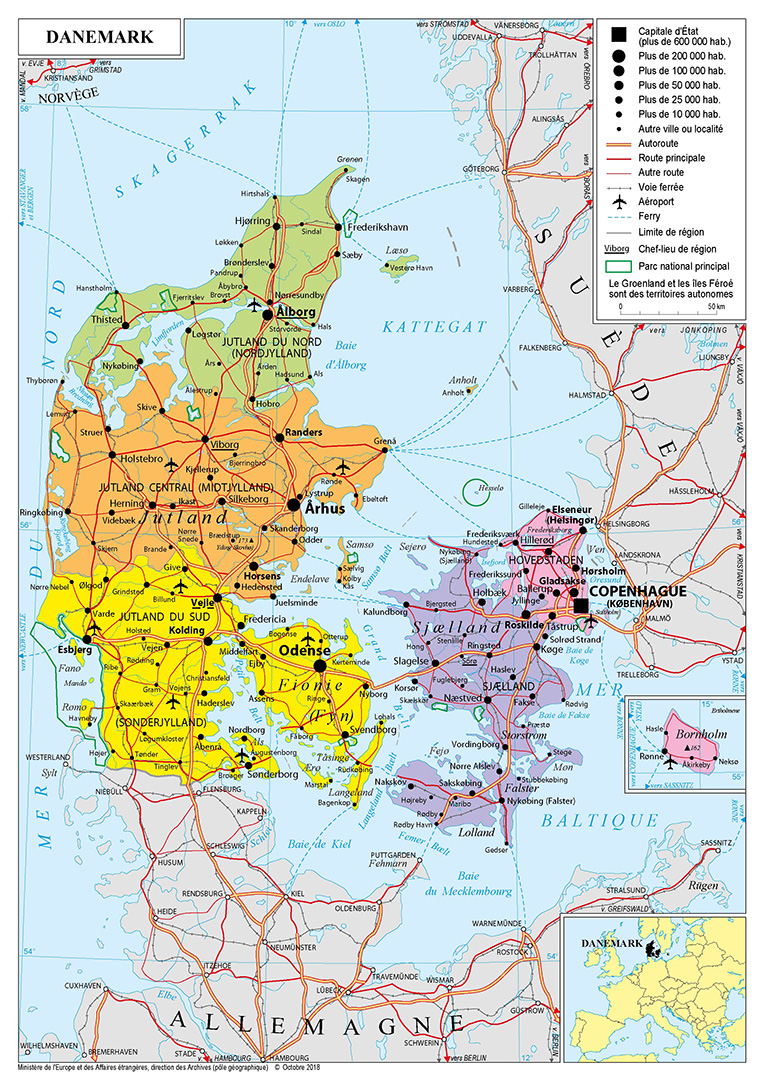
Geography
Area : 43,094 km²
Borders : 68 km (with Germany)
Coastline : 7,314 km
Capital : Copenhagen
Official language : Danish
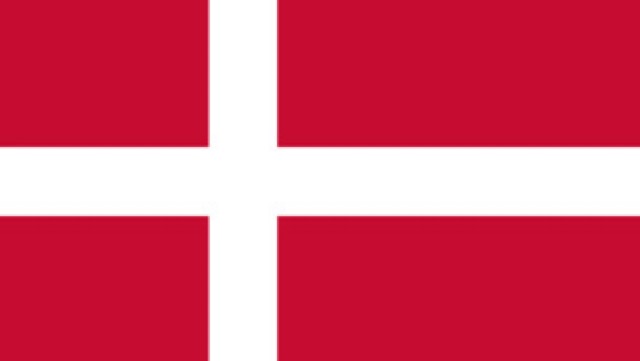
Flag
Population
Population : 5,992,734 inhabitants (2025)
Crude natural change rate : 0‰ (2024)
Population repartition: 15.5% under 15 years old, 20.4% over 65 years old (est. 2025)
Foreign residents: EU nationals 4.6%, non-EU nationals 9.4% (2024)
Crude net migration rate: 5,3‰ (2024)
First time asylum applicants: 1 920 (2025)
Life expectancy: men 80.2 years, women 83.9 years (2024)
Religions: Evangelical Lutheran 74.7%, Muslim 5.5%, other/none/unspecified 19.8% (2019 est.)
Ethnic groups: Danish 84.2%, Turkish 1.1%, others 14.7% (of which Poles, Syrians, Romanians, Germans, Iraqis) (2023 est.)
Source : Eurostat, The CIA World Factbook
Economy
Currency: Danish Crown (DKK) (exchange rate in December 2025: 1 € = 7.47 DKK)
GDP: € 410.37 billion (2025)
GDP per capita (PPS): € 68,310 (2025)
GDP growth : 2.9% (Q4 2025)
Inflation: 0.5% (February 2026)
Public debt: 30.5% of GDP (December 2025)
Unemployment: 7.5% (January 2026)
Stock of foreign direct investment from the entire world: 45.5% of GDP (2024)
Budget balance: 2.7% of GDP (March 2025)
Source : Eurostat, OECD, European Commission, Trading Economics
Political system
Constitutional monarchy, unicameral democratic parliament.
Head of State: King Frederik X since 14th January 2024
Prime Minister: Mette Frederiksen (Social Democratic Party) has been Prime Minister since june 26 2019. She succeeded in forming a coalition with the Socialist People's Party (SF), the Social Liberal Party (RV), and the Moderates (M), although without obtaining an absolute majority (82 seats out of 179).
The Folketing (“The People’s Assembly”) comprises 179 representatives, elected by direct universal suffrage for four years. The Faroe Islands and Greenland are each represented by two representatives.
Political representation
Composition of the Folketing (in March 2026):
- 38 seats SD (Social Democrats)
- 20 seats F (Green Left)
- 18 seats V (Liberals Venstre)
- 16 seats I (Liberal Alliance)
- 16 seats Ø (Red-Green Alliance)
- 14 seats M (Moderates)
- 13 seats C (Conservative People's Party)
- 11 seats (List of Unity) Red-Green Alliance
- 10 seats AE (Denmark Democrats)
- 10 seats B (Danish Social-Liberal Party)
- 5 seats Å (The Alternative)
- 5 seats H (Civic Party, populist)
Women's representations
- in the government: 11/21
- in the Folketing: 86/179
Next Elections:
On The Same Theme
Country Sheet
Country Sheet
Country Sheet
Country Sheet
Country Sheet
Country Sheet
Country Sheet
Country Sheet