Analysis
Elections in Europe
Helen Levy
-

Available versions :
EN
Helen Levy
Researcher at the Robert Schuman Foundation
In keeping with tradition, nearly 7.7 million Swedes will go to the polls on 13 September – the second weekend of the month – to elect the 349 members of the Riksdag, the single chamber of Parliament, as well as all their local representatives: councillors for the local assemblies of the 20 counties and councillors for the 290 municipalities. Voter turnout is likely to be high, given that issues such as crime, immigration and the economy are at the top of Swedes’ list of concerns.
What has changed since 2022?
In the last elections in September 2022, the centre-right parties (the Moderates, the Christian Democrats and the Liberals) failed to secure enough votes to counterbalance the Social Democrats. However, in a break with Swedish political tradition, they decided to bypass the ‘cordon sanitaire’ and formed an alliance with the Sweden Democrats (though the latter did not participate in the government) to form a minority government led by Ulf Kristersson. Indeed, until 2018, the Moderates, the Christian Democrats and the Liberals had had to rely on the uncertain support of the Sweden Democrats to get their programme passed. In 2022, they signed the Tidö Agreement, named after the castle where it was signed, to form an alliance centred on ‘cooperation and support’. This gave the Sweden Democrats greater influence over government policy and decision-making. The promise was to implement a programme of reforms, focusing on immigration and public order, but also on the climate, health and the economy.
An improved economic situation
Since 2022, the Swedish economy has seen a slight recovery. For the period 2026–2027, GDP is forecast to grow by 2 per cent. Inflation has fallen; according to Eurostat, it stood at 0.3 per cent in July 2026, compared with 3.1 per cent a year earlier. On 31 August, the European Commission gave the green light to Sweden’s request for final payment, as the country had completed 100 per cent of its investments and reforms linked to its Recovery and Resilience Plan, just behind Denmark.
The country’s fiscal policy focuses on tax cuts and increased public spending, particularly in the defence sector. This latest measure is in line with that of many other European Union Member States, due to the war in Ukraine and the desire to protect against any threat from the aggressor, Russia, whether in the form of a physical invasion or hybrid interference.
One of the most significant events during this parliamentary term was on 7 March 2024, when Sweden became a full member of NATO, following in Finland’s footsteps (4 April 2023) and thus bringing to an end a tradition of neutrality dating back nearly 200 years (following long-standing opposition from Hungary and Turkey).
A more assertive policy on migration and the fight against crime
As for Ulf Kristersson’s successes in curbing immigration, tackling organised crime and tightening the social benefits available to foreign residents in Sweden, his government has faced criticism from all sides. According to conservative voters, the reforms have not been strict enough, whilst the left is concerned about the weakening of human rights standards and rising levels of discrimination.
The number of asylum seekers entering Sweden and being granted refugee status, or a residence permit has fallen dramatically, continuing a trend initiated by the Social Democrats following the immigration peak of 2015–2016. Incentives to leave or return home, in the form of cash payments of up to €26,855, have led to emigration outpacing immigration in recent years. In 2024, for the first time since 1997, the number of people entering Sweden reached its lowest level on record.
The crime rate has fallen sharply since 2022, reaching its lowest level on record in 2025, whilst the number of homicides fell to its lowest level since 2012, totalling 84 in 2025. This success has been attributed to a combination of new policing strategies introduced by the government, increased use of technology and enhanced powers granted to law enforcement agencies, which have made it possible to tackle gang-related crime more effectively. However, Amnesty International and the UNHCR have warned of potential human rights violations and the erosion of freedom of expression, with a resurgence of hate speech, discrimination and harassment. In March 2026, the UN warned that “civil society organisations are facing increasing bureaucratic demands, whilst funding for human rights activities has declined”.
An about turn regarding the environment
Another area in which Sweden appears to have changed course is its environmental protection policy. A long-standing pioneer, at the forefront of environmental protection measures and an advocate for stricter laws at both national and international levels, Sweden is now accused of reneging on its historic commitment to lead the way on environmental protection. The government claims it is seeking to strike a balance between environmental policies, sustainability and the economy. Although its policies still set targets aimed at achieving carbon neutrality, these have now been pushed back from 2030 to 2045. The German Climate Change Performance Index saw Sweden drop to 13th place globally in 2025. The OECD warned in March 2025 of dangerous trends that are undermining the country’s climate agenda.
How will the Swedes vote on 13 September?
Will they provide enough votes for the current coalition, thereby endorsing the government’s approach over the past four years? Or will they choose to return to a social-democratic tradition? Will the Sweden Democrats win enough votes to be in contention for a place in the next government?
In a highly fragmented political landscape, can the opposition centred on the Social Democratic Party bring together the Left Party, the Centre Party and the Green Party to form an alternative majority? It should be noted that 175 seats are required to secure an absolute majority.
More moderate voters may not want the Sweden Democrats to wield greater power than they have enjoyed over the past four years.
According to the latest polls published on 1st September, the Social Democrats (Socialdemokraterna) are set to lead with 29.2% of the vote, followed by the Sweden Democrats (Sverigedemokraterna), a far-right populist party, with 18.9%. The Moderate Party (Moderaterna), the main party in government, is projected to come in third place with 16.4 per cent of the vote. Next would come the Left Party (Vänsterpartiet) with 8.1 per cent, the Green Party (Miljöpartiet) with 8 per cent, the Centre Party (Centerpartiet) with 7.4 per cent and the Christian Democrats (Kristdemokraterna) with 6.3 per cent.
Notably, the Liberal Party, a member of the governing coalition, is polling at just 3 per cent, which would mean it would not be represented in Parliament as this is below the mandatory 4 per cent threshold.
If the polls prove accurate, the outgoing coalition government (Moderate Party, Christian Democrats, Liberals), supported by the Sweden Democrats, may fail to secure a majority. Conversely, the four opposition parties, if they are able to form a coalition, could secure a victory.
The Swedish Political System
Sweden has a unicameral parliament, the Riksdag, comprising 349 members elected every four years by proportional representation. The country is divided into 29 constituencies (one per county, with those of Stockholm, Skåne and Västra Götaland being subdivided), which elect 310 members of parliament (an average of 11, ranging from 2 to 43 per constituency). Votes are allocated using the modified Sainte-Laguë method, with an initial divisor of 1.4.
The remaining 39 seats, known as ‘compensatory seats’, are distributed amongst the various parties to ensure the most accurate representation possible of the national vote. The candidates elected to these compensatory seats are those whose party has the largest remainder across the constituencies. To be eligible for the allocation of these compensatory seats, a party must have obtained 4 per cent of the valid votes cast at national level or 12 per cent in a given constituency.
The Swedish parliamentary system, unlike that of France or the United Kingdom, for example, where a first-past-the-post system applies, operates in such a way that a bloc securing a majority of seats in Parliament (the majority, and therefore the threshold to be reached in this case, is 175 seats) should be in a position to pass a budget. Of course, it is essential for the government to secure a majority in order to achieve its objectives, but in Sweden, this is achieved through ‘formal agreements, budgetary cooperation or case-by-case negotiations’. On 13 September, it will be important to monitor which parties exceed the 4 per cent threshold and to see which bloc – left or right – comes close to or reaches the 175-seat threshold.
People can vote for a party or cast a preferential vote for one of the candidates on the lists put forward by the parties, thereby influencing the allocation of seats. During the count, the number of seats won by each party is determined, after which the candidates on each list who have received the highest number of votes in their own right are declared elected. In general elections, voters can fulfil their civic duty by post at any post office in the country during the 18 days leading up to polling day, a period which therefore began on 26 August. They may subsequently cancel their postal vote by going to a polling station on polling day. Norwegians and Icelanders who have been registered as residents in Sweden for at least three consecutive years, as well as citizens of the 26 other Member States of the European Union, are entitled to vote in local elections.
Eight parties are represented in the current Riksdag:
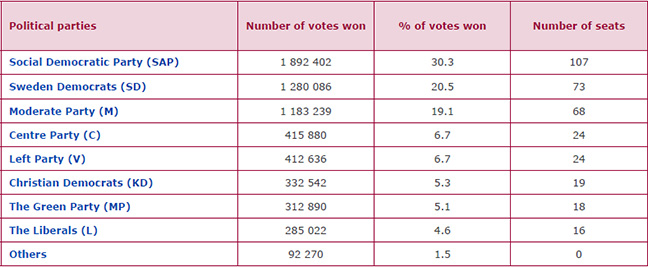
- The Social Democratic Party (SAP), founded in 1889 and led by Magdalena Andersson since November 2021, has played a leading role in Swedish politics for over 70 years. It has 107 elected members;
- the Sweden Democrats (SD), a right-wing populist party founded in 1988 and led by Jimmie Akesson, hold 73 seats;
- the Moderate Party (M), a centre-right party founded in 1904 and led by the current Prime Minister, Ulf Kristersson, holds 68 seats;
- the Centre Party (C), a former agrarian party founded in 1913 and led by Annie Lööf since 2011, holds 24 seats;
- the Left Party (V), a radical left-wing party led since 2012 by Nooshi Dadgostar, holds 24 seats;
- the Christian Democrats (KD), founded in 1964 and led by Ebba Busch Thor, hold 19 seats;
- the Environmental Party – The Greens (MP), founded in 1981 and represented by its spokespersons Per Bolund and Märta Stenevi, holds 18 seats;
- the Liberals (L), founded in 1934 and led by Johan Pehrson, hold 16 seats.
Results of the Swedish general election on 11 September 2022
Turnout: 80.62 %
Source : https://www.val.se/valresultat-och-statistik/riksdags--region--och-kommunval/valresultat-2022
On the same theme
To go further
Elections in Europe

Helen Levy
—
13 October 2026
Elections in Europe

Helen Levy
—
6 October 2026
Elections in Europe
Helen Levy
—
15 September 2026
Elections in Europe
Helen Levy
—
15 September 2026
The Letter
Schuman
European news of the week
Unique in its genre, with its 200,000 subscribers and its editions in 6 languages (French, English, German, Spanish, Polish and Ukrainian), it has brought to you, for 15 years, a summary of European news, more needed now than ever
Versions :