Results
Elections in Europe
Helen Levy
-

Available versions :
EN

Helen Levy
Researcher at the Robert Schuman Foundation
According to still provisional results, the Social Democratic Party (S), led by Magdalena Andersson, came out on top in Sweden’s general election on 13 September, securing 28.1 % of the vote (down 2 % on the previous election in 2022). As the votes were counted, it became clear that the Social Democrats, whilst remaining Sweden’s largest party, had achieved a historically low result. Together with the three other opposition parties (the Left Party, the Green Party and the Centre Party), they appear set to secure one more seat (176) than the absolute majority (175 seats) and win the election, the results of which are extremely close, with the ruling right-wing bloc holding 173 seats.
During the campaign, the right-wing coalition seemed convinced it could remain in power as the gap was narrowing with their rivals. Now, the future of Prime Minister Ulf Kristersson (M), as well as that of the Sweden Democrats (SD), a right-wing populist party, is more uncertain. The SD, which had finished in second place in 2022, came third this time round 17.2 %, (down 3 %), trailing the Moderate Party (M), which garnered 19.9 %. The Liberals (L), after a period of concern during which the polls predicted they would not exceed 4%, finally managed to reach the 5 % threshold and will therefore hold seats in Parliament.
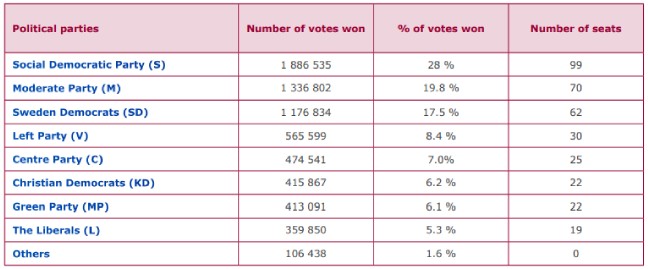
Eight parties will therefore be represented in the next Riksdag (single-chamber parliament):
- the Social Democrats (S) won 28 % (-2.3 %) and 99 seats,
- the Moderates (M) won 19.8 % (+0.7 %) and 70 seats,
- the Sweden Democrats (SD) secured 17.5 % (-3.1 %) and 62 seats,
- the Left Party (V), 8.4 % (+1.7 %) and 30 seats,
- the Centre Party (C), 7.0 % (+0.3 %) and 25 seats,
- the Christian Democrats (KD), with 6.2 % (+0.8 %) and 22 seats,
- the Green Party (MP), 6.1 % (+1.1 %) and 22 seats,
- and the Liberals (L), 5.3 % (+0.7 %) and 19 seats.
In the final days of the campaign, the gap between the left-wing and right-wing blocs narrowed considerably, even though observers had previously predicted that the Social Democrats would win by a margin of at least 5 %.
The Social Democrats ran a lacklustre campaign, promising to strengthen the welfare state and tackle energy and the cost of living head-on. Magdalena Andersson was criticised for lacking charisma and for failing to offer any solutions to counter the seemingly inexorable rise of radical right-wing forces. Following the results, she remained optimistic, ready to govern, and stated that the most important thing was to “set Sweden on a new course”.
The right-wing bloc, led by outgoing Prime Minister Ulf Kristersson, in an attempt to retain power, pledged to build on the achievements of the last parliamentary term, which was marked by a dramatic fall in crime and the lowest number of asylum applications ever recorded. But the Swedish electorate appears not to have wanted to give the Sweden Democrats as strong a position as they had in 2022; they are losing ground and have lost their position as the leading opposition party to the Moderates. However, this may not be their final word.
If the right-wing bloc is offered the opportunity to form a government with the parties that signed the Tidö Agreement, the process will be relatively straightforward. This time, however, the Sweden Democrats might demand ministerial posts, which Ulf Kristersson will find difficult to refuse.
If the left-wing bloc manages to form an alliance, it will have to overcome numerous differences in order to present a united front. This could prove difficult to achieve, as the Centre Party has pledged not to cooperate with the Left Party, and vice versa.
The final result is expected to be announced on 16 September, and things may still change between now and then. Negotiations are well under way but could take several weeks, or even months, before a stable government is formed.
Results of the Swedish general election on 13 September 2026
Turnout: 84.8 %
On the same theme
To go further
Elections in Europe

Helen Levy
—
13 October 2026
Elections in Europe

Helen Levy
—
6 October 2026
Elections in Europe
Helen Levy
—
15 September 2026
Elections in Europe
Helen Levy
—
8 September 2026
The Letter
Schuman
European news of the week
Unique in its genre, with its 200,000 subscribers and its editions in 6 languages (French, English, German, Spanish, Polish and Ukrainian), it has brought to you, for 15 years, a summary of European news, more needed now than ever
Versions :