Analysis
Elections in Europe
Helen Levy
-

Available versions :
EN

Helen Levy
Researcher at the Robert Schuman Foundation
On 3 October, around 1.5 million Latvians are set to elect the 100 members of the Saeima, the unicameral parliament. Fourteen lists, parties or coalitions are standing in this election, fielding a total of 1,428 candidates. The election will take place against a backdrop of political fragmentation and international turmoil, with the conflict between Russia and Ukraine still ongoing.
The ‘decline’ of New Unity
“New Unity” (JV) is a political alliance of five parties (Unity and four regional parties) founded in 2011, which has been part of the government since its inception. It has even led the government ever since (the Dombrovskis, Straujuma, Karins and Silina governments), except between 2016 and 2019 and since May 2026. It is the party that has held power for the longest period since 1991. However, since its election victory in 2022, ‘New Unity’ has been plagued by scandals and internal divisions and is now polling at just 8.9 per cent of voting intentions.
Following the 2018 general election, Krisjanis Karins (New Unity) was appointed Prime Minister. Four years later, he won the 2022 election but resigned in August 2023 due to conflicts within the coalition led by his party. Evika Siliņa succeeded him in September 2023. Recently, after dismissing the defence minister and criticising the slow roll-out of the country’s anti-drone defence system following multiple incursions by ‘Russian’ drones into Latvian airspace, she resigned on 28 May 2026. It should be noted that security is of paramount importance to Latvia and is a highly sensitive issue, as the country shares a direct border with Russia and Belarus, thus forming a frontier for both the European Union and NATO. This is one of the major issues in this election.
“New Unity” (JV) has certainly lost ground since these events, but remains part of the governing coalition. However, it was Andris Kulbergs (United List – AS) who was appointed Prime Minister following Evika Siliņa’s resignation. The United List is now leading in the polls (23.6 per cent). It comprises the Green Party, the Association of Regions and the Liepāja Party. Together, they form a movement that is at once regionalist, green and conservative.
The other parties in the running
According to the latest polls published in early September, the parties competing for seats that are scoring significantly in terms of voting intentions and are likely to be represented in the Saiema after 3 October are, in addition to AS and JV: Latvia First (LPV), a far-right party, is projected to secure 12.6 per cent; the National Alliance (NA), a conservative party, 11 per cent; the Progressives (social democrats and greens), 10.7 per cent; the Agrarian Union (ZZS), a green and liberal party, 10.4 per cent; and, finally, Sovereign Power/Young Latvians (SV/J), founded in 2022 and representing the Russian minority, 9.6 per cent.
These seven parties could therefore win seats in Parliament, as the electoral threshold is set at 5 per cent.
By contrast, all the other parties standing in this election are unlikely to reach this threshold and would therefore win no seats. These are: ‘We’re Changing the Rules’ (MMN), a centrist party, 3.3 per cent; ‘For the Development of Latvia’ (LA), a liberal party, 2.5 per cent; and ST! (For Stability), 2.5 per cent; Harmony (SC), a left-wing party, 1.7 per cent; the Association of New Latvians (ASL), a right-wing nationalist conservative party, 1.2 per cent; and the New Conservative Party (JKP), 0.7 per cent.
Although the United List is riding high, it cannot achieve an absolute majority alone, which stands at 51 seats, and will therefore need to find partners to form a government. The key question is which other parties it will form a coalition with and on what programme.
Key issues in the campaign
Defence
Firstly, given the regular incursions by drones into Latvian airspace, national security is a major concern for the public. Since his appointment in May, the Prime Minister has had extremely limited scope to reassure the public on this matter. The threat of a Russian incursion or interference is such that the government has invited the OSCE to observe this election.
Defence spending is closely linked to this issue. The new government’s task is to restore public confidence, despite the previous government’s massive investment in anti-drone systems and air defence. In 2026, Latvia is expected to spend €2 billion on the armed forces and defence, representing 4.91 per cent of gross domestic product (GDP). However, some in the business community fear that taxes may be raised to fund these ambitions. This issue could therefore influence the voting behaviour of a section of the electorate, as the cost of living and energy prices have risen significantly since Russia’s invasion of Ukraine.
The “Russian” question
Latvia, like Estonia, is home to a significant Russian minority, accounting for around 25 per cent of the total population of 1.89 million. Their integration has always been a challenge for Latvian society. Since independence in 1991, and particularly since the conflict between Ukraine and Russia, laws – sometimes deemed controversial – have been passed to restrict the use of the Russian language in education and the media. During elections, numerous Russian-speaking parties or those aligned with the Russian minority stand for election, such as SC or ST, but few are likely to win seats, with the exception of SV. The question that arises in light of the many laws recently passed is this: how will the Russian-speaking electorate, which has the right to vote, cast its vote? Will they once again opt for loyalty to Latvia – as seemed to be the case in the 2022 elections?
This question is crucial given the demographic picture: most parties emphasise one aspect of this issue in their manifestos, proposing solutions to remedy a critical national situation. Indeed, since independence in 1991, the country has ‘lost’ 780,000 citizens (10 per cent of the population). Some Russians living in the country are classified as ‘non-citizens’ because they do not speak Latvian. Some officials advocate moderate immigration alongside generous family-friendly policies – but the problem of young people (the diaspora numbers 370,000) leaving to seek better prospects elsewhere in the European Union or further afield will not be overlooked by any of the candidates in this election. One constant theme runs through it all: how can Latvia be made attractive again?
Seven parties are currently represented in the Saeima:
- New Unity (JV), a centre-right party led by Evika Siliņa, holds 24 seats
- Union of Greens and Farmers (ZZS), led by Edgars Tavars but founded by the former mayor of Ventspils, Aivars Lembergs, holds 16 seats
- The United List (AS), led by Uldis Pīlēns, an alliance of green and conservative environmentalist parties, holds 12 seats
- The National Alliance (AN), led by Ilze Indriksone, formed from the merger of the Union for Fatherland and Freedom (TB/LNNK) and All for Latvia (VL), holds 12 seats
- The Progressives (P), led by Agnese Lāce and Andris Šuvajevs, hold 9 seats
- Latvia First (LPV), led by Ainārs Šlesers, holds 8 seats
- For Stability (S!), led by Aleksejs Rosļikovs, no longer has enough members to form a parliamentary group following several resignations by its elected representatives: its elected representatives now sit among the non-attached members (which comprises 19 members).
The Latvian political system
Since 1998, the 100 members of the Saeima have been elected for a four-year term by proportional representation using the Sainte-Laguë method. Voters choose a list but may mark a ‘+’ or a ‘-’ next to the names of the candidates of their choice in order to favour or exclude them.
For the general elections, Latvia is divided into five constituencies: Riga (which is the constituency in which Latvians living abroad vote), Vidzeme, Latgale, Zemgale and Kurzeme. The number of seats to be filled in each constituency is determined by the Electoral Commission four months before the election, based on the population of each constituency. Riga will elect 38 members, Vidzeme 26, Zemgale 13, Latgale 12 and Kurzeme 11. Candidates must be at least 21 years of age. Former officials of the USSR, the Latvian Soviet Socialist Republic or the security, intelligence or counter-espionage services are not eligible to stand in general elections; those who worked as technicians within the former Soviet security services have been eligible since 2009. Multiple candidacies are prohibited. A political party must secure at least 5 per cent of the votes cast to be represented in Parliament.
Parties wishing to stand in general elections must have been established at least one year before the election date and have at least 500 members. For the elections on 3 October, each party is authorised to spend up to €708,053 on its election campaign.
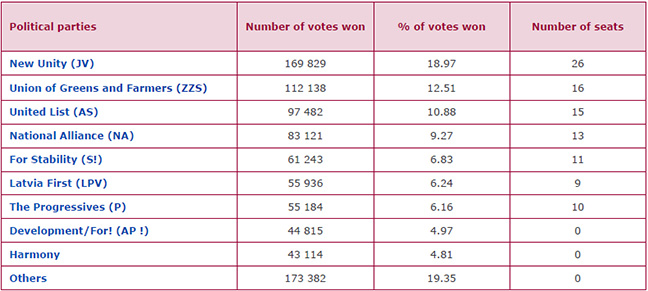
Results of the general elections held on 1 October 2022 in Latvia
Turnout: 59.26 %
On the same theme
To go further
Elections in Europe

Helen Levy
—
27 October 2026
Elections in Europe
Helen Levy
—
13 October 2026
Elections in Europe
Helen Levy
—
6 October 2026
Elections in Europe

Helen Levy
—
15 September 2026

The Letter
Schuman
European news of the week
Unique in its genre, with its 200,000 subscribers and its editions in 6 languages (French, English, German, Spanish, Polish and Ukrainian), it has brought to you, for 15 years, a summary of European news, more needed now than ever
Versions :