Results
Elections in Europe
Helen Levy
-

Available versions :
EN

Helen Levy
Researcher at the Robert Schuman Foundation
On 3 October, Latvians went to the polls to elect the 100 members of the Saeima, the country’s unicameral parliament. This election could have been considered decisive, given the ongoing war in Ukraine, Russian hybrid attacks and the rising cost of living, but turnout was disappointing at 51.8%, i.e. – 8 points lower than in the previous general elections in 2022.
Six parties will be represented in Parliament during the next legislature
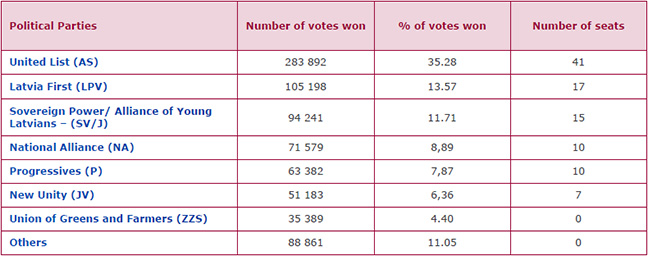
The party of outgoing Prime Minister Andris Kulbergs swept ahead, exceeding pre-election poll projections. The United List (AS) clinched 35.28% of the vote (+25 %), securing 41 seats (+31), nearly triple its 2022 result – a record for a party in a national election since independence in 1991. This reflects both a desire for a degree of stability and the expectation of change; it is worth noting that the Prime Minister has only been in office since… 26 May 2026.
However, two pro-Russian parties, ‘Latvia First’ (LPV) and ‘Sovereign Power’ (SV/J), came second and third respectively, with 13.57% of the vote and 17 seats, and 11.71% of the vote and 15 seats. It is worth noting that ‘Latvia First’ doubled its share of the vote compared with the 2022 election, as has the number of seats it will now hold in the Saeima. ‘Sovereign Power, Alliance of Young Latvians’, formed in 2022 by Julia Stepanenko and Ļubova Švecova, is making its debut in Parliament.
The National Alliance (NA), a conservative party, came fourth with 8.89 % of the vote and 10 seats, followed by the Progressives (P), with 7.87% of the vote and 10 seats as well. New Unity (JV) secured 6.36% of the vote and 7 seats.
The big losers in this election were the Union of Greens and Farmers (ZZS), a member of the outgoing governing coalition, which garnered only 4.4% of the vote – falling short of the 5% threshold required for representation in Parliament – and the Harmony Centre, a Russian-speaking but not pro-Russian party that secured just 0.82% of the vote. Both parties had previously played an important role in Latvian political life, achieving strong results since the early 2000s. It would appear that the Latvian political landscape is undergoing a major realignment.
A path towards continuity, but against a challenging backdrop of economic and demographic uncertainty
By voting massively for the United List, Latvians appear to have chosen to support the outgoing Prime Minister in his determination to continue the work of protecting Latvia from the growing threats from Russia and to support Ukraine in the war launched by the latter in 2022.
However, the votes for ‘Latvia First’ and ‘Sovereign Power’ should undoubtedly be seen as a warning sign, as many Latvians are concerned about the cost of living, rising inflation and low wages. It appears that these latter two parties have also highlighted the economic cost of severing ties with Russia in order to win votes. Led by Ainārs Šlesers, the ‘Latvia First’ party has rallied voters to its cause, mainly through its proposals concerning the introduction of reduced VAT rates, the reduction of red tape and the creation of jobs. The party’s message regarding Russia is that the two countries are inextricably linked and that – at some point once the war is over – ties will need to be re-established to restore more harmonious relations between neighbours. Another strength could be its promise not to call into question Latvia’s membership of the European Union (the party sits in the European Parliament as part of the ‘Patriots for Europe’ (PfE) group) or NATO, and to support Ukraine’s future accession to the European Union.
The leaders of ‘Sovereign Power’ were barred from ‘Latvia First’ on Russia’s invasion of Ukraine in 2022, an act which they clearly did not condemn. The party's manifesto advocates strengthening the study of the Russian language in schools and, above all, the country’s withdrawal from conflicts and wars – which it claims would harm the national interest – without, however, explicitly stating that the party would put an end to all financial aid to Ukraine.
Some regions of Latvia saw low turnout: in Latgale, a region bordering Russia and Belarus, only 47% of the population fulfilled their civic duty. These areas have a large Russian-speaking population, and their lack of interest in the elections could be explained by their uncertainty about their future in the country. The integration of Russian speakers has long been a sensitive issue and, at a time of heightened tensions with neighbouring Russia, the question of identity may well have been a decisive factor.
What kind of coalition will be formed?
It is now up to Andris Kulbergs and the United List, in these delicately balanced circumstances, to safeguard Latvia’s place within the European Union and NATO, to address the public’s economic concerns, and to ensure the creation of a harmonious society where everyone feels at home, fostering a spirit of ‘living together’.
Negotiations are now set to begin in a bid to form a new, stable coalition. Andris Kulbergs’ party does not, on its own, have enough seats to secure an absolute majority (51 seats). He has already ruled out any collaboration with ‘Latvia First’ and ‘Sovereign Power’. Could one solution be to form a new coalition with his current partners in the National Alliance (10 seats) and ‘New Unity’ (7 seats)? Will he form a coalition with two parties, considered more stable? Or with three parties?
In any case, the negotiations could last several weeks.
Results of the general elections on 3 October 2026 in Latvia
Turnout: 51.81%
On the same theme
To go further
Elections in Europe

Helen Levy
—
15 September 2026
Elections in Europe
Helen Levy
—
15 September 2026
Elections in Europe
Helen Levy
—
8 September 2026
Elections in Europe

Helen Levy
—
2 June 2026
The Letter
Schuman
European news of the week
Unique in its genre, with its 200,000 subscribers and its editions in 6 languages (French, English, German, Spanish, Polish and Ukrainian), it has brought to you, for 15 years, a summary of European news, more needed now than ever
Versions :