
Results
Elections in Europe
Helen Levy
-

Available versions :
EN

Helen Levy
Researcher at the Robert Schuman Foundation
On 19 April, Rumen Radev, the former President of Bulgaria (2017–2026), secured a larger-than-expected victory in the general election. His newly formed centre-left coalition, ‘Progressive Bulgaria’, secured 44.59% of the vote and 131 seats, representing an absolute majority of the 240 seats in the National Assembly. The centre-right party, GERB, came second with 13.39% of the vote and 39 seats (-27). Next came the “We Continue the Change – Democratic Bulgaria” PP-DB with 12.61% of the vote and 37 seats (+1), the Movement for Rights and Freedoms with 7.12% and 21 seats (-8) and, finally, the far-right party Vazrazhdane (“Renaissance”) with 4.25% of the vote and 12 seats (-21).
Other parties such as MECh, Vel and the BSP failed to clear the 4% threshold required for representation in parliament. In total, only five parties will be represented in the new Assembly.
Although voting has been compulsory since 2016, turnout was not particularly high for this eighth parliamentary election in five years: it nevertheless reached 51.9%.
The Bulgarian political scene has been dominated by Boyko Borisov’s GERB over the past two decades, but this election marks the end of that era. Confidence in the governing parties has eroded over the course of the eight elections since 2021 and, above all, due to the resulting lack of solid coalitions. They have, in a sense, been penalised for failing to reach an agreement.
Although corruption has declined somewhat, attempts at vote-buying, manipulation and the capture of the state by the oligarchy still persist. The authorities were therefore on high alert during this election, given that both Romania and Hungary have recently suffered interference from foreign powers. This situation has eroded public confidence in the political landscape and, despite active civic engagement demonstrated by strong mobilisation during the protests in late 2025, turnout remains low, reflecting a certain level of weariness amongst the population regarding these repeated elections.
Public discontent at the end of last year led to the resignation of the government, and that of the president – Rumen Radev – who decided to form a new coalition, Progressive Bulgaria, in order to stand in the general election, hoping to win and become Prime Minister.
“These anti-corruption protests boosted his political popularity: he managed to attract some of the pro-European protesters to his side, who see him as a symbol of the fight against corruption, even if it means overlooking his ambiguous stance towards Russia,” says Anna Krasteva, a professor of political science at New Bulgarian University in Sofia.
Rumen Radev has promised to stabilise the country and dismantle the system of corruption. Bulgaria ranks 84th in Transparency International’s 2025 Corruption Perceptions Index, tied with Hungary as the country with the lowest score in the European Union. Bulgaria also shares the status of the EU’s poorest country with Hungary.
Interference in the electoral process
As the election approached, acting Prime Minister Andrey Gurov, a member of the “We Continue the Change” party, pledged to take tougher measures against vote-buying and electoral manipulation. In recent weeks, more than 300 people have been arrested after being caught selling votes in various towns across the country; large sums of money have been seized. Compared with the 2024 elections, the number of arrests and breaches of electoral law has risen; these breaches have sometimes involved organised criminal groups, but also candidates in the parliamentary elections.
Which way will Rumen Radev lean?
Rumen Radev is known for his sceptical stance towards the European Union, as well as for his calls for Bulgaria to remain neutral regarding Ukraine’s struggle against Russian aggression. Many fear he will continue down this path and become Europe’s new ‘troublemaker’, succeeding Hungary’s Viktor Orbán, who was dealt a crushing defeat in the Hungarian elections on 12 April.
He has adopted an ambiguous attitude towards plans to import Russian oil via the TurkStream pipeline; doubts have arisen regarding his motivation and ability to tackle the corruption that pervades even the highest echelons of government, as his candidacy has attracted support from certain rather dubious circles that harbour extreme nationalist tendencies or are involved in unsavoury activities
However, following the election, although he expressed his opposition to the recent agreement with Ukraine, he called for “a historic opportunity to break once and for all with the… oligarchic model”. He also stated that he hoped for “pragmatic relations with Russia, based on mutual respect and equal treatment”.
A compelling victory
Rumen Radev secured an absolute majority with 131 seats out of 240. Vesselin Stoynev, a journalist, argues that this election has demonstrated a consolidation around a single dominant force. “We are witnessing a consolidation of votes, with an undisputed winner holding a considerable lead over his rivals.” What will he do with it? What will his stance be on Ukraine, Russia and Europe?
He is indeed a darkhorse, who keeps his cards close to his chest. Having served nearly two terms as president, he would like to see himself as the “saviour of the country” — and for Bulgaria to become “a bridge to restore relations between Russia and the West”. His country has deep ties with Russia — whether economic, cultural or religious; they share a history of energy dependence and long-standing political networks dating back to the Soviet era[1].
Rumen Radev hailed a “victory of freedom over fear”. While not rejecting the European Union, he nevertheless expressed doubts about the strategy to be adopted, particularly with regard to Russia. Before the election, he stated that he shared the positions of Hungary and Slovakia on sending arms to Ukraine, arguing that he “did not see the point of his poor country paying for it”. In this election, Rumen Radev eroded the support base of the pro-Kremlin party, Vazrazhdane, thanks to his open stance towards Russians and his anti-elite views.
Will Rumen Radev opt for a compromise to stabilise his country and usher it into a new era of growth, setting aside his inclination to align with Vladimir Putin, or will he choose to be a Trojan horse for Russia? The coming months will be decisive.
Aged 62, this former NATO-trained fighter pilot and former member of the Communist Party is expected to become Prime Minister in May.
Results of the general elections held on 19 April 2026 in Bulgaria
Turnout: 50.2%
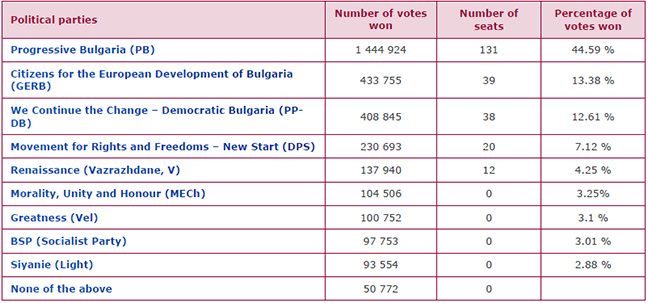
Source : https://results.cik.bg/pe202604/rezultati/index.html
[1] Robert Lansing Institute, From President to Power Broker: Radev’s Rise and the Risk of a Pro-Russian Shift in Bulgaria, 17 April 2026
On the same theme
To go further
Elections in Europe
Helen Levy
—
13 October 2026
Elections in Europe

Helen Levy
—
6 October 2026
Elections in Europe

Helen Levy
—
15 September 2026
Elections in Europe
Helen Levy
—
15 September 2026
The Letter
Schuman
European news of the week
Unique in its genre, with its 200,000 subscribers and its editions in 6 languages (French, English, German, Spanish, Polish and Ukrainian), it has brought to you, for 15 years, a summary of European news, more needed now than ever
Versions :