
Results
News
Corinne Deloy,
Helen Levy,
Fondation Robert Schuman
-

Available versions :
EN

Corinne Deloy

Helen Levy
Researcher at the Robert Schuman Foundation
Fondation Robert Schuman
The present Prime Minister and candidate of the Social Democrat Union of Macedonia (SDSM), Branko Crvenkoski, won the first round of the Macedonian presidential election on 14th April, with 42.9% of the vote against 34.9% for his main rival, Sasko Kedev, member of the main opposition party in Parliament, the Democratic Party for National Macedonian Unity (VMRO-DPMNE). Gëzim Ostreni, the candidate for the Party for Democratic Prosperity (PDP) and the Democratic Union for Integration (PDI), and Zudi Dzhelili (Democratic Albanian Party, PDA) won 14.78% and 8.63% of the vote respectively, that was 4.4 points more for each of them than the other two Albanian candidates in the last presidential election in December 1999.
The electoral campaign was very brief, lasting twelve days only. The four candidates focussed their electoral programme on Macedonia's membership of the European Union and its integration into NATO. Note that Prime Minister Branko Crvenkoski officially delivered his country's request for EU membership on 22nd March in Dublin. During the campaign none of the candidates tried to rekindle any tension that might exist between the Macedonian majority and the Albanian minority, thereby respecting the memory of the former President of the Republic Boris Trajkovski, who was killed on 26th February last in a plane crash in Southern Bosnia and who had distinguished himself during the conflicts in 2001 between Macedonians and Albanians. This was a tragic death the sadness of which was shared by all Macedonians.
The Prime Minister used his long political experience to support his campaign, although he has been much criticised for his poor economic results (more than 35% of the Macedonian working population are unemployed at present and half of Macedonians live below the poverty line). 41 year old Branko Crvenkoski, president of the Social Democrat Union of Macedonia since 1991 did in fact occupy the position of head of government between 1992 and 1998.
Sasko Kedev, a cardiologist, who is almost unknown to the man on the street and a newcomer to politics, focussed his campaign on the need for change and achieved an honourable result, taking his party forwards by 100,000 votes since the previous presidential election in December 1999. "Branko Crvenkoski has to confront a real problem, in a year and a half he has declined from 500,000 votes (general election results on 15th September 2002) to a present 380 000" declared Vlatko Gjorcev, spokesman for the Democratic Party for National Macedonian Unity. For his part the VMRO-DPMNE leader said he was convinced that voters would seize the chance in the second round to oust the Prime Minister. "We are heading for final victory, we shall transform a poor, corrupt, criminal Macedonia into a modern, democratic state", maintained Sasko Kedev. We should recall however that the position of President of the Republic is purely symbolic in Macedonia.
Three hundred international observers and more than 4,000 local observers monitored the election. Isabel De Rut, spokesperson for the Organisation for Security and Co-operation in Europe (OSCE), confirmed "that no significant incident was detected". 14th April was declared a holiday across all of Macedonia in order to encourage voters to turn out.
Branko Crvenkoski and Sasko Kedev will face each other on 28th April in the second round of the presidential election during which the vote of the Albanian speakers, ie one quarter of the population, will be decisive. Participation by at least half of those enrolled is vital for the second round. If the abstention rate is too high the entire election, ie both the first and second round, will be invalidated and will have to be organised again at a later date.
Results of the first round of the Macedonian presidential election on 14th April 2004
Participation rate: 55.4%
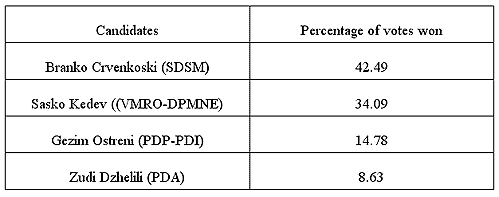 Source: Macedonian Electoral Commission
On the same theme
To go further
Elections in Europe

Helen Levy
—
6 October 2026
Elections in Europe

Helen Levy
—
15 September 2026
Elections in Europe
Helen Levy
—
15 September 2026
Elections in Europe
Helen Levy
—
8 September 2026
The Letter
Schuman
European news of the week
Unique in its genre, with its 200,000 subscribers and its editions in 6 languages (French, English, German, Spanish, Polish and Ukrainian), it has brought to you, for 15 years, a summary of European news, more needed now than ever
Versions :