
Future and outlook
Veronica Anghel
-

Available versions :
EN

Veronica Anghel
Assistant Professor, Robert Schuman Center for Advanced Studies, European University Institute; Visiting Professor, College of Europe; Associate Editor, Journal of European Public Policy
Russia’s war against Ukraine and its wider anti-European aggression turned enlargement from a technocratic queue into a security instrument. Brussels now converges on staged integration with strict conditionality and results-based finance, yet diverges on money, governance, and calendars. 2026 will not crown a “big bang”, but it can lock in a credible track for Ukraine, Moldova, Montenegro, and Albania – if candidate state leaders trade speed for safeguards, and European Union leaders finance the transition, and firewall veto politics.
For enlargement to be a success, the process should be governed as a tool for the management of European common-pool resources, and a geopolitical instrument. To increase both its chances of prosperity and its capacity to deter further aggression, the European Union should expand access in stages, tighten governance at each step, increase mutual monitoring, and pair every benefit with verifiable reforms and automatic snapbacks.
I. The state of the debate in Brussels
There is clear convergence on how to proceed towards further enlargement – staged (also referred to as gradual) integration, results-based money transfers, hard safeguards – but doubts persist about when and how far to push it absent decisions on financing, voting, and ratification strategy. The 2025 enlargement package re-centres the file on security and implementation, yet it leaves the EU’s own housekeeping half way.
European Commission – Staged integration, codified
The Commission has moved enlargement from slogans to an operating system. Its core is staged integration, although not officially branded as such: early and reversible access to slices of the Single Market, participation in EU agencies and programmes – for example, SAFE, and results-based disbursements that unlock only when reforms land. This logic – roadmaps, measurable benchmarks, and potential snap-back clauses – extends the Growth Plan discipline beyond the Western Balkans and hard-wires credibility into Ukraine and Moldova’s tracks.
Two design choices matter. First, acquis clustering concentrates effort on sequences that deliver visible gains – Fundamentals (rule of law, economic criteria and the reform of the civil service), Internal Market, External Relations – rather than scattering reforms across dozens of chapters. Second, the Commission pairs every benefit with an enforcement gate: surveillance of implementation, joint audits, and automatic suspension if indicators fall back. This is not “fast and loose,” it is a "fast, but gated” method.
At the same time, EU reforms remain a work in progress. EU leaders have sketched options – performance related finance (see the Draghi report), sectoral access with safeguards (see the ‘Enlargement Solidarity Facility’ proposed in the Letta report), limited QMV extensions in narrow fields through passerelle clauses. But the major decisions that require leaders’ sign-off (budget re-basing, institutional adjustments, a ratification process) are parked in the Council. Hence the doubt on convergence: the technical scaffolding is sketching a way forward; the political wills are not yet bolted in.
European Council / Council – Parallel tracks, contested sequencing
EU integration proceeds on parallel tracks: widening goes hand in hand with deepening, not after it. That structural reality masks hard choices. Three fault lines define 2026.
Money. Enlargement without budget re-basing is fiction. The struggle ahead is mirrored in the debate around the 2028-2034 Multi-Annual Financial Framework. On enlargement, the question is timing and frequency – how much is phased into pre-accession envelopes versus reserved for the membership moment, and whether to ring-fence Common Agriculture Policy-like support that rewards verifiable compliance rather than political timetables. Capitals will not bless faster access if distributional effects remain opaque.
Governance. Unanimity is both a shield and a choke point. A narrow use of passerelle clauses to shift specified sub-areas – for example, parts of sanctions or export-control listings – to qualified majority voting has moved from taboo to potential tool, but it still requires unanimous launch and national-parliament forbearance. Leaders converge on the need to curb hostage-taking; they diverge on how wide the bridge should be.
Because core EU products - such as the Single Market, the Single Currency or European security - are not exclusive and rivalrous in nature (what political economists refer to as common-pool resources), that divergence becomes dangerous: communities, such as the one created by EU members states, that successfully manage shared resources do not rely on goodwill alone, but on clear rules, mutual monitoring, and credible sanctions for free-riders. For the EU, that means pairing any move away from unanimity with stronger peer review, transparency over national positions, and automatic penalties for systematically blocking or undermining agreed action – the kind of monitoring architecture that allows the commons to survive.
Calendar discipline. The sequencing question is not “dates versus merit,” it is which deliverables count in 2026 – opening and populating clusters, sectoral access acts adopted and enforced, disbursements or fund freezing under Reform & Growth Facilities – and how to protect that calendar from domestic political shocks in both the EU and candidate countries. 2026 will see parliamentary elections in Hungary, Slovenia, Latvia, Sweden and Bulgaria that could alter the composition of the Council. In all these elections, the security threat and the economic costs of enlargement will feature high on politicians’ agenda, with polarizing effects and creating the potential for more delays. Without a shared list of 2026 milestones, headlines from the European Councils may overshadow the implementation of the enlargement process.
European Parliament – Conditionality with citizens in view
The EU Parliament remains broadly pro-enlargement with conditionality. This stance is consistent with its enlargement legacy since the end of the Cold War. It backs staged access, insists on rule-of-law levers that bite, and pushes for citizen-centred oversight: public dashboards on money-for-reform, enforcement scorecards, and clear explanations of snapbacks when benchmarks are missed. Its added value is legitimacy – making the case that enlargement is a security investment that delivers everyday benefits, not an elite project that writes blank cheques. Calling out backsliding on EU metrics and freezing EU funds in the case of problematic candidates (such as Serbia) is fundamental to preserve the credibility of the enlargement process.
Parliament also presses symmetry: if candidates face automatic penalties for backsliding, member states – such as Hungary – must also see internal rule-of-law tools applied with similar rigour. That stance strengthens credibility with sceptical publics and shields the enlargement track from accusations of double standards.
II. Member States Level
The splits in the Council are not abstract ideology; they are fights over how to govern shared European common-pool resources – for example, the Single Market and security – where use by one actor affects others. When market access is widened or sanctions policy tightened, someone pays, someone gains, and everyone worries about enforcement. That rivalry, characteristic for the type of common resources the EU has, creates camps with different instincts about speed, finance, and veto power.
To make negotiations even more complicated, borders between states’ interests blur. A state can be a hawk on money and a maximalist on security; a Western Balkans advocate whilst showing caution with regard to Ukraine, or the reverse; a reform-first moderniser and, on a different file, a sovereignty holdout. The overlaps matter because they define the coalitions that can pass rules, fund benefits, and make snapbacks credible.
Read through that lens, the “maximalists” push to close the security gap fast; the “cautious” demand pilots and hard reversibility so the Single Market isn’t opened on trust; the “hawks” insist on systematic monitoring before any cheque is signed; the “Balkans advocates” want tangible wins now to restore credibility; the “reform-first modernisers” won’t widen without a plan for decision-making, seats and money; and the “spoilers/issue-linkers” use unanimity to extract cross-dossier trades. Because many capitals straddle multiple camps, viable bargains have to braid three strands at once – narrow QMV fixes to stop chronic vetoes, visible but reversible benefits to show movement without risking the sustainability of European common-pool resources, and clear budget guardrails to make costs sellable at home.
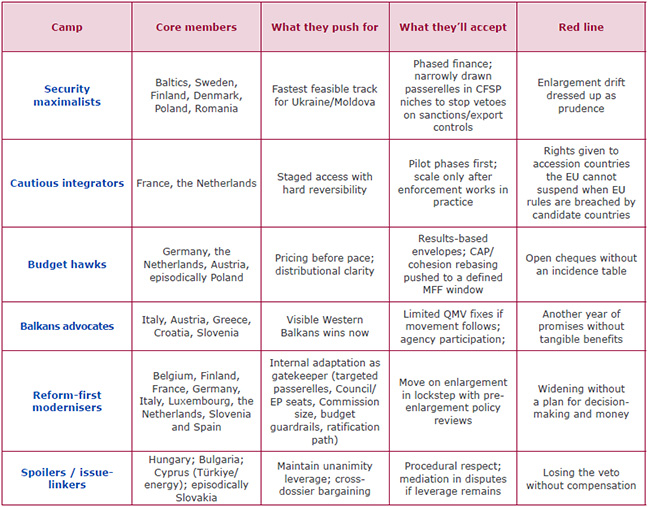
Enlargement is the tool that can align these rival interests with the sustainable administration of Europe’s goods and its geopolitical goals. Staged integration turns access to the Single Market and EU programmes into a manageable tool – granted in slices, measured by benchmarks, and withdrawn automatically when rules are breached. That structure protects incumbents from free-riding, gives candidates predictable rewards for enforcement, and keeps security policy coherent as the EU grows. Put bluntly: widening is how the EU sustains the common-pool resources it already runs and projects power beyond its borders – provided leaders couple each new benefit with the governance that keeps it from being over-used or politicised to death.
III. 2026: an implementation package
There will be no big-bang enlargement in 2026. There can, however, be a tight, workable package that moves fast, stays gated, and is politically sellable in Brussels and in the capitals. The centre of gravity is simple: open and populate the reform negotiation clusters that are ready, grant limited Single Market access where enforcement can be verified, pay only for delivered reforms and keep funds away from those who fail, and remove one chronic veto choke point so foreign policy does not derail the calendar.
The European Union can start with the files that are technically mature. For Ukraine and Moldova, the Council could open and populate three negotiating clusters – Fundamentals, Internal Market, and External Relations – translating paper screening into working plans, peer review, and early enforcement. Including content in these clusters is crucial: it forces ministries to schedule acquis transposition, regulators to stand up supervision, and the European Union to staff joint oversight, a clear step beyond rhetoric. All this is reflected, between the lines, in the 2025 EU enlargement package. In parallel, Montenegro has just closed one chapter and could finalise another, while Albania has now opened all thirty-three negotiation chapters (the last one was opened in November 2025). These steps would create visible momentum without committing to points that the enlargement process would not be able to ratify the following year.
Limited Single Market access should follow the same logic: narrow scope, hard safeguards, and real-time monitoring. As they make progress on reforms, each candidate should receive two sectoral access acts – for example, in energy market coupling, payments interoperability, customs and transit – drafted with snapbacks that bite automatically on measurable breaches. The test is operational, not rhetorical: joint audits by EU and national authorities, electronic certification and traceability, publication of compliance rates, and proportional suspension of access if performance slips. Suspension should be reversible on proof of remediation; the aim is discipline without political drama.
Money must move, but only when reforms do. The Reform and Growth Facilities should disburse first tranches to Western Balkans partners and to Moldova strictly against pre-agreed benchmarks: judicial-independence steps that are visible in case management and appointments; anti-corruption outcomes that survive appeals. Citizens and markets must be able to see that euros flow when rules are enforced, not when deadlines approach.
One targeted institutional fix can prevent familiar hostage-taking during decision making. A micro-passerelle in a tightly defined Common Foreign and Security Policy niche – for example, a subset of sanctions listings or export-control adaptations – would move that lane to qualified majority voting with the usual political safeguards (European Parliament consent, national-parliament non-objection, explicit reversibility). This is not a constitutional revolution. It is a safety valve designed to keep day-to-day alignment decisions from being traded against unrelated dossiers. To keep the rest of the agenda on track, a standing Accession Mediation Mechanism should run alongside it, absorbing bilateral disputes before they spill into the calendar.
Legitimacy is the force multiplier. What governments want does not always align with citizens’ preferences. A plain-language regular review, updated quarterly, should list the milestones due, the money released, the snapbacks triggered, and the remediation timelines agreed. The annual EU communication on enlargement is simply too cumbersome to keep up with. Strategic communications could include short explainers on costs and safeguards in the major EU languages and be mirrored by candidate governments so that both sides talk from the same ledger. If enlargement is the management of European common-pool resources, the management must be visible.
The end of 2026 would see success on a few conditions: three negotiation chapters not only opened but completed for Ukraine and Moldova; the provisional closure of an additional chapter for Montenegro; and the transition from alignment with EU legislation to implementation for Montenegro and Albania. Each candidate has two sectoral access acts in force, with at least one snap-back invoked and (perhaps) resolved to demonstrate credibility in both directions. The use of the passerelle clause gains momentum. The public dashboard registers sustained readership and a small, measurable softening of scepticism in the most cautious member states.
Politically, this bundle is balanced by design. Security maximalists get visible movement on Ukraine and Moldova. Cautious integrators get hard reversibility tested in the wild before any scaling. Budget hawks get incidence transparency and a pay-for-performance discipline they can defend at home. Balkans advocates get tangible wins – disbursements for enforcement, agency participation, and regional market delivery – that restore credibility now. Reform-first modernisers get a limited internal fix that proves the EU can govern a wider membership without rewriting the treaties. Even spoilers get an off-ramp: mediation for bilateral grievances without a standing license to stall everyone else.
***
A successful enlargement should be imagined as disciplined administration of Europe’s shared resources – a policy that takes into account the difficulty to exclude outsiders who already benefit from, for example EU security and (some) access to the Single market, and which considers rivalries that are already in place. It does not pretend that ratification politics will vanish or that CAP and cohesion can see a budgetary rebasing overnight. It does ensure that by the end of 2026 the system is delivering enforceable access where rules are met, withdrawing it cleanly where they are not, and keeping foreign-policy alignment decisions out of permanent gridlock. In other words: not a promise, a schedule – and one that both strengthens deterrence and shows adversaries such as Russia or less committed allies such as the U.S. that the EU is straightening and has real skin in the geopolitical game. A clear schedule for enlargement also preserves the Single Market’s integrity and attractivity.
In brief, across Brussels, the toolbox is settled: staged integration, agency participation, results-based envelopes, and legally robust safeguards. The doubts are political, not technical: who pays and when; how far to lean on passerelles to keep decisions moving; how to lock calendar discipline and ratification into a fractious electoral cycle. The 2025 package gives enlargement a realistic spine. To turn that spine into a functioning body in 2026, leaders must decide on money, voting, and a transparent milestone list – or the system will remain coherent on paper and porous in practice.
Publishing Director : Pascale Joannin
To go further
Budget and Taxation

Valérie Plagnol
—
13 October 2026
Future and outlook

Pape Léon XIV
—
6 October 2026
Future and outlook

Louis Caudron
—
29 September 2026
Education and culture

Blandine Chelini-Pont
—
22 September 2026

The Letter
Schuman
European news of the week
Unique in its genre, with its 200,000 subscribers and its editions in 6 languages (French, English, German, Spanish, Polish and Ukrainian), it has brought to you, for 15 years, a summary of European news, more needed now than ever
Versions :