Migration today remains one of the most complex and politically sensitive issues on the European agenda. It encompasses a wide range of processes: from
irregular migrants and
forced displacement caused by wars and climate crises to the mobility of
students,
entrepreneurs, and
skilled professionals. This multidimensional nature explains why regulating migration flows within the European Union remains an exceptionally complex task that requires balancing humanitarian obligations, the controls of external borders and migratory flows, as well as labour market needs.
Global race for talent: new contours of international competitiveness
Common governance frameworks for migration have been established in the European Union, most notably through the
Pact on Migration and Asylum. Non-EU citizens may reside in the European Union if they are granted a residence permit. In 2023, EU Member States
collectively issued more than 3.7 million first residence permits to non-EU citizens. It was an increase of almost 5% compared to 2022, marking the highest number recorded to date. Only about one-third of the permits were issued for economic reasons, while the majority were granted for family, educational, or other purposes. Economic and skilled immigration remains a limited segment of the EU’s migration policy. At the same time, it plays a decisive role in sustaining the European Union’s
competitiveness and
innovation capacity. Skilled migrants constitute the core of the sectors that drive the structural modernisation of the economy, including digital technologies, engineering, scientific research, healthcare, and “green” innovation.
Therefore, understanding the specific nature of skilled migration requires its contextualisation within the broader field of European migration policy. Unlike irregular migrants or crisis-driven or humanitarian forms of mobility, it represents an investment in human capital that directly affects the European Union’s competitiveness amid the global competition for talent. This article therefore focuses on the relationship between the attraction of skilled immigrants and the EU’s competitiveness.
In today’s globalised world, competition for talent is becoming increasingly intense. Countries and regions are vying to attract skilled immigrants – the so-called ‘race for talent’. Over the past decade, this concept has evolved from a mere metaphor describing the general competition among countries for skilled immigrants into an analytical framework explaining how nations design their migration and innovation policies to strengthen overall competitiveness. In today’s knowledge-based economy, countries
compete to attract the most talented innovators and professionals. These individuals are the driving forces behind innovation and long-term growth. This competition has long transcended the boundaries of traditional recipient countries such as the United States, Canada, and Australia. It increasingly concerns the European Union, which facing demographic decline and a shortage of skills in key sectors, particularly in information and communication technologies, healthcare, construction and transport, struggles to maintain its competitiveness. As highlighted by the
International Centre for Migration Policy Development, the European Union finds itself in a ‘global-scale battle’ for skilled immigrants, seeking to fill vacancies left unoccupied due to the emigration of
high-skilled specialists, the ageing and
declining of its working population, internal migration between member states, and a shortage of local professionals.
The ‘race for talent’ reflects a structural transformation of global migration regimes. Nations are shifting from perceiving migration as a social phenomenon to strategically employing it as an instrument of economic policy. Countries are increasingly reforming their migration systems to enhance flexibility and responsiveness to labour market needs, as well as to attract skilled immigrants. In recent years, most member countries of the
Organisation for Economic Co-operation and Development (OECD) have actively improved their skill-based selection instruments, simplified procedures for specialists in shortage sectors, and launched targeted programmes to integrate skilled immigrants into their national economies.
This transformation in migration policy approaches demonstrates that, in the global competition for talent, human capital has become a strategic resource for innovative development. The focus is not merely on the number of skilled immigrants attracted, but also on the quality of their skills, their adaptability, and their capacity to integrate into high-tech sectors that shape national competitiveness. The extent to which countries can overcome structural growth constraints depends on how effectively they align migration with education and innovation strategies. According to the
European Innovation Scoreboard (EIS), human resources and digitalisation are among the core preconditions for the EU’s innovation capacity. These components are systematically monitored as key ‘bottleneck factors’ for innovation, identified within the Framework Conditions dimension of the EIS.
The EU’s policy evolution
It is within this context that the question arises of the European Union’s ability to transform human potential into innovative outcomes to enhance its competitiveness. Skilled immigrants are not only participants in the labour market, but also carriers of knowledge that drive technological breakthroughs, production transformation, and
economic resilience. As a result, talent attraction policy has become an integral element of the EU’s long-term competitiveness strategy.
In response to these challenges, the European Commission has been steadily developing a regulatory and institutional framework to attract and retain skilled immigrants. Central to this process are key legislative instruments such as
Directive (EU) 2021/1883, which modernised the EU Blue Card system, and
Directive (EU) 2016/801, aimed at facilitating mobility for researchers, academics, and students. Together, these directives have laid the foundations for a common European talent space – an environment in which intellectual mobility is seen as a driver of sustainable economic and social development.
Following the modernisation of the legal framework for the
EU Blue Card, the European Union has continued to update its policy on skilled migration, recognising its strategic importance for global competitiveness. In November 2023, the European Commission presented the
Skills and Talent Mobility package, aimed at addressing the growing shortage of labour and skills across EU Member States. In the explanatory memorandum, the Commission highlights that a significant share of European enterprises, particularly small and medium-sized businesses, face persistent difficulties in recruiting workers with the required competences. The package’s stated objective is ‘to make the EU more attractive to talent from outside the Union, facilitate mobility, and better match skills with labour-market needs.
One of the flagship initiatives of the package is the
EU Talent Pool Regulation, proposed by the European Commission in 2023. The Talent Pool establishes a unified digital platform connecting European employers with skilled professionals from third countries. The initiative aims to create a ‘
European market for talent’ and to bridge the structural gap between skills demand and available labour resources. This initiative not only enhances the EU’s attractiveness as a destination for skilled immigrants, but also provides an institutional instrument for competing with countries that have already implemented similar models – notably
Canada and
Australia, to select and attract qualified migrants.
The European Union continues to shape a common policy framework for attracting skilled immigrants. Within this process, initiatives have been expanded to simplify mobility procedures, improve the recognition of qualifications, and broaden legal pathways for employment. As noted by the
European Migration Network in 2025, Member States are increasingly implementing new and innovative approaches to talent attraction, including mechanisms for recognising qualifications and facilitating intra-EU mobility.
Тalent Partnerships are regarded as a key instrument to address skills shortages in the EU labour market.
Semantic shifts in EU migration policy discourse
Given the steady evolution of the European Union’s legal framework – from the harmonisation of entry procedures to the establishment of a comprehensive system for attracting talent – it is appropriate to move from a descriptive analysis to an empirical examination of the policy discourse itself. The transformation of political language reflects a deeper shift in substance: from regulating labour flows to managing human capital as a strategic resource of competitiveness.
To explore this evolution, this paper conducted a content analysis of key EU documents, issued between 2016 and 2024, tracing how semantic priorities and policy emphases have evolved in the field of skilled migration. The analysis covers directives and European Commission communications defining the framework for the EU’s talent-attraction policy. The study quantitatively assesses the frequency of key terms: skills, talent, mobility, innovation, competitiveness, partnerships, and recognition, and examines their interrelations within each document. This approach captures not only the dynamics of the discourse, but also the gradual integration of the talent agenda into the EU’s broader competitiveness strategy. The selection of these seven key terms for the content analysis is driven by their central role in shaping the European Union’s contemporary policy on skilled migration. They represent interrelated elements of the emerging ‘
talent ecosystem’ that the EU is gradually building in response to structural labour shortages.
The gradual transformation of the European Union’s policy on skilled migration is reflected not only in the substance of adopted documents, but also in the linguistic patterns shaping the EU’s normative discourse. The results of the content analysis indicate a clear shift of emphasis: from terminology associated with academic mobility, to concepts that represent economic attractiveness, competitiveness, and talent management.
In Directive (EU) 2016/801, the term ‘mobility’ predominates, appearing mainly in relation to the academic and research movements of students, teachers, and researchers between EU Member States. The semantic field of this concept encompasses administrative procedures, permit regimes, and residence conditions. Skills, talent, and innovation appear only sporadically. The situation changed with the adoption of Directive (EU) 2021/1883, which modernised the EU Blue Card regime. In this document, the frequency of the terms ‘skills’ and ‘recognition’ increases, reflecting the European Union’s growing ambition to adapt migration legislation to the realities of the labour market. The focus gradually shifts from educational mobility towards the attraction of skilled workers and the mutual recognition of qualifications. In this way, migration policy begins to assume an economic function, responding to structural labour shortages in key sectors of the economy.
A new stage began in 2023 with the adoption of the
Skills and Talent Mobility package, which integrates education, labour, and migration policies within a single framework. In the texts of this package, the frequency of the terms ‘skills’, ‘talent’, ‘competitiveness’, and ‘innovation’ increases sharply. This marks a transition towards a strategic approach in which skilled professionals are viewed not merely as a labour force, but as carriers of innovative potential. For the first time at the EU level, the logic of ‘
talent as a strategic asset’ is introduced, reflected in the proposal to establish the European Talent Pool – a digital platform designed to facilitate the recruitment of professionals in shortage occupations.
In the
Directive (EU) 2024/1233 in 2024, the notions of ‘partnerships and ‘recognition’ acquire a new meaning. They no longer describe technical mechanisms, but institutional links between the European Union and third countries. The policy thus gains an external dimension, with the establishment of Talent Partnerships aimed at fostering mutually beneficial exchanges of skills, developing joint educational and professional programmes, and simplifying mobility procedures.
The results of the content analysis therefore demonstrate that between 2016 and 2024 the European Union has undergone a profound transformation in its approach to skilled migration: from regulating academic mobility to building an institutional ecosystem for the development and circulation of talent. The new paradigm ‘
from mobility to attractiveness’ is based on the recognition that human capital constitutes the foundation of the EU’s competitiveness in an era of global competition for skills and innovation.
Challenges to EU Attractiveness
In this context, a broader question arises: what position does the European Union hold within the global system of competition for talent, and to what extent can its policies transform the attraction of skilled professionals into a driver of long-term competitiveness? Addressing this strategic dilemma requires not only an examination of policy frameworks, but also an empirical assessment of the EU’s attractiveness to highly qualified professionals. It is therefore appropriate to conduct a comparative analysis of EU Member States and the world’s leading talent destinations. Such comparison makes it possible to assess how effectively European countries compete in the global ‘market for talent’, where the key determinants are not only quality of life but also opportunities for professional development, access to high-technology sectors, and long-term employment stability.
For this purpose, the analysis draws on the results of the
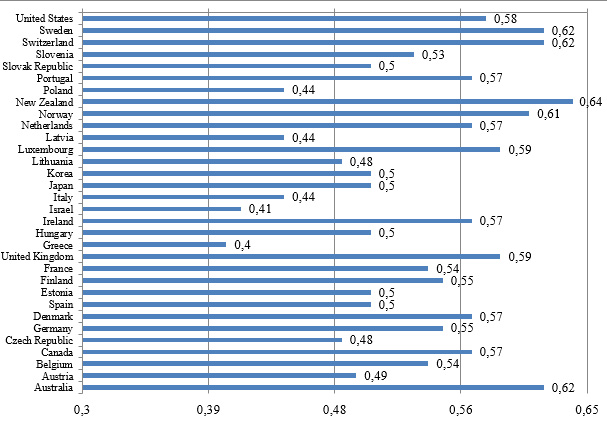
OECD Talent Attractiveness, which provides a comprehensive evaluation of national systems through an integrated index measuring each country’s attractiveness to highly educated workers (Figure 1).
Fig.1. Comparative attractiveness of countries for highly educated workers (OECD Talent Attractiveness Index, 2023)
The average Talent Attractiveness Index for EU Member States stands at 0.52, significantly lower than that of leading non-European economies such as Australia (0.62), New Zealand (0.64), Switzerland (0.62), and the United States (0.58). This indicates that, despite notable social progress and high quality of life, EU countries lag behind their global competitors in the institutional mechanisms for attracting and retaining highly educated workers. These mechanisms refer to comprehensive regulatory, administrative, and coordination frameworks that govern and support talent mobility. They include
legal and regulatory instruments,
institutional coordination (governments-business-universities),
incentive systems (grants, start-up funding),
digitalisation.
Within the European Union, a clear regional stratification emerges. Northern and Western Member States, including Sweden, the Netherlands, Ireland, Denmark, and Luxembourg, display levels of attractiveness comparable to the world’s leading talent hubs. These countries combine open labour markets, advanced innovation infrastructure, and high living standards, creating a favourable environment for skilled immigrants. In contrast, Southern and Central-Eastern European countries remain in the low- to mid-attractiveness range for highly qualified professionals from abroad (Italy 0.44; Spain 0.50; Poland 0.44; Latvia 0.44; Greece 0.40, among others), which limits their competitiveness in the global race for talent.
At the same time, the European Union faces a persistent phenomenon of technical talent outflow – engineers, IT professionals, and researchers moving to major innovation hubs outside the EU, notably the United States, Canada, and Australia. According to the
World Bank, the emigration of highly skilled workers can lead to a loss of human capital and fiscal resources in countries of origin, particularly when labour markets are rigid and opportunities for qualified employment are limited. However, the overall impact depends on governments’ ability to develop mechanisms for knowledge circulation and leverage diaspora potential for innovation and investment.
Evidence from the
European Parliament confirms that an increasing number of European researchers, engineers, and STEM graduates are leaving the EU in search of better working conditions and research funding. The most intensive outflow is observed in
Central and Southern Europe, where the absence of competitive research programmes and weak cooperation between universities and the private sector encourage emigration. Moreover, as noted by the
World Bank, high-skilled technological migration from Europe remains selective: return rates are particularly low among professionals from Central and Eastern European countries who have moved to the United States, Canada, and Australia, indicating a steady outflow of talent in the fields of digital technologies, engineering, and scientific research towards non-European innovation hubs.
The impact of skilled immigration on the EU’s competitiveness
The European Union stands out for its balanced social model and high quality of life, yet remains less attractive to skilled immigrants – a factor that limits the realisation of its competitive potential in the global knowledge economy. This leads to a deeper question: how exactly does skilled immigration affect national competitiveness? Today, talent mobility is viewed not merely as a demographic or labour phenomenon, but as a
structural driver of innovation, productivity, and technological renewal. The international mobility of skilled professionals
amplifies knowledge spillovers.
Knowledge spillovers (the diffusion of ideas and expertise generated through research and development activities) stimulate innovation, enhance competitiveness, and drive sustainable economic growth. Similarly, an
OCED study shows that regions with a higher share of highly skilled immigrants record higher levels of labour productivity, confirming the direct impact of human capital on economic performance. Consistent results are provided by
another study which identifies a persistent positive relationship between inflows of highly skilled immigrants, R&D expenditure, and patenting activity. In addition, the
OECD International Migration Outlook 2024 underlines that immigrants are increasingly acting as founders of start-ups and innovative enterprises, thereby stimulating job creation and accelerating technological renewal in host economies.
In this context, it is important to trace how the migration of skilled workers correlates with indicators of national competitiveness. To achieve this objective, the following indicators are used:
-
Foreign highly skilled personnel (IMD World Talent Ranking, 2025), which measures a country’s ability to attract highly qualified workers from abroad, reflecting the effectiveness of its talent-oriented migration policy, labour market openness, and overall quality of life;
-
World Competitiveness Ranking (2025), which provides a comprehensive assessment of Economic Performance, Government Efficiency, Business Efficiency, and Infrastructure.
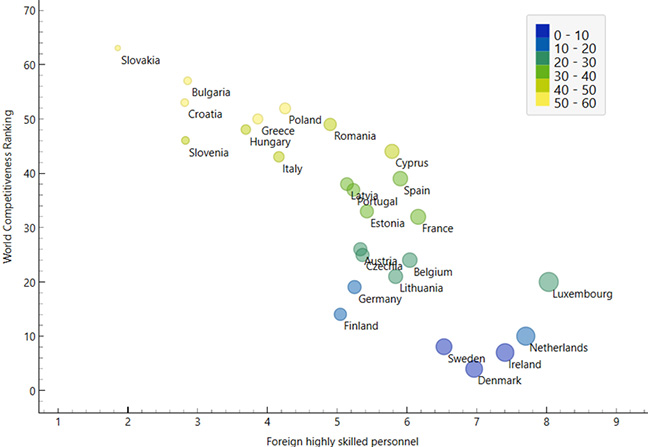
Comparing these two indicators makes it possible to observe how the attraction of foreign talent affects countries’ positions on the global competitiveness map, as well as to identify internal differences among EU Member States within the ‘race for talent’. To visualise the relationship between the skilled immigration and the level of competitiveness across the EU, a correlation plot was constructed (Figure 2).
Fig. 2. Correlation between foreign highly skilled personnel and national competitiveness in EU countries
The constructed diagram shows a clear correlation between the ability of EU Member States to attract highly skilled professionals and their level of competitiveness. Countries that more successfully integrate foreign talent, such as Denmark, Sweden, Ireland, the Netherlands, and Luxembourg, also occupy leading positions in the global competitiveness ranking. This confirms that skilled immigration is one of the key drivers of competitiveness growth across EU economies.
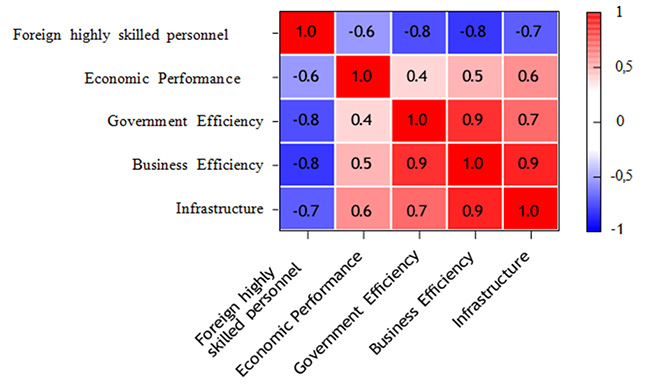
For a more detailed assessment of this relationship, it is relevant to analyse how the indicator of attracting highly skilled workers correlates with the main structural components of competitiveness defined by the IMD World Competitiveness Ranking: Economic Performance, Government Efficiency, Business Efficiency, and Infrastructure (Figure 3). Such differentiation helps to identify the specific channels through which skilled professionals from abroad contribute to national competitive advantages: whether through economic performance, government efficiency, business flexibility, or infrastructure development.
Fig. 3. Correlation between high-skilled immigration and the sub-indices of national competitiveness in EU countries
The results of the correlation analysis clearly demonstrate that the attraction of foreign highly skilled professionals has a systemic rather than a marginal impact on the competitiveness of EU Member States. Lower rank values correspond to better positions in the global competitiveness index. Hence, a negative correlation does not indicate a decline but rather an improvement in a country’s standing as the number of skilled immigrant’s increases.
The strongest correlation is observed between the indicator ‘Foreign highly skilled personnel’ and the sub-indices ‘Business Efficiency and Government Efficiency’. This suggests that the inflow of high-quality human capital is directly associated with improvements in the effectiveness of the business environment, managerial performance, and the institutional capacity of the state. In countries with a higher concentration of skilled immigrants, the business environment typically displays greater organisational flexibility, faster adoption of digital technologies, and a higher degree of openness to transnational cooperation.
This finding is supported by studies showing that inflows of highly skilled workers positively correlate with the level of business digitalisation, particularly the use of Big Data and artificial intelligence
technologies. Highly qualified immigrants are most frequently employed in sectors linked to technological innovation, automation, and digital transformation, thereby enhancing the overall competitiveness of the entrepreneurial sector. Moreover, skilled immigrants are increasingly becoming entrepreneurs in innovative industries, contributing to the creation of new business models and the expansion of the high-tech start-up market – a development that strengthens the European Union’s integration into global knowledge networks.
A slightly weaker, yet still significant, correlation is observed between the level of skilled immigration and the ‘Infrastructure’ component. This underlines that the quality of infrastructure – digital, educational, and scientific – not only attracts professionals but is itself strengthened by their presence. The correlation with ‘Economic Performance’ is of moderate strength, indicating an indirect relationship between skilled immigration and macroeconomic outcomes. Its effect materializes through improved business efficiency and enhanced quality of governance.
Thus, in today’s global context, skilled immigration functions not only as a demographic or labour phenomenon but as a structural factor of economic and innovation-driven modernisation. Through this channel, human capital becomes a resource for technological renewal, increased business efficiency, and infrastructure development – in other words, a foundation of the European Union’s long-term competitiveness.
Policy options for enhancing EU competitiveness
The results of the correlation analysis show that the inflow of skilled immigrants is most strongly associated with business efficiency and the quality of governance, with correlation coefficients reaching approximately -0.8, and also has a significant impact on infrastructure development. In this context, the focus should not be on expanding the quantitative dimensions of mobility, but on enhancing its qualitative impact: creating conditions in which each recruited professional becomes a carrier of managerial, innovative, and technological practices that transform the business environment and improve institutional effectiveness.
First and foremost, it is advisable to reconsider the role of skilled immigration within the European Union’s economic development strategies, integrating it into the broader frameworks of competitiveness, digital transformation, and innovation policy. In this regard, the instruments launched by the European Commission should be expanded towards deeper integration with innovation, industrial, and entrepreneurship policies.
The strong correlation between the indicator ‘Foreign highly skilled personnel’ and the ‘Business Efficiency’ sub-index suggests that the main transmission channel through which migration affects competitiveness operates via corporate dynamics: productivity, innovation, and the capacity for digital transformation. Accordingly, EU policy should promote such connections through financial and fiscal incentives, the expansion of corporate traineeship opportunities, and the creation of platforms for the exchange of managerial practices.
At the same time, the relationship between ‘Foreign highly skilled personnel’ and ‘Government Efficiency’ indicates a two-way interaction: effective institutions attract talent, while their presence, in turn, strengthens institutional quality. As emphasised in the
New European Innovation Agenda, enhancing Europe’s attractiveness for talent requires the establishment of a modern regulatory environment that enables the rapid testing and commercialisation of innovations while maintaining transparency and the competitiveness of the internal market.
Finally, the relationship between skilled immigration and ‘Infrastructure’ development confirms that scientific, educational, and digital infrastructures not only attract professionals but are themselves strengthened by their presence. This aligns with the findings of the OECD, which highlight the interdependence between access to research infrastructures and the quality of international scientific networks. In its initiative
Flagship 4: Fostering, Attracting and Retaining Deep Tech Talent, the European Commission underscores that modern infrastructure constitutes the foundation of Europe’s attractiveness to innovative professionals.
***
Therefore, the European Union’s policy on attracting skilled professionals must evolve from the liberalisation of mobility towards building the structural foundations of its effectiveness – institutional, business, and technological. This will require not only aligning migration mechanisms with labour market needs, but also developing indicators that measure the real contribution of talent to business performance. Only under these conditions will migration of talents become a core pillar of the EU’s sustainable competitiveness in the global knowledge economy.
At the same time, the attraction of skilled professionals should not be perceived only as a ‘brain drain’ from countries of origin, but rather as an opportunity to foster mutually beneficial partnerships that promote the circulation of knowledge and the development of human capital. The European Union, in its
policy framework, emphasises that the development of Talent Partnerships should contribute not only to the EU’s economic growth but also to strengthening the capacities of partner countries through investments in education, skills training, and technological exchange.
An important step in this direction is the conclusion of bilateral agreements between the European Union and countries of origin aimed at developing skills, providing vocational training, and creating conditions for the voluntary return of professionals with acquired experience. This approach transforms the concept of ‘brain drain’ into ‘brain circulation’, ensuring a fairer and more sustainable balance between the needs of the European labour market and the development of human potential in a global context.