
News
Corinne Deloy,
Helen Levy,
Fondation Robert Schuman
-

Available versions :
EN

Corinne Deloy

Helen Levy
Researcher at the Robert Schuman Foundation
Fondation Robert Schuman
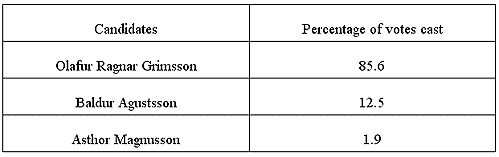
Olafur Ragnar Grimsson was easily re-elected President of the Republic of Iceland during the presidential election that took place on Saturday 26th June. The outgoing President won 85.6% of the vote far ahead of his two main adversaries, Baldur Agustsson, who won 12.5% of the vote and the businessman and militant pacifist Asthor Magnusson, who won 1.9% of the vote. Olafur Ragnar Grimsson was credited with around 90% of the intentions to vote in the most recent opinion polls versus 8.5% for Baldur Agustsson and 1.5% for Asthor Magnusson. The latter, who had notably distinguished himself by sending out hundreds of e-mails announcing an imminent terrorist attack against Iceland after 11th September 2001, had promised to make the presidential position apolitical again.
The turn-out rate comprised the only stake in this election in which Olafur Ragnar Grimsson was not threatened by any of his rivals. 62.5% of Icelanders turned out to vote i.e. 23.4 points less than during the presidential election on 29th June 1996 (President Grimsson was declared re-elected in 2000 without the organisation of an election). The abstention rate this time was the greatest ever recorded in Iceland's history. In addition to this one voter in five (20.7%) followed the voting advice of the President's opponents by placing a blank slip in the ballot box. Usually blank and void slips represent between 1 and 2% of the vote. "A figure of around 10% would indicate that the President is no longer a consensual political figure and that he has taken on a more political role", declared Olafur Hardarsson, a professor of political science at the University of Iceland just before the election. Like the high abstention rate the high numbers of blank slips bear witness to a certain amount of discontent of part of the population with their President.
The start of the third four year mandate by Olafur Ragnar Grimsson as head of the Icelandic State will be marked by the organisation of a referendum relative to the law on the media voted on 25th May last by the Althing, the Icelandic Parliament. This popular election that follows the President's veto on the Prime Minister David Oddson is to be organised during the month of August.
Results of the Icelandic Presidential Election on 26th June 2004
Turn out rate: 62.5%
 Source: Agence France Presse
On the same theme
To go further
Elections in Europe

Helen Levy
—
2 June 2026
Elections in Europe

Helen Levy
—
26 May 2026
Elections in Europe
Helen Levy
—
12 May 2026
Elections in Europe
Helen Levy
—
5 May 2026

The Letter
Schuman
European news of the week
Unique in its genre, with its 200,000 subscribers and its editions in 6 languages (French, English, German, Spanish, Polish and Ukrainian), it has brought to you, for 15 years, a summary of European news, more needed now than ever
Versions :