
Analysis
Elections in Europe
Helen Levy
-

Available versions :
EN

Helen Levy
Researcher at the Robert Schuman Foundation
On 27 April, the President of Malta, Myriam Spiteri Debono (Labour Party, PL), dissolved the House of Representatives (Kamra tad-Deputati), the single chamber of Parliament, following a call by the outgoing Prime Minister, Robert Abela (PL), for a snap election on 30 May. This decision comes nine months ahead of schedule, due, according to Robert Abela, to the international geopolitical situation, as he seeks a fourth consecutive term in order to maintain ‘stability’. He believes that in these troubled times, Malta needs strong leadership to guide it in the context of the war in Ukraine and, above all, the conflict in the Middle East.
Alex Borg, leader of the Nationalist Party (PN), will lead the election campaign in an attempt to return to power after 13 years in opposition.
The most recent polls published on 6 May suggest a victory for the Labour Party, which is expected to win 52% of the vote, compared with 43% for the Nationalist Party.
Candidates had until 11 May to submit their applications. The list of candidates is available on the Electoral Commission’s site.
Immediate launch of the campaign
The Labour Party launched its campaign the day after the election was called. It has pledged to extend maternity leave, cut taxes and provide financial support for young people, first-time homebuyers and senior citizens. It also announced that it would make the ferry service between Malta and Gozo free for pedestrians; it also promised a €45 million interconnector (an undersea power cable, which would improve the reliability and security of the energy supply in this part of the archipelago), as well as the modernisation of schools and the repair of infrastructure in Gozo.
The Nationalist Party was quick to announce its proposals, which are quite similar to those of the Labour Party, whilst claiming that it had been the first to come up with these same ideas and to have presented them during the last election campaign in 2022. Alex Borg, however, has emphasised reform and restructuring. He wishes to attract young people back to Malta by establishing what he calls the ‘innovation economy’, asserting that the country has already made significant progress in terms of growth and prosperity, but that the time has now come to examine how this momentum can be sustained in a viable manner, for the benefit of all. He proposed extending maternity leave from the current 18 weeks to six months on full pay.
The election campaign
It would appear that purchasing power and inflation are at the heart of the campaign; yet key issues such as the economy and the international situation are completely absent, as is corruption, which has taken a back seat. This stands in stark contrast to previous elections and, above all, to the situation that followed the 2017 murder of the 53-year-old journalist and whistleblower Daphne Caruana Galizia.
The lack of attention paid to the rule of law in this election may come as a surprise, given that Malta was the focus of a debate in the European Parliament on 21 October 2025 (the anniversary of Daphne Caruana Galizia’s death), the two sides of the Maltese political scene accused each other of trying to damage Malta’s reputation.
The debate concluded that, although progress had been made since the murder in terms of protecting journalists and media freedom, much work remained to be done to ensure the safety and security of those involved and to eradicate corruption. Indeed, although five people have been convicted in connection with Daphne Caruana Galizia’s death, the authorities have still not brought the mastermind behind the plot to justice. In February 2019, Yorgen Fenech, a businessman, was arrested and charged with being an accomplice in the murder of Daphne Caruana Galizia, but after more than 30 months in custody – the maximum period for pre-trial detention in Malta – he was released on bail in February 2025 and is currently awaiting trial. He was one of the people the murdered journalist was investigating due to their involvement in the ‘Panama Papers’ scandal. It should be noted that in October 2020, the European Parliament decided to award a prize for journalism named after the Maltese journalist.
The parties in the running
Since Malta gained independence from the United Kingdom on 21 September 1964, only two political parties have won seats in Parliament: the Labour Party (PL), on the left, and the Nationalist Party (PN), a Christian-democratic party on the right.
A few smaller parties, such as the Democratic Alternative (AD) and the Democratic Party (PD), the environmentalist coalition (AD+PD), Momentum (a centrist party), Imperium Europa (far right) and the conservative People’s Party (Aħwa Maltin), will field candidates in this election, but their chances of overturning the existing two-party system are slim. There will also be independent candidates.
In the archipelago, partisan divisions are deep and voter loyalty to their party is high (between 70% and 80%). Finally, Maltese voters are by far the most likely among Europeans to turn out for every election, even though voting is not compulsory.
The Maltese political system
The Maltese Parliament is unicameral. The House of Representatives comprises 65 members elected from thirteen constituencies (five members per constituency) for a five-year term; however, additional seats may be allocated to ensure that the proportion of the vote received by each party corresponds to the number of seats it holds, which must always be an odd number; as a result, the current House has 79 members.
The voting system – proportional representation with a single transferable vote – is unusual in that the island has shared it since 1921 with only two other countries in the world: Ireland and Australia.
Several reforms have been proposed to simplify this voting system, but without success. In 1987 and 1996, however, a number of amendments were adopted, notably to ensure that the party receiving the highest number of first-preference votes secures a majority. On 12 December 1981, the Nationalist Party came first in the general election but won fewer seats than the Labour Party, leading to a political crisis.
Under this system, voters select, from a list of candidates, the one or ones for whom they wish to vote, in order of preference. The number 1 is written next to the preferred candidate, then, if desired, the numbers 2, 3, 4, etc. next to the names of the other candidates on the list. The calculation of the electoral quotient—that is, the minimum number of votes a candidate must obtain to be elected—is the first step in the counting process. This quotient corresponds to the total number of votes cast divided by the number of seats to be filled (3, 4 or 5 depending on the constituency) plus one. Any candidate who obtains this number of votes is elected. Votes exceeding this number are then distributed among the second-choice candidates.
Candidates may stand in a maximum of two constituencies. If they are elected in both, they choose which one they will represent following the election. Vacant seats are filled through a so-called ad hoc election prior to the first session of the House of Representatives (which must take place within two months of the announcement of the results). Any candidate not elected in the main election may stand in the ad hoc election in their constituency. However, in practice, only candidates from the party that left the seat vacant take part in the election (so that the overall result remains unchanged).
Anyone wishing to stand in the general election must obtain the support of at least four people in their constituency. Their €90 deposit is refunded if they obtain more than one-tenth of the electoral quotient.
Maltese citizens living abroad must return home to vote. Air Malta operates charter flights to enable them to fulfil their civic duty.
In Malta, donations to political parties and election campaigns are anonymous (in Europe, only Denmark and Andorra still guarantee this anonymity). There is no law requiring political parties to make their accounts public.
Finally, the Maltese Parliament elects the President of the Republic of Malta for a five-year term; the President has few powers, and the role is essentially ceremonial. The current Head of State, Myriam Spiteri Debono (PL), was elected on 4 April 2024. She is the first woman from Gozo to hold the presidential office.
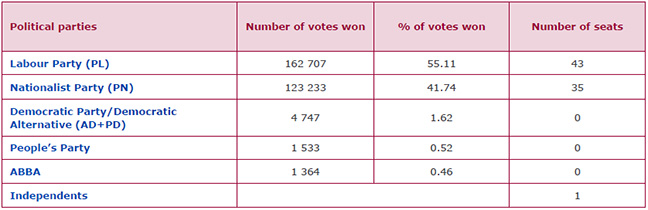
Two political parties are represented in the current House of Representatives:
the Labour Party (PL), a social-democratic party founded in 1920 and led by the outgoing Prime Minister Robert Abela, holds 43 seats;
the Nationalist Party (PN), a Christian-democratic party founded in 1880 and led by Alex Borg, holds 35 seats.
One MP is an independent.
Results of the general election held on 26 March 2022 in Malta
Turnout: 85.6%
On the same theme
To go further
Elections in Europe

Helen Levy
—
13 October 2026
Elections in Europe

Helen Levy
—
6 October 2026
Elections in Europe

Helen Levy
—
15 September 2026
Elections in Europe
Helen Levy
—
15 September 2026
The Letter
Schuman
European news of the week
Unique in its genre, with its 200,000 subscribers and its editions in 6 languages (French, English, German, Spanish, Polish and Ukrainian), it has brought to you, for 15 years, a summary of European news, more needed now than ever
Versions :