
Analysis
Elections in Europe
Helen Levy
-

Available versions :
EN

Helen Levy
Researcher at the Robert Schuman Foundation
On 24 May, more than half a million Cypriots are set to go to the polls to elect 56 members of Parliament, the Vouli antiprosopon. The Speaker of the House, Annita Demetriou, dissolved the House of Representatives on 23 April, in accordance with the mandatory 30-day period preceding general elections.
These elections, taking place whilst the country holds the presidency of the Council of the European Union until 30 June and as the conflict in the Middle East affects it, could mark a turning point on the political scene, as confidence in the old system, in place since the island’s independence from Britain in 1960, is waning.
Rise of the far right
The Democratic Rally (DISY, EPP), a Christian Democratic movement which, in thepast, won the majority of votes alongside the Democratic Party (DIKO, S&D), the Socialist Party (EDEK, S&D) and the far-left Progressive Party of Working People (AKEL, Left), now face stronger competition from the National Popular Front (ELAM, ECR).
Since its creation in 2011, and then in the wake of the 2012–2013 financial crisis, the party led by Christos Christou has made steady gains by capitalising on public discontent. Voting intentions in favour of ELAM have doubled compared to the last election in 2021. It is now credited with 13.8% compared to 6.78% in 2021. Although the Cypriot proportional representation system has favoured its rise in rural areas, rather than in cities, this has enabled it to establish itself on the political scene, particularly in opposition to immigration and progressive social norms. It has also emphasised the need to increase defence spending to counter any attempt by Turkey to strengthen its positions around Cyprus. Finally, it has highlighted energy supplies, framing these issues as matters of Cypriot sovereignty rather than as pragmatic solutions. The discourse on sovereignty and identity is a refrain that plays on the population’s feelings of identity and nationalism, thereby enabling the party to win popular support.
… and the arrival of newcomers
The ALMA party (Citizens for Cyprus), a ‘big tent’ movement - open to all and non-partisan, was founded by a former auditor general, Odysseas Michaelides, in May 2025. Although he was dismissed from his post following a controversy in September 2024, he retains among many Cypriots a reputation as a man who fights corruption and advocates transparency. He claims that his new party aims to reform and revitalise political life.
Another newcomer is Feidias Panagiotou, known as Fidias, a 25-year-old YouTuber and influencer who founded the Direct Democracy (ADK) party in October 2025 after winning a seat as an independent MEP in the June 2024 European elections with 19.3% of the vote. His victory sparked a wide-ranging debate on the future of traditional parties in Cyprus, due to his use of new methods on social media to gain an audience and, consequently, support. The interest he generated was mainly triggered by his focus on the ‘Cyprus problem’ – with the aim of appealing to Turkish Cypriots – whose republic is recognised only by Turkey. He posted a video with a famous Turkish Cypriot YouTuber, “Urban Cypriot” – alias Ibrahim Beycanli – as they met at the Ledra Street crossing, which was reopened for the first time in 29 years in April 2003. This meeting sparked mixed reactions among the public since the video was released on 14 August, the 50th anniversary of the second phase of the 1974 Turkish invasion, which divided the island. But despite the criticism expressed, he has received numerous messages of support. On the Turkish side, the reception has been mixed. His stance could be interpreted as a message from young voters, weary of a situation which, in their view, should now be resolvable. However, the division of the island remains a major bone of contention. Talks regarding a federal solution to the problem, and the dialogue led by the UN, are still ongoing. The current president, Nikos Christodoulides, has expressed his hope for a unified Cyprus.
Strategic position in the Eastern Mediterranean
Due to its strategic position in the eastern Mediterranean, Cyprus finds itself at the centre of the ongoing conflict between Iran and Israel, and particularly its spillover into Lebanon. The island received notably the support of France, during a visit by the French President last March alongside the Greek Prime Minister, to ensure the security of the region. This solidarity was once again recalled on the sidelines of the informal European Council meeting held in Cyprus on 23 and 24 April.
Political situation and voting intentions
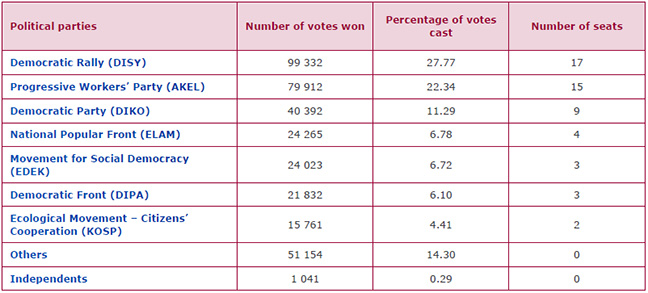
Seven political parties won seats in the House of Representatives in the last general election on 30 May 2021:
- The Democratic Rally (DISY), founded in 1976 and led by Annita Demetriou, holds 17 seats; - The Progressive Party of Working People (AKEL), founded in 1926 as the Communist Party (CPC) but which has abandoned some of its Marxist-Leninist ideals, is led by Stefanos Stefanou and holds 15 seats;
- the Democratic Party (DIKO), founded in 1976 and led by Nicolas Papadopoulos, holds 9 seats;
- the National Popular Front (ELAM), an offshoot of the Greek ‘Golden Dawn’ party, a nationalist party led by Christos Christou, holds 4 seats.
- the Movement for Social Democracy (EDEK), founded in 1969 and chaired by Nikos Anastasiou, holds 3 seats;
- the Democratic Alignment (DIPA), a centrist, liberal-democratic party led by Marios Karoyian, holds 3 seats;
- the Green Movement – Citizen Cooperation (KOSP), a green party led by George Perdikes, holds 2 seats.
25 political parties have already registered to take part in the general election. Applications from two further parties are currently under review; if their applications are successful and they submit their candidacy by 6 May, the number of participating parties could rise to 27.
According to the latest polls, the DISY and AKEL parties are neck and neck (21–22% of the vote), ahead of the ELAM (13.8%), ADK (10%) and ALMA (9%) parties. The DIKO party is expected to secure 7.7%. The other parties are credited with VOLT at 5%, EDEK at 3%, KOSP and KEKK at 2.6% and DIPA at 1.8%. Candidates also have until 6 May to declare their intention to stand in the election. The new parliament will convene on 4 June.
The Cypriot political system
The 1960 Constitution has not been applied on the island since the inter-communal unrest of 1963. The President of the Republic of Cyprus, elected by universal suffrage for a term of five years, also serves as head of government.
The Vouli antiprosopon (House of Representatives) is the single chamber of Parliament. In July 1985, MPs passed a law setting the number of seats at 80: 56 (70%) are elected by Greek Cypriots and 24 (30%) are reserved for the Turkish community. Given that no peace agreement has yet been signed to resolve the division of the island, these seats remain vacant and will not be filled on 24 May.
Candidates in the parliamentary elections must be at least 25 years old.
The electoral law sets a spending limit of €25,000 for each candidate’s campaign, with an additional €5,000 allowed for personal expenses. Parties and campaign teams have been reminded that they are required to provide detailed statements of their income and expenditure.
The election is being held using the Hare-Niemeyer method across six constituencies: of the 56 seats, 19 will go to MPs from Nicosia, 12 to MPs from Limassol, 11 to MPs from Famagusta, 6 to MPs from Larnaca, 5 to MPs from Paphos and 3 to MPs from Kyrenia. Paphos has gained an additional seat for this election due to the increase in its electorate, with this gain coming at the expense of Nicosia. Voters may choose to vote for a single party (by ranking that party’s candidates in order of preference) or for candidates from different parties.
Finally, the Cypriot Parliament has 3 MPs who represent the country’s religious minorities (Armenian Orthodox, Maronite Catholics and Latin Catholics) and who are each elected solely by members of their own community. Each community has around 5,000 members and is grouped into an enclave. The legislative powers of these MPs are limited to education and ethnic and religious matters.
It should be noted that Cyprus elects its President of the Republic, who also serves as Head of Government. In February 2023, Nikos Christodoulides, former Minister of Foreign Affairs (2018–2022) and former Government Spokesperson (2013–2018), won the presidential election with 51.97% of the vote in the second round. A former member of the Democratic Rally (DISY), supported by the Democratic Party (DIKO), the Movement for Social Democracy (EDEK) and the Solidarity Movement (DIPA), he stood as an independent. He beat Andreas Mavroyiannis, who secured 48.03% of the vote and was also standing as an independent, whilst being supported by the Progressive Party of Workers (AKEL) and the left-wing party Generation Change. Voter turnout stood at 72.45%. The next presidential election will be held in 2028.
Results of the general elections held on 30 May 2021 in Cyprus
Turnout: 65.72%
Source : https://results.elections.moi.gov.cy/english/parliamentary_elections_2021_127/islandwide
On the same theme
To go further
Elections in Europe

Helen Levy
—
13 October 2026
Elections in Europe

Helen Levy
—
6 October 2026
Elections in Europe

Helen Levy
—
15 September 2026
Elections in Europe
Helen Levy
—
15 September 2026

The Letter
Schuman
European news of the week
Unique in its genre, with its 200,000 subscribers and its editions in 6 languages (French, English, German, Spanish, Polish and Ukrainian), it has brought to you, for 15 years, a summary of European news, more needed now than ever
Versions :