
Results
Elections in Europe
Helen Levy
-

Available versions :
EN

Helen Levy
Researcher at the Robert Schuman Foundation
568,000 Cypriots were eligible to vote on 24 May 2026 to elect the 56 representatives (the 24 seats allocated to the Turkish speaking part of the population have remained empty since 1985) who will sit in the single Chamber of Representatives for the next five years. They were able to cast their ballot in 1,217 polling stations across the island and in 13 situated abroad (5 in Athens, 3 in Thessaloniki, 4 in London and 1 in Brussels). In this election a record number of candidates were standing; 752 people representing more than 18 parties or themselves (independents) were registered. This number possibly heralds the weakening influence of the three main parties and notably those forming the coalition (DIKO, DIPA and EDEK) supporting incumbent president Nikos Christosdoulides.
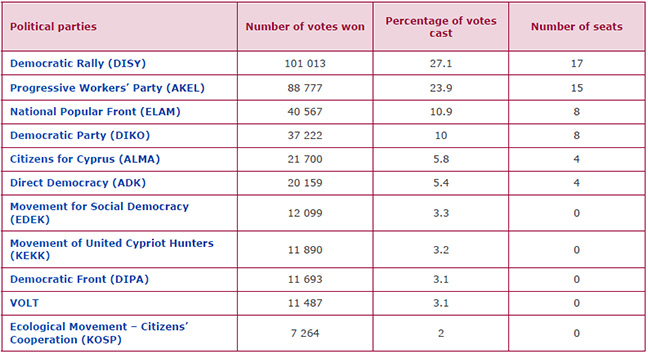
The election resulted in a win for the Democratic Rally (DISY) with 27.1% and 17 seats, losing only 0,8% in comparison with the last election in 2021, followed closely by the left-wing Progressive Workers’ Party (AKEL), with 23.9% of the vote and 15 seats (+1.4%). The far-right movement, ELAM (National Popular Front), captured third place with 10.9% and 8 seats, (+4%) running neck and neck with the Democratic Party (DIKO) which garnered 10% and 8 seats (-1.3%). Two newcomers in the shape of ALMA (Citizens for Europe) 5.8%, 4 seats and ADK (Direct Democracy) 5.4% and 4 seats, will be making their entry into parliament. All of the other parties failed to rise above the 3.5% mark necessary to be represented in Parliament. These were the moderate left Movement for Social Democracy (EDEK), which came 7th and scoring only 3.3%, (-3.5%) and losing 4 the four seats it had won in 2021, the centrist Democratic Front (DIPA) 3.1% (-3%) which also lost four seats, KEKK, 3.2%, Volt 3.1% and the Ecological Movement – Citizens’ Cooperation (KOSP), 2% (-2.5%) which lost 3 seats.
Six parties will be represented in the Chamber of Representatives (in contrast to 7 in the previous legislature).
As forecast the Cypriot political landscape is evolving; the next parliament will comprise two newcomers: the anti-corruption platform ALMA, headed by former Auditor General Odysseas Michaelides and a more modern movement, ADK, led by You Tube/social network influencer Fidias Panayiotou. There will also be a stronger representation on the far-right. ELAM, led by Christos Christou, who campaigned on an anti-migration, anti-Turk ticket. This party will be a force to be reckoned with, although many who have captured seats have already ruled out working with ELAM in the future parliament.
The electorate clearly seems to be challenging the status quo: it seems they are tired of the continued division of the island, and as in other countries, they have other grievances on their mind such as the cost of living, migration. This result could also be a mark of a growing lack of trust in the institutions that have headed the country since its independence from the UK in 1960.
One thing is certain however, a more difficult period now lies ahead of President Nikos Christodoulides who was elected in 2023 after campaigning to unite all Cypriots, promising to focus on the cost of living, immigration and the “Cyprus problem” – i.e. its division. Having lost his centrist allies, he will have to play a delicate game in securing the continuation of the path he promised for key policies such as the economy, migration, social policy and energy.
This general election therefore represents a significant political test ahead of the 2028 presidential election.
Results of the general elections held on 24 May 2026 in Cyprus
Turnout: 66.91%
Source : https://live.elections.moi.gov.cy/
On the same theme
To go further
Elections in Europe

Helen Levy
—
13 October 2026
Elections in Europe

Helen Levy
—
6 October 2026
Elections in Europe

Helen Levy
—
15 September 2026
Elections in Europe
Helen Levy
—
15 September 2026
The Letter
Schuman
European news of the week
Unique in its genre, with its 200,000 subscribers and its editions in 6 languages (French, English, German, Spanish, Polish and Ukrainian), it has brought to you, for 15 years, a summary of European news, more needed now than ever
Versions :