
Results
Elections in Europe
Helen Levy
-

Available versions :
EN

Helen Levy
Researcher at the Robert Schuman Foundation
On 30 May the Maltese opted for the “stability” offered by Robert Abela’s Labour Party in the snap election that was organised nine months ahead of the originally planned date. This victory was not as comfortable as in 2022. The Labour Party won with a majority of just under 22,000 votes whilst its margin stood at 39,474 in the previous election. This means a fourth consecutive term in office for the Labour Party, a first for any party since the introduction of universal suffrage in Malta in 1921. It captured 51.77% of the vote and 36 seats (8 seats down on the previous election). The National Party, led by Alex Borg won 44.68% of the vote and garnered 31 seats (-4). Another significant point is that Labour did not succeed in securing the 13th district which lies on Gozo, one of Malta’s smaller islands. This was a first in 20 years according to the local press.
For its part Momentum garnered 1.54% of the vote, AD/PD won 1.31%, Aħwa Maltin 0.6% and Imperium 0.05%, illustrating that Malta is still very much a two-party nation with little room for any alternative movements to make headway.
48-year-old Robert Abela declared that his party “had made history” and that he now had a strong mandate from the people to continue his policy which aims to shield the island from the turmoil caused by the ongoing conflict in neighbouring Middle East that is threatening import-dependent Malta. The Labour Party had campaigned on its economic achievements since 2013, declaring that it could continue along this stable path. 30-year-old Nationalist Party leader, Alex Borg conceded victory to his rival. The Nationalist Party had campaigned on change and restructuration.
These elections also mark a real turning point for women, as for the first time they have doubled their tally and secured 10 elected representatives (5 from each party), compared with just 4 in 2022. Furthermore, a gender parity adjustment mechanism, introduced in 2021, provides for up to 12 additional seats (6 per party) in the event that an ‘under-represented gender’ secures fewer than 40% of the seats in Parliament. This compensatory measure to ensure better representation of women will apply to both parties and will effectively lead to the allocation of additional seats for women in the new legislature.
Voter turnout was high at 87.5%, 2 points up from the last elections, showing that the Maltese are very much engaged in the political life of their country and dedicated to supporting their preferred parties.
Robert Abela was sworn in as prime minister at a ceremony held in Valletta at 11am on Monday June 1.
Results of the general election held on 30 May 2026 in Malta
Turnout: 87.5%
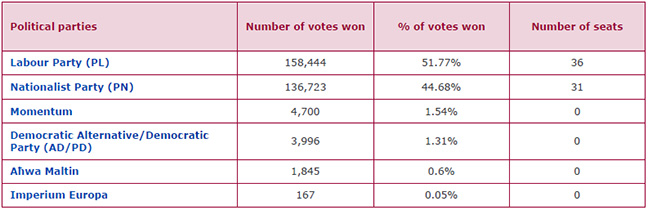
Source : Electoral Commission of Malta
On the same theme
To go further
Elections in Europe

Helen Levy
—
13 October 2026
Elections in Europe

Helen Levy
—
6 October 2026
Elections in Europe

Helen Levy
—
15 September 2026
Elections in Europe
Helen Levy
—
15 September 2026

The Letter
Schuman
European news of the week
Unique in its genre, with its 200,000 subscribers and its editions in 6 languages (French, English, German, Spanish, Polish and Ukrainian), it has brought to you, for 15 years, a summary of European news, more needed now than ever
Versions :