
Analysis
Elections in Europe
Corinne Deloy
-

Available versions :
EN

Corinne Deloy
On 18 January, 11 million Portuguese citizens will go to the polls for the first round of the presidential election to choose the successor to Marcelo Rebelo de Sousa (Social Democratic Party, PSD), who has been head of state since 2016, serving two terms, and who cannot stand for re-election. If none of the candidates wins more than 50% + 1 vote, a second round between the two leading candidates will be held on 8 February.
Portuguese citizens living abroad are allowed to vote by post or by going to the embassies or consulates of the countries where they live. The Portuguese diaspora comprises around 1.5 million people. Only 30,000 of them voted in the previous presidential election in January 2021.
The 2026 presidential election is the fifth election in which Portuguese citizens have been called to vote since March 2024 (the seventh for the inhabitants of Madeira, who have voted twice in regional elections), following the legislative elections of 10 March 2024, the European elections on 9 June 2024, the legislative elections on 18 May 2025 and the local elections on 12 October 2025.
The centre-right liberal Social Democratic Party won the latter election with 34.30% of the vote (winning 136 town halls, 22 more than in the municipal elections of 26 September 2021), ahead of the Socialist Party (PS), which won 33.20% of the vote (127 town halls, down 21, including those of Lisbon and Porto). 59.30% of Portuguese citizens turned out to vote.
The candidates in the running
Eleven candidates are running in the presidential election on 18 January and 8 February, a record number in the country's history:
- Henrique Gouveia e Melo (independent), former Chief of Staff of the Navy (2021-2024), also known for leading the Covid-19 vaccination programme in Portugal;
- Andre Ventura (Chega! CH), founder and leader of the radical right-wing party and Member of Parliament;
- Luis Marques Mendes (Social Democratic Party, PSD), former Secretary-General of the PSD (2005-2007) and former Minister for Parliamentary Affairs (2002-2004);
- Antonio Jose Seguro (Socialist Party, PS), former secretary-general of the PS (2011-2014);
- Joao Cotrim Figueiredo (Liberal Initiative, IL), Member of the European Parliament;
- Antonio Filipe (Communist Party, PCP), supported by Heloisa Apolonia's Ecologist Party-The Greens (PEV), Member of Parliament;
- Catarina Martins (Left Bloc, BE), Member of the European Parliament;
- Jorge Pinto (Livre/Free, L), Member of Parliament;
- André Pestana (independent), national coordinator of the Union of All Teachers (STOP);
- Manuel Joao Vieira (independent), artist;
- Humberto Correia (independent), artist.
The latest opinion poll credits Andre Ventura with 20% of the vote, Luis Marques Mendes with 19%, Antonio Jose Seguro with 17% , Henrique Gouveia e Melo and Joao Cotrim Figueiredo with 16%. Given the low reliability of polls in Portugal and the narrow margins between these five candidates, it is difficult to know who will qualify for the second round.
One thing is certain however: this election is unlikely to produce a successor to Marcelo Rebelo de Sousa in the first round, which would be a first since 1986. Apart from then, 40 years ago, which saw the victory of Mario Soares (PS), the head of state has always been elected in the first round since the Carnation Revolution, which in 1974 brought an end to the dictatorship established by António Salazar in 1933.
Issues such as health, immigration, labour law and the use of presidential powers, such as the authority to dissolve parliament, are central to the election campaign.
The Electoral Campaign
In November 2024, Henrique Gouveia e Melo refused to be reappointed as Chief of Staff of the Navy and began preparing his candidacy for the Presidency of the Republic. "I served Portugal for 45 years. When Portugal needed me, I was there, I was always there. I didn't ask the Portuguese people at the time whether they were left-wing or right-wing. The only thing I asked was what needed to be done, and I did it. The Portuguese people know they can count on me," he recently declared.
Gouveia e Melo likes to emphasise that his candidacy ‘aims to unite the Portuguese people’ and that ‘his party is Portugal’. He sees himself as the only independent candidate, and declares that he is ‘truly above political divisions, independent and a bringer of change’. He emphasises the defence of Europe. ‘My candidacy is the one that can contribute the most, at this moment, to Portugal's security, stability and progress in cohesion,’ he said, adding, "I am a moderate and balanced person, positioned in the centre, but I am a pragmatist. I want to solve the problems that have been affecting the lives of the Portuguese people for a long time. For more than 20 years, the country has been stagnating." Gouveia e Melo is considered by many of his compatriots to be the saviour of the country because of his role during the Covid-19 epidemic.
Long considered the favourite in opinion polls, he saw his popularity decline after televised debates in which he showed his inexperience. These debates between candidates began on 17 November.
Andre Ventura is campaigning in an attempt to capitalise on the unease and discontent of some of his compatriots. He wants to stop all immigration. On 22 December, Judge Ana Barao of the Lisbon court ordered the far-right leader to remove his campaign posters that targeted the Roma community within 24 hours. The court ruled that certain slogans, such as ‘Gypsies must respect the law’, might possibly incite hatred and discrimination.
Ventura has said he supports the organisation of referendums on the regionalisation of Portugal and on euthanasia. ‘If I am elected President of the Republic, I will not be a ribbon cutter, I will pursue interventionist policies and I will be an active head of state,’ he said.
‘Andre Ventura wants to take advantage of this election campaign to continue to advance his party, but he knows that even if he manages to make it to the second round, he will not win,’ commented José Adelino Maltez, a political scientist at the University of Lisbon.
For his part Luis Marques Mendes, former president of the PSD, can draw on his political experience. He quickly established himself as his party's candidate, announcing his candidacy in February 2025 and securing its support in May. Backed by Nuno Melo's Democratic and Social Centre/People's Party (CDS/PP), the PSD's partner in government, and by Prime Minister Luis Montenegro, Marques Mendes nevertheless is struggling due to internal divisions within his party. Supporters of Pedro Passos Coelho, who was Prime Minister between 2011 and 2015, do not like him and have chosen to support the PS candidate, Antonio Jose Seguro! Those close to former PSD president (2018-2022) Rui Rio are backing Henrique Gouveia e Melo.
The former secretary-general of the PS, Antonio Jose Seguro, who managed to impose his candidacy within his party, should therefore not be underestimated. He is a representative of the centrist wing of the PS. He will have to contend with three other left-wing candidates: MP Antonio Filipe (Communist Party, PCP), MEP Catarina Martins (Left Bloc, BE) and MP Jorge Pinto (Livre/Free, L).
The presidential office in Portugal
The President of the Portuguese Republic is elected every five years by direct universal suffrage. Anyone wishing to stand as a candidate for the highest office must be at least 35 years of age and has to have the signatures of at least 7,500 voters.
The role of head of state in Portugal is mainly ceremonial. As a moral authority, the President of the Republic nevertheless has two essential powers: he appoints the Prime Minister and can dissolve Parliament (Article 172 of the Constitution) six months after taking office, which leads de facto to new general elections.
The President of the Republic is the head of the armed forces and appoints the chiefs of staff. On the recommendation of the government, he appoints ambassadors. He may declare a state of emergency or martial law, or even war in the event of actual or imminent aggression. He signs laws and decrees passed by Parliament, over which he has the right of veto. On the recommendation of the government or Parliament, he decides on the organisation of referendums.
The Head of State may not serve more than two consecutive terms.
Reminder of the results of the presidential election held on 24 January 2021 in Portugal
Turnout: 60.74%
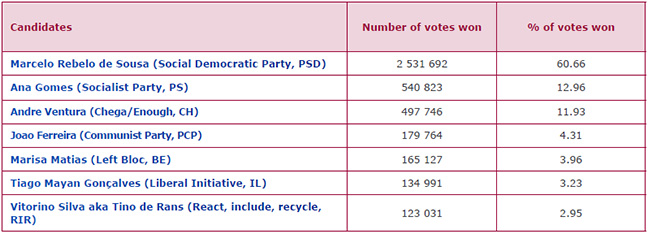
Source : https://files.diariodarepublica.pt/1s/2021/02/02702/0000200002.pdf
On the same theme
To go further
Elections in Europe

Helen Levy
—
13 October 2026
Elections in Europe

Helen Levy
—
6 October 2026
Elections in Europe

Helen Levy
—
15 September 2026
Elections in Europe
Helen Levy
—
15 September 2026

The Letter
Schuman
European news of the week
Unique in its genre, with its 200,000 subscribers and its editions in 6 languages (French, English, German, Spanish, Polish and Ukrainian), it has brought to you, for 15 years, a summary of European news, more needed now than ever
Versions :