
Results
Elections in Europe
Corinne Deloy
-

Available versions :
EN

Corinne Deloy
10.9 million Portuguese citizens, including 1.6 million living abroad, have made their choice: António José Seguro (Socialist Party, PS), former secretary-general of the Socialist Party (2011–2014), and André Ventura (Chega! Enough! CH), founder and leader of the radical right-wing party, are the two candidates who came out ahead in the first round of the presidential election on 18 January. Once again, opinion polls failed to predict the results of the election.
The Socialist candidate won 31.11% of the vote, a very high result compared to that predicted by the polls, while the far-right leader won 23.52% of the vote. He improved on his result in the previous presidential election on 24 January 2021, but failed in his bid to finish in the lead. Antonio Jose Seguro and Andre Ventura will face each other in a second round on 8 February. This is the first time since 1986 that Portugal has had a second round, since the head of state is usually elected in the first round.
The winner will succeed Marcelo Rebelo de Sousa (Social Democratic Party, PSD), who has been head of state since 2016, serving two terms, and who is therefore ineligible for a third term. He will become the sixth president of the Third Republic.
This presidential election brought together 11 candidates, a record number in the country's history. It is the most contested since the first election of the President of the Portuguese Republic by direct universal suffrage in 1976, two years after the Carnation Revolution that ended the dictatorship established by António Salazar in 1933.
Henrique Gouveia e Melo (independent), former Chief of Staff of the Portuguese Navy (2021-2024), came in third place with 16% of the vote. He was followed by MEP Joao Cotrim Figueiredo (Liberal Initiative, IL), who obtained 12.32% of the vote. The candidate supported by the incumbent Prime Minister Luis Montenegro (Social Democratic Party, PSD), Luis Marques Mendes (PSD), came in fifth with 11.3% of the vote. The latter had a difficult election campaign: he suffered from his proximity to the ruling party and competition from both the Liberal candidate and Henrique Gouveia e Melo. The latter suffered from his political inexperience.
Finally, Joao Cotrim Figueiredo, who had made a breakthrough in the opinion polls, was weakened by accusations of sexual assault made in recent weeks by a former colleague in his parliamentary group in the Assembly of the Republic, the lower house of parliament. The six other candidates each obtained under 2% of the vote.
Voter turnout was high in a country where it is traditionally low: 52.35%, up 13.09 points from the first round of the previous presidential election on 24 January 2021.
Results of the first round of the presidential election on 18 January 2026 in Portugal
Turnout: 52.35%
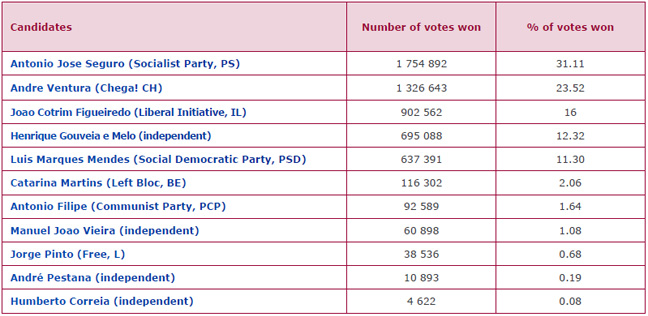
Source : https://www.presidenciais2026.mai.gov.pt/resultados/globais
Antonio Jose Seguro had indicated that he wanted to turn the first round into a ‘useful vote’ for the left. It seems that his wish was granted beyond his expectations. As soon as the results were announced, he called for unity against the far right: ‘I call on all democrats, all progressives and all humanists to join us so that, together, we can defeat extremism and those who sow hatred and division among the Portuguese people,’ he said, adding: "All democrats are welcome. For me, there are no good or bad Portuguese people. Portugal will only prosper if we know how to preserve our common territory." Criticised within his party for his centrist stance[1], Antonio Jose Seguro has turned this into an asset by conducting a personal, non-partisan campaign that gives him hope of rallying the majority of Portuguese voters behind his name in the second round and defeating André Ventura. He has stated that, if elected, he would make health ‘the top priority’.
Andre Ventura entered the presidential race to remain in the spotlight, retain his electorate and counter the threat posed by Admiral Henrique Gouveia e Melo, who was running as an independent candidate and who is known for his critical views of political parties. For many weeks, Gouveia e Melo was the favourite in opinion polls. ‘André Ventura ran for office to retain his electorate. He may be surprised to see it grow,’ said Antonio Costa Pinto, professor of political science at the Lusophone University of Lisbon, adding, ‘André Ventura decided he had to go for it. He didn't want to lose his electoral base.’
Even if he does not come out on top in the first round, his qualification for the second round marks a new milestone in his electoral rise, which began in 2019 when he founded his party, Chega! ‘Andre Ventura is consolidating his position in the political landscape as leader of the opposition,’ said Jose Castello Branco, professor of political science at the Catholic University of Lisbon. ‘Reaching the second round is a victory in itself for Andre Ventura, giving Chega greater leverage with the centre-right minority government,’ said Antonio Costa Pinto. Above all, ‘another strong result for the far right confirms its dominance on the political scene and marks a new chapter in the ongoing battle within the right wing, between the traditional centre-right and the emerging far right,’ said the analysis firm Teneo. André Ventura concluded his campaign by asking the other right-wing parties not to ‘stand in his way’. ‘The right has fragmented like never before, but the Portuguese people have given us the leadership,’ said the far-right candidate, who asked his compatriots ‘not to be afraid of change’.
Andre Ventura campaigned trying to capitalize on the unease and discontent of some of his compatriots. ‘In every election, his tactic is the same: he puts on a show and grabs the spotlight, without ever presenting a concrete plan. He's a rabble-rouser,’ said Antonio Costa Pinto.
‘Andre Ventura wants to take advantage of this election campaign to continue to advance his party, but he knows that even if he manages to make it to the second round, he will not be able to win,’ said José Adelino Maltez, a political scientist at the University of Lisbon.
The rise of Chega! can be explained in part by the social situation in Portugal. The country is experiencing a major housing crisis: in a decade, property prices have risen four times faster (+169%) than wages, according to Eurostat and the National Statistics Institute (INE). The minimum wage, which stands at €1,073 gross per month, remains one of the lowest in Western Europe. ‘Despite Portugal's strong macroeconomic performance, which has balanced its public accounts and reduced its debt, frustration is growing among the middle classes, who are suffering from low wages and high housing prices,’ says José Reis, professor of economics at the University of Coimbra. It should be noted that the country experienced its first general strike in 12 years on 11 December 2025. The Portuguese gathered to protest against a reform of the labour code championed by the government.
‘Any candidate who finds themselves in the second round against Andre Ventura would win by acclamation,’ said Paula Espirito Santo, a political scientist at the Higher Institute of Social and Political Sciences at the University of Lisbon. Opinion polls prove her right. However, they are not very reliable in Portugal.
Prime Minister Luis Montenegro has refused to give any voting instructions for 8 February. ‘Our political space will not be represented in the second round (...) and we will not give any voting instructions,’ he said. Whatever the outcome of the election, the head of government will have to cohabit with a head of state who is not from his political camp.
The second-round campaign is underway.
On the same theme
To go further
Elections in Europe

Helen Levy
—
13 October 2026
Elections in Europe

Helen Levy
—
6 October 2026
Elections in Europe

Helen Levy
—
15 September 2026
Elections in Europe
Helen Levy
—
15 September 2026
The Letter
Schuman
European news of the week
Unique in its genre, with its 200,000 subscribers and its editions in 6 languages (French, English, German, Spanish, Polish and Ukrainian), it has brought to you, for 15 years, a summary of European news, more needed now than ever
Versions :