
Analysis
Elections in Europe
Helen Levy
-

Available versions :
EN

Helen Levy
Researcher at the Robert Schuman Foundation
On 26 February, Danish Prime Minister Mette Frederiksen of the Social Democratic Party (SD) called a snap general election for 24 March next. Indeed, it will be held earlier (7 months) than previously planned as it comes in response to Donald Trump’s manoeuvres to achieve – by any means possible – US domination over the semi-autonomous territory of Greenland that is part of Denmark’s sovereign territory. Trump’s discourse at the beginning of January was even seen by some as a direct threat to NATO and its future existence.
The Prime Minister’s Response
Backed by other European Union leaders, Mette Frederiksen took a firm stance against Trump declaring in no uncertain terms that the American President’s suggestions and threats would hold no sway over Denmark or any other issue that should be decided firstly by Denmark and Greenland, and also with their NATO allies. Since then, the Danish Prime Minister has benefited from a positive wave of support on the part of the Danish population, which is buoying her party up at the moment. Recent polls at the end of February show that she could very well clinch a majority for the left-bloc in the upcoming election. Since 2022 she has governed in a cross-partisan coalition with the Liberal Party and the Moderates (led by former Prime Minister Lars Lokke Rasmussen), which is not the usually the norm – Denmark is ordinarily governed by either a left (red bloc) or right (blue bloc) coalition.
Her government has been struggling however since the last general election in 2022 due to high inflation rates and the lack of attention — it has been said — given to problems at home. Some of these have involved housing costs, food prices, welfare, inequality and immigration (although Denmark has one of the toughest policies in the European Union regarding refugees and migrants — with further plans to deport individuals who have been sentenced to more than a year in prison and to electronically tag those who have not yet succeeded in their asylum requests). The population has also had to make sacrifices so that more can be invested in the military (an important Bank Holiday was axed in order to fund more defence spending).
The Social Democrats suffered setbacks in European and local elections last year as they lost nearly half of the municipalities under their control, including the capital, Copenhagen, ending more than a century of Social Democrat rule.
Why Greenland matters?
Since 2018 Donald Trump has been slightly obsessed by Greenland, as he has tried to purchase it and even threatened to invade and take it by force, suggesting that the territory is crucial for US security. The pressure was raised early in January 2026 as Trump made his wishes to acquire Greenland come what may, extremely clear.
Greenland is in effect a strategic asset for NATO and possibly for the US, but not only that. It is a country rich in natural resources that to date have not been exploited, which might also explain why Trump is insisting on the territory being relinquished.
After the World Economic Forum Trump backed down somewhat on his demands but as Mette Frederiksen says the issue has not gone away and it is up to Europe to stand united and for Denmark and Greenlanders to show that they will not be blackmailed.
The Electoral Campaign
In addition to concentrating on defence, security and Denmark’s sovereignty in the face of threats emanating from the US and Russia, Mette Frederiksen has also spoken of introducing a wealth tax to fund education and welfare; she would like to reform of the retirement age and maintain a strict policy regarding immigration in a bid to appease anti-migration parties, whilst maintaining a fine line so as not to go against European Union’s human rights laws.
The opposition has been taken somewhat by surprise by the snap election. Although some of their number have been part of a governing coalition since 2022, the Liberals and the Moderates seem to have influenced government policy that although successful in rural areas, have alienated the more left-leaning electorate in urban areas like Copenhagen. In the upcoming vote the right-wing will be focusing on immigration and integration, as well as welfare and economic reform in a bid to cut red tape. They will also be concentrating on presenting a united front. So far it seems there is a consensus regarding the present Defence Minister Troels Lund Poulsen (V – Liberals) as possible candidate to try and unseat Mette Frederiksen as Prime Minister; but Poulsen has not yet confirmed whether he wants to be Prime Minister if the blue-bloc wins. Another possible candidate is the chairman of the Citizens' Party Lars Boje Mathiesen. To date though no other candidate has stepped firmly forward.
The Danish Political System
Candidates will be vying for 179 seats in the Folketing for a four-year term on the basis of proportional representation using the Sainte-Laguë method. To enjoy a majority 90 seats must be won. In Denmark there is usually a coalition with the left or the right forming a bloc.
Over 4.3 million Danes are eligible to vote and turnout is usually high, around the 80 to 90% mark. The candidates running will be announced as of 16th March.
Voters may choose to support a party list or an independent candidate. Parties represented in parliament are allowed to present lists of candidates, while parties not represented must collect a number of signatures corresponding to 1/175th of the valid votes cast in the previous parliamentary elections, i.e. 20,182 voters this year. Finally, independent candidates must collect signatures from at least 150 voters in the constituency in which they wish to run.
The provinces of Greenland and the Faroe Islands each have two seats. The remaining 175 seats are divided between three regions - Copenhagen, Jutland and the Islands - divided into 3 urban and 7 rural constituencies. The number of seats allocated to each of these constituencies, proportional to the number of inhabitants, is reviewed every 5 years. The calculation (population, number of voters in the last parliamentary elections and the area of the constituency in km2 multiplied by 20, then divided by 175) favours the most sparsely populated regions.
The distribution of seats in Folketing is done in two stages, first by party and then by candidate. 135 of the 175 seats in the Folketing are constituency seats, the remaining 40 are called compensatory seats. They are distributed according to the number of votes obtained by the parties at national level. This distribution method helps to ensure a fairer national representation of the 'smaller' parties. To qualify for the distribution of compensatory seats, a party must have obtained a minimum number of seats in a given constituency or a number of votes equal to or greater than the number of votes needed to obtain a seat in at least 2 of the 3 regions of the kingdom or at least 2% of the votes cast at national level.
12 political parties are represented in the Folketing at present:
- The Social Democratic Party (SD), founded in 1871 and led since April 2015 by outgoing Prime Minister Mette Frederiksen, has 50 seats
- The Liberal Party (V), a liberal and agrarian party founded in 1870 and led by Jakob Troels Lund Poulsen, has 22 seats
- The Moderates – a centrist party founded by former Prime Minister Lars Lokke Rasmussen in 2022 – it presently holds 14 seats
- The Socialist People's Party (SF), an opposition party created in 1959 by a former president of the Communist Party who was expelled for criticising the USSR's intervention in Hungary in 1956. It is a socialist and environmentalist party led by Pia Olsen Dyhr and has 15 seats
- The Denmark Democrats is a right-wing populist party founded in 2022 by Inger Støjberg – in the present parliament it holds 16 seats
- The Liberal Alliance (LA), founded in 2007 by dissidents from the Social Liberal Party and the Conservative People's Party. Led by Alex Vanopslagh, it has 15 seats
- The Conservative People's Party (KF), founded in 1915 and led by Mona Juul, has 10 seats
- The Unity List-Red-Green Alliance (E), founded in 1989 as an alliance of the Communist Party (DKP), the Socialist Workers' Party (SA) and the Socialist Left (VS). It is led by a 25-strong executive committee and its spokesperson, the leader of the party's parliamentary group, is Pernille Skipper. The party has 9 MPs
- The Social Liberal Party (RV), a centre-left party founded in 1905 after a split from the Liberal Party. Led by Martin Lidegard, it has 7 seats
- The Danish People's Party (DF), a right-wing populist party founded in 1995 and led by Morten Messerschmidt, has 7 seats
- The Alternative (A), an environmentalist and pro-European party created in 2013 by the former Minister of Culture (2011-2012) in the government led by Helle Thorning-Schmidt (SD), led by Franciska Rosenkilde, has 5 MPs
- The Citizens’ Party led by Lars Boje Mathiesen, founded in April 2024 has one seat in the Folketing
- Unaffiliated MPs hold 5 seats.
Not forgetting the four parties representing the semi-autonomous regions of Faroe and Greenland which each have 2 seats in the parliament, although they do not generally get involved in matters pertaining to mainland Denmark, in this case their cooperation in forming a majority might be crucial. These parties are:
- Sambandsflokkurin (Union Party) and
- Javnaðarflokkurin (Social Democratic Party) for the Faroe Islands;
- Inuit Ataqatigiit (Community of People) and
- Siumut (Forward) for Greenland.
Results of the 1 November 2022 general election in Denmark
Turnout: 84.10%
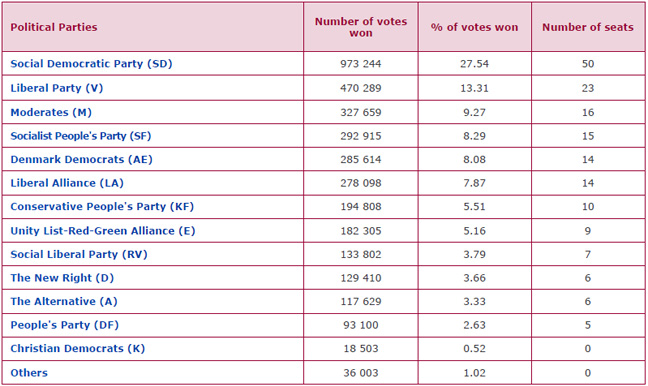
Source : https://www.dst.dk/valg/Valg1968094/other/Valgopgorelse2022.pdf
With the Social Democratic Party riding relatively high just four weeks before the election some possible coalition options are emerging. These might take the shape of the Social Democrats, the Liberals, Liberal Alliance, Conservative People’s Party with the Moderates; a second might comprise the Social Democrats, the Liberals, Liberal Alliance, Conservative People’s Party with the Social Liberal Party; a third possibility would comprise the Social Democrats, the Liberals, the Liberal Alliance, the Moderates and the Social Liberal Party and finally the Social Democrats, the Socialist People’s Party, the Red-Green Alliance, the Moderates and the Social Liberal Party.
All of these outcomes lead to a centre-left coalition, but everything rests on whether the Danes trust Mette Frederiksen to navigate their country through the turbulent waters of high geopolitical tension, as well as challenging obstacles at home.
On the same theme
To go further
Elections in Europe

Helen Levy
—
13 October 2026
Elections in Europe

Helen Levy
—
6 October 2026
Elections in Europe

Helen Levy
—
15 September 2026
Elections in Europe
Helen Levy
—
15 September 2026
The Letter
Schuman
European news of the week
Unique in its genre, with its 200,000 subscribers and its editions in 6 languages (French, English, German, Spanish, Polish and Ukrainian), it has brought to you, for 15 years, a summary of European news, more needed now than ever
Versions :