
Results
Elections in Europe
Helen Levy
-

Available versions :
EN

Helen Levy
Researcher at the Robert Schuman Foundation
Despite violent storms that hit Portugal in recent days and calls for the election to be postponed, the second round of the presidential election was held on February 8. The Portuguese elected António José Seguro, who will succeed Marcelo Rebelo de Sousa. The latter has served two five-year terms and cannot run again. With 66.82% of the vote, he won by a large margin over André Ventura, who garnered 33.18%. Voter turnout was 50.11%.
Antonio José Seguro will become the sixth president of the Third Republic, established after Portugal's return to democracy following the Salazar dictatorship in 1976.
This result can be explained by a significant transfer of votes from supporters of Henrique Gouveia e Melo (independent, 12.32% in the first round) and Luís Marques Mendes (Social Democrat, 11.3%), as well as those who had initially voted for João Cotrim de Figueiredo (Liberal, 16%).
On January 18, after the first round, Antonio José Seguro (center-left (PS)) called on “all democrats, all progressives, and all humanists” to vote for him on February 8 in order to defeat ‘extremism’ and “those who sow hatred and division among the Portuguese.” He also emphasized his independence, stating that his candidacy was not that of a particular party, but that of democracy, and it seems that the electorate heard this message.
During a televised debate that took place between the two rounds on January 27, the gap between the two candidates was palpable. Although nothing new was brought to the discussion during the 75-minute program, André Ventura was combative and António Seguro more measured, appealing to the center-left and more moderate conservatives. André Ventura emphasized crime rates and immigration, while Antonio Seguro emphasized constitutional continuity and stability.
Despite this defeat, André Ventura has made a rapid breakthrough in the political landscape with his populist Chega! (Enough!) movement since its creation six years ago, becoming the main opposition party with the aim of overthrowing the centre-right Social Democratic Party (PSD). As the second round approached, he attempted to capitalize on voter discontent by highlighting rising housing costs, low wages, and what he considers “excessive” immigration. His rise to power should serve as a warning to the moderate right, as this election may be seen as a test of how many votes he could rally to his name. With this election, the Portuguese have strengthened their democracy by preferring “a familiar institutional figure to a polarizing challenger.” This also echoes the continued rise of other far-right populist movements in several European countries.
The challenge for the new president will now be to coexist with a minority government led by the PSD (Luis Montenegro), elected in the 2025 parliamentary elections (the third in three years). Luis Montenegro relies on a delicate balance between support from the right and the left to keep his government in power. The question is whether António Seguro will be able to help or hinder him in this task. Although normally an impartial figure with no executive power, the President of Portugal remains influential. He can veto bills presented to parliament (although this can be reversed) and, as a last resort, he can dissolve parliament.
Results of the second round of the presidential election on 8 February 2026 in Portugal
Turnout: 50.11%
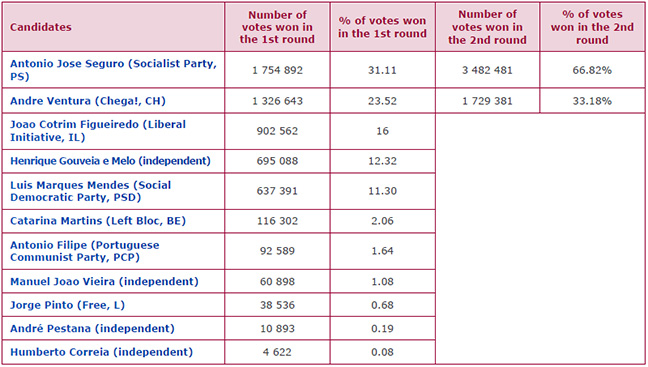
Source : https://www.presidenciais2026.mai.gov.pt/resultados/globais
Antonio José Seguro, 63, is originally from Penamacor, in the central region of the country on the Spanish border. From an early age, he took an interest in politics and studied international relations at the Autonomous University of Lisbon. He joined the Socialist Party and was first elected to Parliament in 1991. From 1999 to 2001, he was a Member of the European Parliament. He then held various positions in several governments, notably under António Guterres. He became president of the Socialist Party in 2011. In 2014, after being challenged by António Costa for the party leadership and losing to him, he resigned and withdrew from political life. It was not until 2024 that his interest in the presidency was rekindled, after he began working as a political commentator for CNN Portugal. The new president will be sworn in on 9 March, just before the spring legislative session.
On the same theme
To go further
Elections in Europe

Helen Levy
—
6 October 2026
Elections in Europe

Helen Levy
—
15 September 2026
Elections in Europe
Helen Levy
—
15 September 2026
Elections in Europe
Helen Levy
—
8 September 2026

The Letter
Schuman
European news of the week
Unique in its genre, with its 200,000 subscribers and its editions in 6 languages (French, English, German, Spanish, Polish and Ukrainian), it has brought to you, for 15 years, a summary of European news, more needed now than ever
Versions :