Analysis
Elections in Europe
Helen Levy
-

Available versions :
EN

Helen Levy
Researcher at the Robert Schuman Foundation
On 22 March 2026, Slovenians will go to the polls to elect the 90 members of the lower house of parliament, the Državni Zbor, in an election called by President Natas Pirc Musar on 6 January. In the last general elections in 2022, this country of just over 2 million inhabitants overturned Janez Jansa's right-wing party (SDS) and gave a landslide victory to the Movement for Freedom (GS) newly founded by Robert Golob. In these particularly turbulent geopolitical times, the Slovenian president called on candidates to focus ‘on finding solutions to the challenges facing society rather than on divisions’.
After the elections in April 2022, Robert Golob (GS, 41 seats) formed a coalition with the Social Democrats (7 seats) and the Left (5 seats), enjoying a comfortable majority of 53 seats. However, since taking office, the government has been plagued by numerous scandals. There have been several cabinet reshuffles between 2023 and 2025, giving an impression of instability. These events have undermined the government's credibility, with several high-ranking ministers, as well as the current Prime Minister himself, having been accused of wrongdoing.
Eighteen lists of candidates have been submitted for the general elections, including 16 in all constituencies. Four candidates have been nominated for the position of representative of the Italian community and two for that of representative of the Hungarian community. The lists of candidates will be published in their final form by 6 March by the country's central electoral commission.
A recent opinion poll published on 14 February indicates that Janez Jansa's Democratic Party (SDS) leads, ahead of Robert Golob's Svoboda Movement, followed by Levica/Vesna, the Social Democrats (SD), the New Slovenia Alliance (NSi)/People's Party (SLS)/FOKUS, Demokrati (D) and Resnica. The other parties are not expected to achieve the 4% threshold required to be represented in Parliament.
Troubled waters for Robert Golob's coalition
The most notable challenge faced by the Golob government has been the Litijska affair: in December 2022, questions were raised about the transparency of the purchase of buildings for the judiciary. The Prime Minister was accused of corruption and improper use of influence. In 2022, Interior Minister Tatjana Bobnar resigned after disagreements with Robert Golob and the rejection of her choice of candidate for the position of police chief. It appears that the Prime Minister was unhappy that senior police officials appointed under Janez Jansa had not been purged, leading to accusations of interference in police affairs. Finally, in October 2025, following the murder of Aleš Šutar involving the Roma community, a law was hastily passed by Parliament giving local police more powers to act in certain sensitive neighbourhoods. This case drew criticism both from the far right, which accused the government of being lax, and from the European Parliament, the Council of Europe and Amnesty International, which suggested that the bill unnecessarily targeted an already blighted minority.
Robert Golob attempted to defend himself by stating: ‘I believe in the rule of law and will therefore respond to all accusations and reject them through legal channels’, but with the elections approaching, successive scandals have undermined the initial advantage enjoyed by the Svoboda Movement and its coalition in Parliament and among the population. The outgoing government's decline in popularity in the polls bears witness to this.
The return of Janez Jansa?
The popularity of Janez Jansa and his SDS party has been on the rise since the 2024 European elections. Promoting conservative values in his campaign, he is running for Prime Minister for the fourth time (having already held the position from 2004 to 2008, 2012 to 2013 and 2020 to 2022). He has espoused a firm stance against immigration and regularly attacks the press. This former liberal dissident now seems to be leaning more towards right-wing populism, aligning himself with other leaders currently in power, such as Viktor Orbán in Hungary, Robert Fico in Slovakia and Andrej Babiš in the Czech Republic. However, unlike them, he has always supported Ukraine and the application of sanctions against Russia; he is also a staunch supporter of NATO.
The common denominator among all these ‘populist’ leaders is that they are fervent admirers of Donald Trump, whose goal it seems is to ensure that the conservative right gains as much power as possible in Europe. Although Slovenia is a small Balkan country, the elections taking place there could be seen as another sign of the rise of illiberal tendencies in Europe.
In early February, the leaders of the main groups in the European Parliament, the EPP, Socialists and Democrats (S&D) and Renew Europe, travelled to Ljubljana to show their support for their affiliated parties. Janez Jansa received the support of Manfred Weber, president of the EPP, of which the SDS is a member. He said he hoped that the SDS would ‘be given the mandate to implement our priorities in the upcoming elections in Slovenia’. Renew has fielded 83 candidates, including the outgoing Prime Minister, who will lead the campaign. The movement's programme is based on four pillars: strong public services, particularly in the areas of health, innovation, economic competitiveness and strengthening security.
The Slovenian political system
Slovenia has a bicameral parliament. The Drzavni Svet (National Council), the upper house, is appointed every five years by indirect suffrage and comprises 40 members: 18 representatives from professional and socio-economic sectors (4 for employers, 4 for employees, 4 for farmers, small business owners and the self-employed, and 6 for non-profit organizations) and 22 people representing local interests. The role of the National Council is purely advisory.
The lower house, the Drzavni Zbor (Assembly), has 90 members, elected every four years by proportional representation. The Constitution guarantees one seat to each of the country's two officially recognized minorities (Italian and Hungarian). Their representatives are elected in two constituencies (Koper and Lendava). These two representatives are elected by a single-round majority vote. Candidates must have the support of at least 30 voters.
Apart from these two elected representatives, Slovenia is divided into eight constituencies, each of which elects 11 representatives. Each constituency is divided into 11 districts, with one candidate elected in each district. Candidate lists submitted by parties must be supported by three representatives and 100 voters; to be eligible for election, lists submitted by a group of voters must be signed by 1,000 voters in the constituency in which they are standing. Finally, political parties must present at least 35% female candidates. Lists with only three candidates must include at least one man and one woman. Voting is proportional and preferential (voters can indicate their preferences by ranking the candidates on the list). An initial distribution of seats is carried out at the constituency level using the Droop quotient (the number of votes cast in a constituency, across all lists, is divided by the number of representatives elected in that constituency + 1). The remaining seats are allocated at the national level using the d'Hondt method, with representatives being selected from the lists with the highest remainders.
Political parties must obtain at least 4% of the vote to be represented in the Drzavni Zbor. Sometimes, a constituency elects more than one representative, but some constituencies do not elect any representatives, which was the case in the 2014 elections in 21 of the country's 88 constituencies.
Five political parties won seats in the last general elections on April 24, 2022:
- The Freedom Movement (GS), a pro-European liberal party founded in 2022, succeeded the Green Action Party (Z-DEJ). It is led by Robert Golob and won 41 seats.
- The Democratic Party (SDS), a liberal party created in 1989 and led by Janez Jansa, won 27 seats;
- New Slovenia (NSi), founded in 2000 and led since January 2018 by Jernej Vrtovec, won 8 seats;
- The Social Democrats (SD), founded in 1993 and originating from the former Communist Party (PCS). Led by Matjaž Han, the party won 7 seats;
- The Left (Levica), a party created in 2017 and led by Luka Mesec, won 5 seats.
In Slovenia, the President of the Republic is elected by direct universal suffrage and serves a five-year term. Natasa Pirc Musar became the first woman to be elected to this position in Slovenia on November 13, 2022, in the second round of voting, with 53.86% of the vote. A lawyer, she was Commissioner for Access to Public Information (Ombudsman) between 2004 and 2014 and ran as an independent candidate.
Reminder of the results of the 24 April 2022 general election in Slovenia
Turnout: 69.54 %
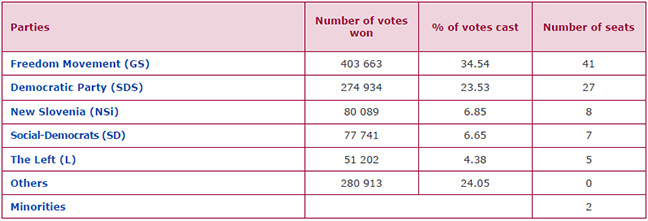
Source : https://volitve.dvk-rs.si/#/rezultati
It appears that Robert Golob's Svoboda Movement may not win the upcoming elections, as Janez Jansa seems to have regained broad support among the population over the past two years. However, the question remains as to with which other parties he could form a coalition government. At present, three scenarios seem plausible: the first would be a centre-right coalition between the SDS, Demokrati and the Nsi/SLS/Fokus Alliance. The second scenario could lead to a right-wing coalition between the SDS, Demokrati and Resnica. Finally, Svoboda could form a centre-right/centre-left coalition with Demokrati, SD and the Nsi/SLS/Fokus Alliance. Everything seems to hinge on the results achieved by Demokrati and the Nsi/SLS/Fokus Alliance, which will be the kingmakers!
On the same theme
To go further
Elections in Europe

Helen Levy
—
27 October 2026
Elections in Europe
Helen Levy
—
13 October 2026
Elections in Europe

Helen Levy
—
6 October 2026
Elections in Europe

Helen Levy
—
15 September 2026
The Letter
Schuman
European news of the week
Unique in its genre, with its 200,000 subscribers and its editions in 6 languages (French, English, German, Spanish, Polish and Ukrainian), it has brought to you, for 15 years, a summary of European news, more needed now than ever
Versions :