
Analysis
Elections in Europe
Helen Levy
-

Available versions :
EN

Helen Levy
Researcher at the Robert Schuman Foundation
On 13 January last, the Hungarian President, Tamas Sulyok, called a general election for 12 April. 7.8 million Hungarians are set to elect the 199 members of the Orszaggyules (National Assembly), the single chamber of Parliament. This election will be crucial, not only for Hungary but also for Europe, as the past sixteen years have seen this EU Member State transform into an ‘illiberal’ democracy in which Viktor Orbán and his party, Fidesz, have established control over the media and the judiciary that is hardly compatible with democratic practice.
He has thus set himself up as a model for other European “illiberals”, such as Robert Fico in Slovakia and Andrej Babiš in the Czech Republic, with the explicit and public support of the American MAGA movement.
A formidable opponent, Peter Magyar (a former member of Fidesz) and his Tisza party are in direct opposition to Orbán’s regime. Growing in popularity since the 2024 European elections, in which his party won 30% of the vote, Peter Magyar could be poised to change Hungary’s image as the European Union’s “disruptor”.
Unchallenged power for 16 years
When Russia invaded Ukraine in February 2022, Viktor Orbán initially condemned Russia and backed the sanctions, fearing he would lose part of his electorate if he did not. Indeed, many members of the Hungarian elite have remained anti-Russian since 1956 and the Soviet Union’s repression and occupation. However, whilst having consolidated his grip on power, he now appears increasingly pro-Russian and opposes any military aid to Ukraine. He often uses the European Union as a scapegoat, designing it as Hungary’s sworn enemy, and does not hesitate to denigrate it systematically.
Since 2010, he has implemented a redistribution policy, in the form of subsidies for buying a house or a car, for example, if couples marry and start a family. Among the measures taken to try to win over the population are an increase in the minimum wage, income tax exemptions for young people, wage bonuses and pay rises for nurses, social workers, the police and the army. In terms of values, he is extremely conservative. By playing on religion and traditional nationalist themes, he has built up a solid voter base. Furthermore, he is determined to ‘purify’ the education system of what he considers to be propaganda. To support this policy, he has amended school history curricula to champion the white race and Christian roots.
Are the tables turning on Viktor Orbán?
But the situation appears to be about to change and turn against Viktor Orbán, if the polls are to be believed. There are several reasons for this shift, which stems from mistakes made in economic policy, the geopolitical situation, and the increasingly repressive nature of the regime he has established.
Economic downturn
By the end of 2025, the public was feeling the pinch of falling purchasing power, whilst Orbán’s approval ratings were on the decline. Pensions were increased – a move that was by no means disinterested, given that pensioners account for nearly a quarter of Viktor Orbán’s electorate. However, this measure may prove insufficient and too little, too late, as many Hungarians have been bearing the brunt of galloping inflation since the pandemic. Economic growth has been slow (0.4% in 2025) and food prices in Hungary remain higher than anywhere else in the EU, according to a Human Rights Watch report published in November 2025.
The green transition plans at issue
As part of the European Union’s ‘green transition’ and Viktor Orbán’s desire to ‘restore Hungary to its former glory’, the go-ahead has been given for the construction of several Chinese-funded factories to produce batteries for electric vehicles, despite a fall in demand from car manufacturers. Orban’s plan, which has been in development since 2020 and aims to make Hungary a major hub in this sector, has met with opposition from the public. People are unhappy and fear they are not sufficiently protected against pollution caused by the heavy metals used in battery production. This could alienate some voters who have hitherto been loyal to Viktor Orban.
Tension with “friends”
In December 2025, a dispute arose with neighbouring Slovakia. Prime Minister Robert Fico had in fact made it a criminal offence to criticise the Beneš Decrees, which were introduced after the Second World War to collectively punish the German and Hungarian minorities living in Slovakia and the Czech Republic. During the communist era and as a result of these laws, thousands of people (between 41,000 and 120,000) were stripped of their citizenship and had their property confiscated. This new Slovak law provoked anger on the part of the Hungarian government, which has officially lodged a complaint with the European Commission. However, within the European Union, Viktor Orbán needs his Slovak ally, who advocates the same policies as he does, but at the same time, he cannot ignore the 8–10 per cent of Slovakia’s population who are Hungarian—and whose vote carries significant weight. Indeed, Hungarians living in neighbouring countries, such as Slovakia, Ukraine, Romania, Serbia, Croatia, Slovenia and Austria, have played a major role in keeping Orban in power since 2010. Whilst he has decided to adopt a cautious line with Fico, Peter Magyar has accused his rival of abandoning the Hungarians of Slovakia, declaring that the Slovak Prime Minister is “anti-Hungarian” and Orbán a “traitor”. This could be an opportunity for Magyar to win votes.
... and with Ukraine
In late January, Russian drones damaged the Druzhba pipeline, leading to the suspension of Russian oil supplies to Hungary and Slovakia via Ukraine. Viktor Orbán criticised Ukraine for failing to repair it! He blocked all further aid to Ukraine, including a €90 billion loan approved by the European Council and, for the time being, the European Union’s 20th package of sanctions against Russia. He announced the deployment of the army to ‘protect’ all the country’s energy facilities, claiming that Ukraine has been trying to harm the Hungarian economy. The dispute with Kyiv has escalated, and Viktor Orbán’s aim is to stir up as much strong emotion as possible around this issue. Some suggest that he fears his rivals will win the election and that he would be prepared to do anything to stay in power, including the possibility that, in an extreme scenario, he could declare a state of emergency[1] and cancel the elections, as, according to the Constitution, these cannot be held during a state of emergency.
... and with the European Union
Viktor Orbán has turned his opposition to Brussels and the European Union into a badge of honour, winning the support of other ‘illiberal’ figures, as well as that of the current US administration. He has ignored the European Commission’s calls to reform draft legislation that undermines the rule of law. Since 2023, his government has passed at least three bills granting the authorities unlimited power to monitor NGOs, the media and journalists and subject them to official investigations. Consequently, his stance has led to the suspension of European funds for Hungary that had been granted following the 2021 pandemic to help Member States overcome the crisis. Thus, European funds totalling €19 billion have been frozen due to non-compliance with the principles of the rule of law, of which €10 billion comes from the NextGenerationEU mechanism.
The deadline for the disbursement of funds is set for the summer. If Peter Magyar wins the election, there will be strong pressure for Hungary to comply with the European Union’s requirements regarding the rule of law (independence of the judiciary, the fight against corruption and conflicts of interest, fundamental rights and non-discrimination, academic freedom) and to recover part of the frozen funds under the conditionality mechanism.
Who are Peter Magyar and Tisza?
Peter Magyar, a 44-year-old lawyer, joined Fidesz in 2002 and held various positions within the party until 2010. In 2024 he broke with Viktor Orbán and founded a centre-right party, Tisza (Respect and Freedom). Peter Magyar originally distanced himself from the party following a scandal involving his ex-wife Judit Varga, then Minister of Justice, who had co-signed a pardon with Katalin Novák, then President of Hungary, for a person who had helped cover up paedophile crimes in a nursery. Katalin Novák was forced to resign in February 2024.
Tisza’s campaign was launched on 21 February and aims to revive the economy, end corruption and restore freedom (e.g. press freedom and civil society organisations). However, he intends to maintain a firm stance on immigration; Zoltán Tarr, Tisza’s deputy leader, stated that the party’s objective is to “keep the border fence in place, oppose mandatory migration quotas and Ukraine’s accelerated accession, pursue peace, combat Russian propaganda, strengthen the V4 [Hungary, Poland, the Czech Republic and Slovakia] and Central Europe without being the bad boy of Europe”.
Peter Magyar has deftly turned Orbán’s rhetoric against him, exposing the glaring gap between nationalist rhetoric and the government’s actual achievements. He argues that Viktor Orbán has not actually defended Hungary’s interests, but has instead undermined the economy, impoverished the population and isolated the country from its European allies, turning increasingly towards Russia and other undemocratic states. His ambition is to bring Hungary back into the European fold and to prioritise the people over the oligarchs, whose numbers have grown considerably in recent years. By targeting rural areas, which are generally Orbán’s strongholds, he aims to weaken Orbán’s traditional electoral base. As an MEP (EPP), Peter Magyar will be more inclined to support European policies, particularly regarding Ukraine and the protection of fundamental freedoms.
The Hungarian political system
The Orszaggyules (National Assembly), the single chamber of Parliament, comprises 199 members elected for a four-year term: 106 of them are elected in single-member constituencies and 93 through proportional representation. Voters are given two ballot papers: one to choose a political party, the other to vote for a candidate.
On 15 December 2020, the electoral law amended the minimum number of candidates required for a party to stand in general elections: from now on, only parties standing in at least 71 constituencies and at least 14 counties, as well as in Budapest, may field candidates under the proportional representation system. To be represented in Parliament, a party must obtain at least 5% of the votes cast; an alliance of two parties must obtain 10%, and an alliance of three or more parties, 15%.
The way in which votes are counted and seats allocated in parliamentary elections has been the subject of debate and criticism since Viktor Orbán came to power sixteen years ago. In 2011, the system was amended to strengthen its first-past-the-post features. This enabled Fidesz to win in constituencies where its support was weak. Constituency boundaries were redrawn again to favour the ruling party in December 2024. Finally, the proportional component includes ‘compensation votes’ from the constituencies. The idea is to ensure that votes ‘lost’ in local contests still count at the national level.
Voters registered as members of a national minority[2] vote for their lists rather than for national parties. Parties representing Hungary’s various national minorities are exempt from the minimum threshold (5%) and can secure a seat with as little as 0.27% of the vote. A party representing Hungarians of German origin was thus able to secure a seat in 2022. Minorities that do not reach the required threshold join the Committee on National Minorities and send a non-voting spokesperson to Parliament.
In this election, 1,227 candidates were registered. However, only 5 parties submitted lists, a historically low number: Fidesz, Tisza, Mi Hazánk, the Democratic Coalition (DK) and the Hungarian Two-Tailed Dog Party (MKKP).
Results of the general elections held on 3 April 2022 in Hungary
Turnout: 68.7%
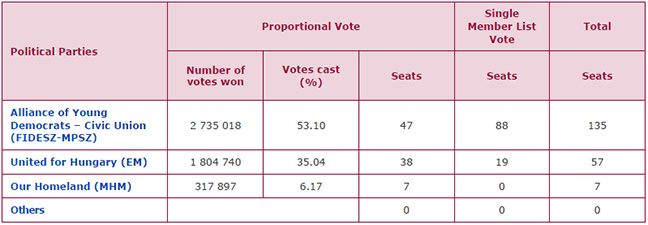
Source : National Election Office - Parliamentary Elections 2022
What do the polls say?
The latest poll published on 11 March suggests that Tisza is leading ahead of FIDESZ, with 49% and 37% respectively, whilst Mi Hazank is on 6% and DK on 5%. The MKKP (4%) would not be represented in Parliament as it is expected to fall short of the 5% threshold.
However, it is difficult to make accurate predictions, as some polling organisations are affiliated with the government. Furthermore, nothing can be ruled out regarding what Viktor Orbán, currently in a weakened position, might do to distort the results, or even cancel the elections. Since 2010, he has gradually eroded democracy by redrawing electoral constituencies and making amendments to the Constitution.
In recent days, Peter Magyar has issued repeated warnings about foreign interference, which could take various forms, suggesting that Russia might be tempted to interfere in the conduct of the election. Indeed, such actions could take the guise of disinformation, via social media, as seen during the presidential election in Romania in late 2024. The most unverifiable rumours are circulating regarding the presence of Russian experts in Hungary. The US Secretary of State, Marco Rubio, following Vice-President J.-D. Vance, made a special trip to Budapest in February to support the outgoing government, and so US interference cannot be ruled out either.
Peter Magyar declared confidently, “We are on the brink of victory”, as he spoke to thousands of enthusiastic supporters in Budapest.
[1] Growing Fears That Hungary’s Orbán May Cancel Next Month’s Election, The Bulwark 2 March 2026
[2] Hungary recognises 13 national minorities: Germans, Armenians, Bulgarians, Croats, Greeks, Poles, Roma, Romanians, Ruthenians, Serbs, Slovaks, Slovenes and Ukrainians
On the same theme
To go further
Elections in Europe

Helen Levy
—
13 October 2026
Elections in Europe

Helen Levy
—
6 October 2026
Elections in Europe

Helen Levy
—
15 September 2026
Elections in Europe
Helen Levy
—
15 September 2026

The Letter
Schuman
European news of the week
Unique in its genre, with its 200,000 subscribers and its editions in 6 languages (French, English, German, Spanish, Polish and Ukrainian), it has brought to you, for 15 years, a summary of European news, more needed now than ever
Versions :