Results
Elections in Europe
Helen Levy
-

Available versions :
EN

Helen Levy
Researcher at the Robert Schuman Foundation
In the snap Danish general election on 24 March, the ‘red bloc’[1] won the race by a narrow margin with 84 seats, ahead of the ‘blue bloc’[2] which won 77 seats, thereby depriving the outgoing Prime Minister, Mette Frederiksen, of a clear majority to form a new government. The absolute majority is 90 seats out of a possible 179. The Moderates, a party led by former Prime Minister Lars Løkke Rasmussen, secured 14 seats and, occupying a firmly established position in the centre, are very likely to play the role of kingmaker. It appears difficult for the current three-party coalition to form a new government as it would no longer hold a majority. On 25 March, Mette Frederiksen tendered her resignation to King Frederik, who asked her to lead negotiations to form a new government in light of the election results.
In total, twelve parties won seats in the Folketing (parliament) for a four-year term. Mette Frederiksen’s Social Democratic Party leads with 21.9% of the vote and 38 seats (-12), ahead of the Socialist People’s Party (SF), which secured 11.6% and 20 seats. Next came the Liberal Party (V), with 10.1% and 18 seats; the Liberal Alliance (I) with 9.4% and 16 seats; the People’s Party (DF) with 9.1% and 16 seats; the Moderates (M) with 7.7% and 14 seats; the Conservatives (C) with 7.6% and 13 seats; the Unity List–Red-Green Alliance with 6.3% and 11 seats, the Democrats (DD) with 5.8% and 10 seats, the Social Liberal Party (B) with 5.8% and 10 seats; the Alternative with 2.6% and 5 seats, and finally the Citizens’ Party with 2.1% and 4 seats. Greenland and the Faroe Islands each have two representatives.
4,303,429 voters cast their ballots in this election, bringing the turnout to 83.98%.
Mixed results
Over the past four years, Mette Frederiksen’s popularity has steadily declined since she entered into an atypical coalition with the Liberal Party (Venstre) — which broke away from the ‘Blue bloc’ — and the Moderates (M) in the wake of the 2022 general election, in which her party won 27.54% of the vote and 50 seats. The election on 24 March delivered the worst result for the Social Democratic Party since 1903. The Liberals of Venstre also lost ground, perhaps due to their four years in coalition with the Social Democrats.
In the local elections of November 2025, the Social Democrats suffered huge losses in regions where they were traditionally strong, notably in Copenhagen, which they had governed for 100 years. However, certain measures taken proved popular with the more conservative sections of the population in rural areas, such as the strict stance on immigration, which generally wins votes for the People’s Party. It seems that this was enough to stifle the voice of this radical movement somewhat. Ultimately, however, although Mette Frederiksen has earned the respect of the Danish people for her leadership of the country in a turbulent international climate – notably during the spat with Donald Trump over Greenland – it was domestic discontent that tipped the balance in this election. Although their country is one of the wealthiest in the European Union, the Danes paid particular attention to issues at home. The campaign focused on the debate surrounding the ban on pesticides in sensitive groundwater areas, increased defence spending, the lifting of the ban on nuclear energy, animal welfare and the reinstatement of a religious public holiday, amongst other issues. Indeed, during the final weeks of the campaign, the environment came to the fore, with growing concerns regarding livestock farming methods, particularly pig farming[3], ranging from animal welfare to the pollution caused by this sector of the agricultural industry.
Results of the general elections held on 24 March 2026 in Denmark
Turnout: 83.98 %
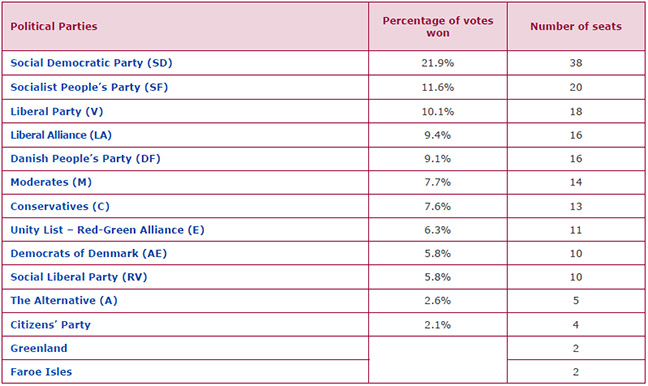
Source : Folketingsvalg 2026: Sådan blev resultatet / Folketinget
What future coalition?
So, everything has yet to be decided. By calling a snap election, Mette Frederiksen has staked her future on the outcome, placing her potential third term as Denmark’s Prime Minister in the hands of the voters. She knew her popularity was waning; but thanks to the dispute over Greenland and the firm stance she and her government took against Donald Trump, she managed to regain some of her popularity. However, the Danes chose not to give her a clear majority. It now remains to be seen how Lars Løkke Rasmussen will choose to position himself. Will he lean to the right and call for a ‘blue bloc’ coalition? Or will he turn to the ‘red bloc’ and allow Mette Frederiksen to be re-elected for a third term? Or will he call for a multi-party coalition, with or without the outgoing Prime Minister? The role of the four candidates elected in Greenland and the Faroe Islands must not be overlooked either, as they could well prove decisive! The coming weeks or months will be marked by heated discussions in the quest to form the next government and appoint its leader.
Mette Frederiksen has warned the other parties regarding the length of the negotiations, stating that the world “will not wait for Denmark” and that it is urgent to come together as quickly as possible.
The new Folketing must convene no later than 12 working days after the election, i.e. on 10 April.
[1] Left-wing bloc: Social Democrats (A), Socialist People’s Party (SF), Social Liberals (RV), Red-Green Alliance (Enhedslisten).
[2] Right-wing bloc: Venstre (V), Conservative People’s Party (C), Liberal Alliance (I), People’s Party (DF), Democrats (AE).
[3] Denmark is the world’s fifth-largest producer of pork (25 million pigs per year) / 44% of its agricultural land is devoted to fodder cultivation.
On the same theme
To go further
Elections in Europe

Helen Levy
—
27 October 2026
Elections in Europe
Helen Levy
—
13 October 2026
Elections in Europe

Helen Levy
—
6 October 2026
Elections in Europe

Helen Levy
—
15 September 2026
The Letter
Schuman
European news of the week
Unique in its genre, with its 200,000 subscribers and its editions in 6 languages (French, English, German, Spanish, Polish and Ukrainian), it has brought to you, for 15 years, a summary of European news, more needed now than ever
Versions :