
Results
Elections in Europe
Helen Levy
-

Available versions :
EN

Helen Levy
Researcher at the Robert Schuman Foundation
On 12 April, Peter Magyar (Tisza – EPP, centre-right) succeeded in his bid to oust Viktor Orbán (Fidesz – PfE, far right) after sixteen years in power, thereby denying him a fifth term. His party, Tisza, won a resounding victory in Hungary’s general election with 53.18% of the vote and 141 seats in the Országgyűlés, the Hungarian parliament, out of a total of 199. Fidesz secured 38.61% and 52 seats, whilst Our Homeland (Mi Hazánk) won 5.63% and 6 seats. The Democratic Coalition, along with the Two-Tailed Dog Party, failed to secure enough votes to be represented in parliament, having fallen short of the required 5% threshold. Consequently, only three parties will sit in the next assembly.
Given the scale of the Tisza party’s unequivocal victory, Viktor Orbán quickly conceded defeat. He thanked the people who had voted for him, vowing to continue working for them and the country. But Fidesz will now find itself in opposition. How much of a disruptive force might it prove to be regarding the new executive’s programme?
Very early on, too, several European leaders congratulated Peter Magyar on his clear victory: among others, French President Emmanuel Macron, British Prime Minister Keir Starmer, German Chancellor Friedrich Merz, Polish Prime Minister Donald Tusk, and Ukrainian President Volodymyr Zelensky.
A thirst for change
The Hungarian people, particularly the young, weary of Viktor Orbán’s posturing and rhetoric, the widespread corruption he has fostered, and his failed policies to tackle the economic crisis, have overwhelmingly chosen to replace their leader in the hope that their economic situation will improve and that the country will emerge from the isolation into which Viktor Orbán had led it. Proof of this is the exceptionally high turnout (78.99%), the largest since the 2002 general election (70.5%) – a year that also saw the defeat of a certain Viktor Orbán.
With 141 seats, the Tisza party has secured a two-thirds majority (133 seats) in parliament, paving the way for Peter Magyar to undertake the vital reforms promised during his campaign. This is particularly important, as the stranglehold Viktor Orbán has managed to establish over the judiciary, the media and the economy has been harmful and extremely damaging to Hungary’s standing within the European Union.
Peter Magyar has pledged to restore the rule of law by dismantling the corrupt system that Viktor Orbán fostered to gradually take control of various sectors of society. He has promised to restore media plurality, to join the European Public Prosecutor’s Office, to return to a healthy separation of judicial and political powers, and to re-establish a balanced system of checks and balances. Viktor Orbán’s stance had effectively deprived Hungary of nearly €18 billion in financial aid, particularly in the wake of the Covid pandemic, as the country was unable to benefit from the European Union’s Recovery and Resilience Fund.
The Tisza party owes this victory to a meticulous grassroots campaign led by Peter Magyar, which has gradually gained momentum over the past two years, in the wake of his party’s success in the June 2024 European elections, when Tisza came second, just behind Fidesz. Since then, Tisza has been riding the wave of a deep appetite for change and voter discontent with the economic situation. For example, Viktor Orbán’s plan to turn Hungary into a major hub for the manufacture of electric vehicle batteries. A laudable initiative, some might say, as it formed part of the EU’s Green Deal, yet one that has opened the door wide to increased dependence on specific Chinese companies. Furthermore, the factories were built without taking into account citizens’ concerns regarding pollution and the impact this would have on their health.
During his campaign, Peter Magyar emphasised restoring Hungarians' purchasing power, which has been severely eroded since the end of the Covid pandemic; some analysts have even described Hungary as the “European champion of inflation.”
A stand against interference
Other factors also contributed to Peter Magyar’s victory. First, there were the surprising revelations that the Hungarian Foreign Minister, Peter Szijjarto, was leaking a steady stream of information to the Kremlin after every European Council meeting. He reportedly told his Russian counterpart, Sergei Lavrov, quite clearly, “I am at your service”, a stance that is highly contradictory given the country’s history and the 1956 uprisings against Soviet occupation.
Then came a destabilisation operation during which neighbouring Serbia claimed to have discovered explosive devices placed on a strategic oil pipeline on its border, which was immediately blamed on the Ukrainians; a repeat of Viktor Orbán’s statements after the Druzhba pipeline was damaged by Russian drones, for which he had nevertheless accused Ukraine of sabotage and demanded that it repair the damage.
In a world now dominated by disinformation, fake news and attempts to cause harm, every possible means was used during the election campaign to smear the candidates; it seems, however, that Viktor Orbán ended up shooting himself in the foot, as the electorate decided not to give in to the moral panic fuelled by his increasingly desperate attempts to win votes.
Even the visit by the US Vice-President five days before the election appears to have been counterproductive. On that occasion, J.D. Vance accused the European Union of all manner of evils, notably of interfering in Hungary’s domestic affairs, whilst he himself had come to support his friend who was struggling in the polls… at least those that are still independent. If that isn’t interference, what is it? In any case, it did not prove successful.
Viktor Orbán’s old tactics backfired on him. He has never hidden his admiration for what he considers to be strongmen, namely Vladimir Putin and Donald Trump, and has built up long-standing support across the Atlantic, such as Steve Bannon, within ultra-conservative circles, seeking to make him a model for the European Union, particularly in Brussels through the Mathias Corvinus Collegium (MCC). But Viktor Orbán’s strategy seems to have run its course, and the electorate did not buy into this anti-Ukraine, pro-Russian rhetoric.
The return of Hungary to the European fold
Well acquainted with Viktor Orbán, Peter Magyar argued that, rather than defending Hungary’s interests, Viktor Orbán has isolated and impoverished the country by favouring oligarchs at the expense of entrepreneurs, who are the driving force behind economic growth and prosperity. He highlighted all the harmful effects of the policies pursued over the last sixteen years, ultimately convincing a large section of the population – particularly young people who have known nothing but the ‘Orbán system’ – to rid themselves of it and take a different path for the future.
Peter Magyar certainly focused his campaign on domestic policy, thereby gaining popularity, but he also indicated that he would restore Hungary to a calmer relationship with the European Union. Indeed, Viktor Orbán had made it his scapegoat for many years, not hesitating to plaster the streets with caricatures of numerous European leaders, including Jean-Claude Juncker and Viviane Reding, then President of the European Commission (2014–2019) and European Commissioner (1999–2014), and more recently Ursula von der Leyen, President of the Commission, or Manfred Weber, President of the European People’s Party (EPP) group, or even the Ukrainian President, Volodymyr Zelensky.
With Peter Magyar, we can therefore expect less tumultuous relations, such as, for example, the lifting of the veto imposed by Viktor Orbán earlier this year on the €90 billion aid package for Ukraine at the European Council, even though Tisza and Peter Magyar will likely continue to oppose any military support, such as the deployment of weapons and troops, as well as Ukraine’s rapid accession to the Union. Similarly, he will work to ensure that Hungary can finally benefit from the European funds it has been deprived of due to the Viktor Orbán regime’s failure to respect the fundamental values of the Union following the triggering of Article 7 of the Treaty on European Union (TEU) in September 2018. This decision was taken after Viktor Orbán systematically refused to bring his country back in line with the rule of law. Similarly, Hungary has not received the funds made available following the Covid pandemic, under the Next Generation EU recovery plan. This amounts to nearly €18 billion in aid that Hungary has therefore been unable to receive, having already lost €1 billion by January 2025. Yet this money is sorely needed by many Hungarians.
Finally, Peter Magyar, despite having been a member of Fidesz, broke away from the party and, together with Tisza, succeeded in finding the right arguments to defeat Viktor Orbán. Ironically, Tisza sits within the main group in the European Parliament, the EPP (centre-right), where Fidesz had long been a member before finally leaving in a blaze of controversy in 2021. Its elected representatives now sit within the Patriots Group, alongside France’s National Rally, among others. This political shift does not appear to have served it well. Does this mean that Peter Magyar’s victory will help halt the nationalist-populist trajectory that has swept through European politics in recent years? Is the illiberal model championed by Orban over? Some leaders, such as Robert Fico (Slovakia) or Andrej Babiš (Czech Republic), have lost their role model. But what about elsewhere? Nothing could be less certain when one looks at the results of certain parties such as the AfD in Germany, Reform UK in the UK or the RN in France, at least in terms of voting intentions. But the lesson from Hungary is worth pondering: do these parties truly embody a solution for the future?
Does Viktor Orbán’s defeat also signify the failure of the illiberal experiment he sought to establish in his country? The ‘Trojan Horse’ that constantly sought to destroy the European Union from within has been decisively ousted. A new era is beginning, but the future remains to be written. There is strong pressure on Magyar to bring Hungary back within the European fold. This will be no easy task, and the four years of his term will be needed to implement the expected reforms and desired changes.
Results of the general elections held on 12 April 2026 in Hungary
Turnout: 78.99 %
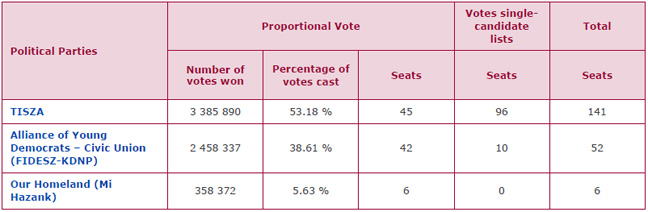
Source : https://vtr.valasztas.hu/ogy2026
On the same theme
To go further
Elections in Europe

Helen Levy
—
13 October 2026
Elections in Europe

Helen Levy
—
6 October 2026
Elections in Europe

Helen Levy
—
15 September 2026
Elections in Europe
Helen Levy
—
15 September 2026

The Letter
Schuman
European news of the week
Unique in its genre, with its 200,000 subscribers and its editions in 6 languages (French, English, German, Spanish, Polish and Ukrainian), it has brought to you, for 15 years, a summary of European news, more needed now than ever
Versions :