Results
Elections in Europe
Helen Levy
-

Available versions :
EN

Helen Levy
Researcher at the Robert Schuman Foundation
On 22 March, 1.7 million Slovenians were called to the polls to elect the 90 members of the Drzavni Zbor, the lower house of Parliament. The Movement for Freedom (Svoboda) led by outgoing Prime Minister Robert Golob appears to have narrowly edged out Janez Janša’s Democratic Party (SDS). Five other parties managed to exceed the 4% threshold required for representation in parliament.
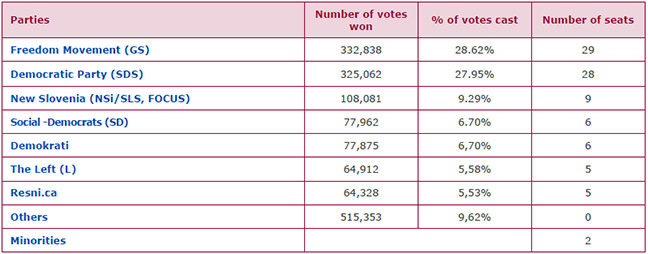
Svoboda is therefore expected to come out in front with 28.62% of the vote and 29 seats, ahead of the SDS, which secured 27.95% and 28 seats. The NSi/SLS/FOCUS coalition (centrist) comes in third place with 9.29% and 9 seats; followed by the Social Democrats (centre-left) and the Democrats (centre-right), a new party, which each won 6.70% and 6 seats. The Left (Levica) secured 5.58% and 5 seats, and Resni.ca (far right) 5.53% and 5 seats. Italian and Hungarian minorities secured 2 seats.
Tight results
Although Robert Golob came out ahead, he lost the majority he had secured in the previous 2022 general election, when he won 41 seats. He had promised, alongside his three-party left-wing coalition (with Levica and the Social Democrats), that the era of ‘illiberalism’ was over in Slovenia and that Slovenians could count on him to restore the healthcare system and bring rising energy and food prices under control. Unfortunately, after four years in office, the results achieved do not seem to have convinced the public. Just before the elections, however, Robert Golob had urged Slovenians to turn out in large numbers to vote, as he feared that democracy might be at risk.
Voter turnout stood at 69.26%, virtually unchanged from the previous elections in 2022 (69.54%).
Results of the general election of 22 March 2026 in Slovenia
Turnout: 69.26%
Source : https://volitve.dvk-rs.si/dz2026/#/rezultati
Acute duality
Since the 2024 European elections, in which the SDS won over 30% of the vote compared to 22% for Svoboda, Janez Jansa has capitalised on his opponent’s decline in popularity to accuse him of widespread corruption and of failing to keep his promises. He therefore focused his campaign on budgetary savings, promising significant tax cuts for businesses and a reduction in social spending.
The two men clashed on numerous issues, covering both domestic and foreign policy – notably regarding Israel and Palestine, or Russia and Ukraine.
As the elections approached, a scandal made headlines, bringing to light allegations of foreign interference. Videos and audio recordings were released, accusing Robert Golob and his government of corruption, embezzlement and mismanagement. These were reportedly filmed in secret and compiled by an Israeli intelligence firm, Black Cube. These materials were quickly seized upon by Janez Janša, who used them to highlight the corruption of his electoral rivals. Robert Golob claims that these documents take the facts out of context and have been manipulated with the aim of discrediting him and his entourage.
Robert Golob and the President, Nataša Pirc Musar, who has no political affiliation, have both called for immediate action, as this type of activity could jeopardise Slovenia's democratic foundations. A letter has been sent to Ursula von der Leyen requesting the launch of an investigation, asserting that this is clearly a hybrid attack on the Slovenian electoral process. The National Security Council and Sova (the Intelligence and Security Agency), as well as the police, have been called upon to launch investigations into this matter.
What majority?
This latest scandal may have influenced voters’ decisions and appears to have bolstered Robert Golob in extremis.
Given that the results are still provisional, nothing is certain regarding the political configuration that will enable the formation of a governing majority. Difficult negotiations lie ahead, and the smaller parties, which have won a modest but significant number of seats, will play a decisive role as kingmakers. Will the centre-right coalition (Nsi/SLS/Focus) and the new Demokrati party be tempted to form a coalition? And with whom? Svoboda or SDS? What will the Social Democrats and the Left decide?
In any case, it will take more than three parties this time to form a stable majority, which must secure 46 seats. This is likely to take some time.
On the same theme
To go further
Elections in Europe

Helen Levy
—
27 October 2026
Elections in Europe
Helen Levy
—
13 October 2026
Elections in Europe

Helen Levy
—
6 October 2026
Elections in Europe

Helen Levy
—
15 September 2026

The Letter
Schuman
European news of the week
Unique in its genre, with its 200,000 subscribers and its editions in 6 languages (French, English, German, Spanish, Polish and Ukrainian), it has brought to you, for 15 years, a summary of European news, more needed now than ever
Versions :