
Results
News
Corinne Deloy,
Helen Levy,
Fondation Robert Schuman
-

Available versions :
EN

Corinne Deloy

Helen Levy
Researcher at the Robert Schuman Foundation
Fondation Robert Schuman
It was not a surprise when Prime Minister Janez Drnovsek won the second round of the presidential election in Slovenia with 56.52% of the vote against 43.48% for his adversary Barbara Brezigar. "I am very happy to have won the support of so many voters. Clearly they acknowledged the work that I have done today and that we have established Slovenia as a State crowned with success. We are now able to open a new chapter in Slovenian history," declared Janez Drnovsek when the results were announced. The victor also made a point of congratulating his rival Barbara Brezigar: "She achieved sound results. The fact that she made it to the second round was a surprise in itself. She led an excellent campaign." The present President Milan Kucan was also happy with the election results saying "I am happy that this post has been granted to a man with experience in State Affairs and sufficient knowledge about political work."
The man who is a qualified economist and was Prime Minister of Slovenia for 10 years (except for an interlude of several months in 2000) is to be the second President of the most prosperous and most stable of the former Republics of ex-Yugoslavia since independence in 1991. Slovenians believe that the new President succeeded in transforming the country into one of the richest States in Central Europe and also one of the most advanced candidates towards the enlargement of the European Union. Janez Drnovsek, who will take over the supreme office, underwent an operation in July 1999 for a kidney tumour. He is also suffering from a rare type of lung tumour but hopes to reduce his workload and yet continue to play a major political role. In spite of his lack of charisma the man who managed to take his political movement, the Liberal Democratic Party of Slovenia (LDS) from 14% of the vote in the 1992 general elections to 36% in 2000 is now unequivocally the most popular politician in the country.
Janez Drnovsek is due to resign from his present position shortly in order to enable the appointment of a new Prime Minister and the creation of a new government. The Liberal Democratic Party of Slovenia has already selected the present Finance Minister, Anton Rop to succeed him. Before the election the new President also announced that if he won he would give up the presidency of his party. "According to our Constitution the President must be impartial." he stressed. The political community is expecting the appointment of Gregor Golobic, who is the present president of the governing council of the LDS, as head of the party. Janez Drnovsek will officially take over from President Milan Kucan on 23rd December.
On Sunday evening Barbara Brezigar, the candidate who lost, also said that she was "very happy with the results." "We started off with nothing and we achieved a very good score, much more than we had been predicted to win," she confirmed when the results were announced. The present Prosecutor of the Republic really did achieve an excellent score in the first round, winning, to everyone's surprise, 30.75% of the vote. Although she was never really a threat for her adversary she did manage convey the voice of change and enforce herself as a real alternative to Janez Drnovsek's rule thanks to a concerted electoral campaign and her position on the political scene. The candidate who was supported by the Social Democrat Party of Slovenia (SDS) and New Slovenia (Nsi) succeeded in transcending the usual anti-communist rhetoric held by the opposition in order to stand as a candidate for all Slovenians.
Apart from the presidential election the Slovenians also voted for their local representatives on Sunday. The Liberal Democrat Party of Slovenia did not have the same success locally as nationally, recording a number of failures across the country. The LDS lost the capital's town hall Ljubljana in favour of a leftwing movement and did not manage to pull through in Maribor another major town in the country. These results, just as the change in political personnel after the election of Janez Drnovsek as head of State, might herald difficult times for the Liberal Democrat Party of Slovenia, a movement that has dominated Slovenian political life for the last 10 years. The next general elections in Slovenia will take place in 2004.
Results of second round of the presidential election on 1st December:
Participation : 65 ,12%
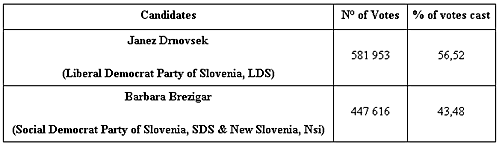 Source: Embassy of Slovenia in Paris
On the same theme
To go further
Elections in Europe

Helen Levy
—
2 June 2026
Elections in Europe

Helen Levy
—
26 May 2026
Elections in Europe
Helen Levy
—
12 May 2026
Elections in Europe
Helen Levy
—
5 May 2026

The Letter
Schuman
European news of the week
Unique in its genre, with its 200,000 subscribers and its editions in 6 languages (French, English, German, Spanish, Polish and Ukrainian), it has brought to you, for 15 years, a summary of European news, more needed now than ever
Versions :