
News
Corinne Deloy,
Helen Levy,
Fondation Robert Schuman
-

Available versions :
EN

Corinne Deloy

Helen Levy
Researcher at the Robert Schuman Foundation
Fondation Robert Schuman
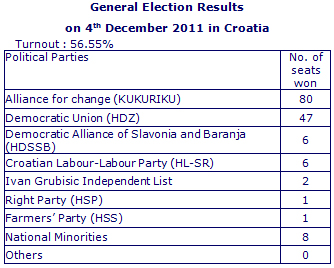
The Kukuriku coalition – "Alliance for Change" - led by the Social Democratic Party (SDP), the main opposition party of Zoran Milanovic rallying Ivan Jakovcic's Istrian Democratic Assembly (IDS), Radimir Cacic's People's Party-Liberal Democrats (HNS) and Silvano Hrelja's Pensioners' Party (HSU), won the general elections that took place on 4th December in Croatia with 44.5% of the vote and 80 seats (+13 in comparison with the previous election on 25th November 2007) in the Hrvatski Sabor, the only chamber in Parliament.
It took the lead over the Democratic Union (HDZ) led by outgoing Prime Minister Jadranka Kosor, which won 22.1% of the vote and 47 seats (-19). The Democratic Alliance of Slavonia and Baranja (HDSSB) led by Vladimir Sisljagic won 6 seats, as did the Croatian Labour-Labour Party (HL-SR) led by Dragutin Lesar. The Independent List led by former priest, Ivan Grubsic, won 2 seats. The Farmers' Party (HSS) led by Josip Frisic and member of the outgoing government coalition won one seat, as did the Right Party (HSP).
The Kurkuriku coalition won in 8 of the 10 electoral constituencies. The HDZ won in 3 including that of the expatriate Croats, (70.24%) of the vote.
As far as the 12th constituency is concerned, which represents the national minorities, Milorad Pupovac, Vojislav Stanimirovic and Jovo Vukovic were elected for the Serbs, Robert Jankovics for the Hungarians, Furio Radin for the Italians, Vladimir Bilek for the Czechs and the Slovaks, Zeljko Balog for the Austrians, Bulgarians, Germans, Poles, Roma, Romanians and Ruthens and Ermina Lekaj Prljaskaj for the Albanians, Bosnians, Montenegrins, Macedonians Slovenians.
Turnout rose to 56.55%, i.e. -3,1 points in comparison with the general election on 25th November 2007.
"Croatian citizens have given us their trust. They have given us a chance to lead Croatia and our responsibility is great. I promise that we shall not let you down. We are going to be of benefit to Croatia together," declared Zoran Milanovic when the results were announced, adding, "We shall join the EU and it is a great chance for us." "We are taking this show of support seriously and we shall work hard. This gives us a strong mandate but it is also a major duty," declared Vesna Pusic, former Pensioners' Party leader, who is due to become Foreign Minister, as she spoke on Nova TV.
The Democratic Union admitted its defeat. "Now we shall start work towards victory in the next general elections. We shall serve our people with dignity even though we'll be in the opposition," indicated outgoing Prime Minister Jadranka Kosor. Poor economic results and various corruption scandals explain the failure of the ruling party. "Jadranka Kosor did not fail, it was Ivo Sanader who made us lose this election," maintains former Justice Minister (2003-2006) and present chair of the Democratic Centre (DC), Vesna Skare-Ozbolt, alluding to the trial of the former HDZ leader and former Prime Minister (2003-2009) Ivo Sanader, who has been on trial on six charges since 3rd November. Moreover the party is also the focus of an inquiry on the part of the Bureau to counter organised crime (USKOK) with respect to the funding of the electoral campaigns in 2003 and 2007 and the presidential election of 2005, in which Jadranka Kosor was a candidate.
"I am expecting better cooperation than we've had until now. I am an optimist. The election has showed that Croatia is a mature democracy" declared the President of the Republic Ivo Josipovic.
Zoran Milanovic, who is 45, is a law graduate of Zagreb University. He worked at the Foreign Affairs Ministry before moving to the Nagorno Karabakh, where he was the first Croatian to take part in a UN peacekeeping mission. Between 1996 and 1999 he was advisor to the Croatian Mission at the EU and NATO. In 1999 he joined the Social Democratic Party and after the party's victory in the general elections on January 3rd 2000 he was appointed to take care of relations with NATO, then in 2003, he became Deputy Foreign Minister.
On 2nd June 2007 Zoran Milanovic was elected as head of the Social Democratic Party beating three other candidates Zeljka Antunovic, Milan Bandic and Tonino Picula. On 23rd November 2010 he signed an agreement with the People's Party-Liberal Democrats (HNS) the Istrian Democratic Assembly (IDS) and the Pensioners Party (HSU) to form a political coalition named the Alliance for Change in view of the general elections in 2011.
Zoran Milanovic's future government will have to undertake an austerity policy cutting into budgetary spending and achieve Croatia's economic recovery; unemployment affected 17.4% of the population in October, the sovereign debt is over 100% of the GDP, and growth is not due to rise above 0.5% this year. The new team will have to step up the fight to counter corruption. Zoran Milanovic said that "victory was the easy part and was just the start of work." "Reforming Croatia will be more difficult" warned the leftwing leader, who kept the strategy he would implement in order to keep his promises, a well guarded secret during the electoral campaign (reduction of the debt, creation of jobs, the end of the brain-drain etc ...)
Zoran Milanovic announced that the "budget would be put on a diet" and that "the Croatians should work more, harder and longer" He promised measures to stimulate economic revival, such as the abolition of the tax on reinvested profit or a reduction of social contributions with every new job.
"The greatest danger is if our sovereign rate is downgraded," stresses Zdeslav Santic, an analyst with the Splitska bank "In the coming months the next budget will have to show that accounts are being consolidated and we shall have to reassure foreign investors," he added.
On 9th December next Croatia will sign its membership treaty of the European Union in Brussels. On 1st December the European Parliament approved 564 votes in support, 38 against and 32 abstentions, Zagreb's accession to the EU. Croats are to vote within the next few weeks by referendum on their country's accession to the EU. If they vote yes, this will become effective on 1st July 2013.
On 1st December MEPs invited Zagreb to address "problems that continue to exist, particularly in the area of legal reform and the fight to counter corruption and organised crime," and to step up its efforts in view of prosecuting war crimes, respecting all of the recommendations made by the International Criminal Tribunal for Former Yugoslavia in the Hauge (ICTY) and to encourage the return of war refugees, notably the Serbs.
On the same theme
To go further
Elections in Europe

Helen Levy
—
13 October 2026
Elections in Europe

Helen Levy
—
6 October 2026
Elections in Europe

Helen Levy
—
15 September 2026
Elections in Europe
Helen Levy
—
15 September 2026

The Letter
Schuman
European news of the week
Unique in its genre, with its 200,000 subscribers and its editions in 6 languages (French, English, German, Spanish, Polish and Ukrainian), it has brought to you, for 15 years, a summary of European news, more needed now than ever
Versions :