Analysis
Elections in Europe
Helen Levy
-

Available versions :
EN

Helen Levy
Researcher at the Robert Schuman Foundation
In Bulgaria, snap general elections have been called for 19 April. They will take place against a backdrop of growing public discontent, linked to the level of corruption among the elite, the announcement of increases in taxes and social security contributions — which led to protests in late 2025 — and, above all, the resignation of the government led by Rossen Jeliazkov (GERB) on 11 December 2025. Rumen Radev, then president, called on the three main parties – GERB (centre-right), PP-DB (centre) and APS (Alliance for Rights and Freedoms, centre) – to form a government, as provided for in the Constitution, but this attempt failed. For the eighth time since April 2021, 6.6 million Bulgarians are being called upon to vote to elect the 240 MPs of the National Assembly (Narodno sabranie), the unicameral chamber of Parliament.
A never-ending electoral cycle
These eighth general elections follow those held in April, July and November 2021, then in October 2022, April 2023, and finally in June and October 2024. On each occasion, GERB (Citizens for the European Development of Bulgaria), led by former Prime Minister Boyko Borisov (2009–2013, 2014–2017, 2017–2021), has always managed to come out ahead — but this has never been enough to form a stable and lasting coalition with other government partners.
On 19 January 2026, President Rumen Radev resigned before the end of his term (which was due in November) and announced that he would form a new party, Progressive Bulgaria (PB), to stand in the general election! The new movement brings together three centre-left groups: the Political Movement of Social Democrats (PDS), the Social Democratic Party (SDP) and the Our People Movement (DNN), as well as the national conservative movement (VMRO-BND).
Vice-President Iliana Iotova, who became President following Rumen Radev’s resignation, called an election, stating that “the rules of a fair election must be respected by all”. On 12 February, she appointed the Deputy Governor of the Bulgarian National Bank, Andrey Gyurov, to lead an interim government until the general election. He replaced Rossen Jeliazkov on 19 February.
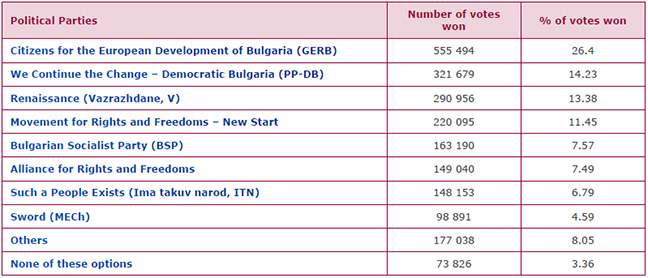
In the last election on 27 October 2024, the GERB party won 26.4% of the vote. “We Continue the Change – Democratic Bulgaria” (PP-DB), a liberal coalition bringing together the party led by Kiril Petkov and Democratic Bulgaria, which included Yes Bulgaria, Democrats for a Strong Bulgaria and was led by Hristo Ivano, came second with 14.23%, followed by Renaissance (Vazrazhdane, V), a nationalist party led by Kostadin Kostanidov, with 13.38%. The Movement for Rights and Freedoms – New Start garnered 11.45%; the Bulgarian Socialist Party (BSP) 7.57%; the Alliance for Rights and Freedoms 7.49%; There Is Such a People (ITN) 6.79%; Sword 4.59%; other parties obtained 8.05%; and a novelty in Bulgarian elections, ‘none of these options’, 3.36%.
In January 2025, GERB formed a coalition led by Prime Minister Rossen Jeliazkov, with the Bulgarian Socialist Party (BSP) and the far-right party “There Is Such a People” (ITN). This coalition did not last a year.
Could Rumen Radev become prime minister?
Rumen Radev, a former air force commander, was first elected president in 2016 and re-elected in 2021. He supported the street protests in late 2025 and pledged to "meet the expectations of Bulgarians by dismantling the oligarchic model of corruption". He is known for his criticism of the European Union, his reluctance regarding Bulgaria’s accession to the euro area (which took place on 1 January 2026) and his reservations about supplying arms to Ukraine.
In the hope of attracting as many people as possible to his cause, his party, ‘Progressive Bulgaria’, includes a wide range of diverse figures.
The political forces running for election
The Central Electoral Commission has officially registered 14 parties and 10 coalitions. The main ones are:
• Progressive Bulgaria (PB): The new “centre-left” coalition led by former President Rumen Radev. It is considered the favourite, with polls placing it at the top of the voting intentions.
• GERB: The centre-right coalition led by former Prime Minister Boyko Borisov. Long the dominant force, it now ranks second in opinion polls.
• PP-DB (We Continue the Change – Democratic Bulgaria): A centrist, pro-European coalition led by Assen Vassilev, focused on the fight against corruption.
• Renaissance (Vazrazhdane): A far-right, nationalist, Eurosceptic and pro-Russian party, led by Kostadin Kostadinov.
• DPS – New Start: A faction of the Movement for Rights and Freedoms (traditionally representing the Turkish minority), led by Delyan Peevski.
• BSP – United Left: a coalition of left-wing and socialist parties.
• Alliance for Rights and Freedoms (APS): another branch of the DPS, loyal to its historic founder Ahmed Dogan.
Several parties are fighting for their parliamentary survival. ITN (There Is Such a People) and MECh are predicted to win less than 4% of the vote, making their entry into Parliament highly uncertain.
The Bulgarian political system
The Bulgarian Parliament is unicameral. The National Assembly (Narodno sabranie) comprises 240 members, elected every four years in 31 multi-member constituencies corresponding to the country’s oblasts (provinces). The electoral system is mixed: 31 members are elected by a first past-the-post system (single round) and 209 by proportional representation (from closed lists). The Hare-Niemeyer method is used for the allocation of seats. A political party must obtain at least 4% of the votes cast to be represented in Parliament.
Candidates must be at least 21 years of age. To be able to field candidates, parties must collect the signatures of at least 15,000 voters and are required to pay the electoral authorities the sum of 10,000 lev (€5,113), which is refunded to them if they obtain at least 1% of the votes cast. Independent candidates must be supported by at least 10,000 voters in the constituency in which they are standing.
Since 2016, Bulgarians have also had the option of submitting a ballot paper expressly stating ‘I do not support any of the candidates’.
Bulgarians living abroad must have applied to vote abroad by 24 March. Applications at diplomatic missions began on 6 March. As of 12 March, 16,000 people had registered to vote from abroad, mainly in Turkey, Germany and the United Kingdom. 720 polling stations will be open outside Bulgaria for this election.
Bulgarians also elect their President of the Republic by direct universal suffrage. On 21 November 2021, Rumen Radev, supported by the BSP, We Continue the Change, There Is Such a People and Stand Up BG! We Are Coming! (Izpravi se BG! Nie idvame!), was elected for a second term in the second round with 66.72% of the vote. He defeated Anastas Gerjikov, backed by GERB and the Union of Democratic Forces, who secured 31.80% of the vote. Turnout stood at just 33.55%.
There are currently eight parties represented in Parliament:
- “Citizens for the European Development of Bulgaria” (GERB), founded in 2006 by former Prime Minister Boyko Borisov, has 66 MPs;
- We Continue the Change (PP), a liberal and anti-corruption party, has 36 MPs;
- Renaissance (Vazrazhdane, V), a far-right nationalist party founded in 2014, holds 33 seats;
- Movement for Rights and Freedoms/New Start, representing the Turkish-speaking minority, founded in 1989 and chaired by Delyan Peevski, holds 29 seats
- The Socialist Party / United Left (BSP), led by Nataliya Kiselova, holds 19 seats
- There Is Such a People (Ima takuv narod, ITN), a populist party founded by the singer and television presenter Slavi Trifonov, and chaired by Toshko Yordanov, has 16 MPs;
- The Alliance for Rights and Freedom was founded in 2025 following a split from the MRF. Advocating liberalism and the interests of the Turkish minority, it is led by Hayri Sadakov and holds 14 seats
- MECh (Sword/Morale, Unity, Honour), a far-right Eurosceptic party led by Kiril Veselinski, holds 11 seats;
- Greatness (Velichie), a pro-Russian party founded and led by Ivelin Mihailov, holds 10 seats.
- Independent MPs hold 6 seats.
Results of the general elections held on 27 October 2024 in Bulgaria
Turnout: 38%
Source : https://results.cik.bg/pe202410/rezultati/index.html
Interference and Corruption
To ensure that the election is conducted in line with the rule of law and prevent any risk of fraud, numerous international observers and representatives from the OSCE will be present for the election. George Sharkov, the minister responsible for e-governance in the interim government, stated that 100% of the machines used in the election would be checked before voting begins to detect any anomalies. Furthermore, CCTV systems will be installed in all polling stations across the country to provide live coverage, amongst other security measures.
What do the most recent polls say?
According to the latest poll published on 18 March, five parties are expected to enter Parliament following the 19 April elections: Progressive Bulgaria (21.1%); GERB (18.5%); We Continue the Change (PP-DB) (12%); Movement for Rights and Freedoms (7.2%); Vazrazhdane (4.9%). All other parties are expected to remain below the 4% threshold required to enter Parliament. The election is therefore set to be a close contest.
In this election, 51% of the population have said they intended to vote. Voter turnout has fallen with each successive election, and in 2024, only 38% of voters fulfilled their civic duty. This time, turnout could be decisive if voters wish to give a stable government a majority. However, around 1 million voters still say they are undecided with one month to go before the election, which could alter the order in which certain parties finish.
If Rumen Radev were to finish in first place on 19 April, with which other parties could he form a coalition? On what policy platform? And for how long? Would he be an ally to the European Union, or would he turn to other ‘illiberal’ models, such as the prime ministers of Slovakia, Hungary or the Czech Republic? At the very least, three parties will be needed to form a majority coalition.
On the same theme
To go further
Elections in Europe
Helen Levy
—
13 October 2026
Elections in Europe

Helen Levy
—
6 October 2026
Elections in Europe

Helen Levy
—
15 September 2026
Elections in Europe
Helen Levy
—
15 September 2026
The Letter
Schuman
European news of the week
Unique in its genre, with its 200,000 subscribers and its editions in 6 languages (French, English, German, Spanish, Polish and Ukrainian), it has brought to you, for 15 years, a summary of European news, more needed now than ever
Versions :