News
Corinne Deloy,
Helen Levy,
Fondation Robert Schuman
-

Available versions :
EN

Corinne Deloy

Helen Levy
Researcher at the Robert Schuman Foundation
Fondation Robert Schuman
According to final results three of the four parties in the outgoing coalition, the Alliance for European Integration – the Liberal Party (PL) led by interim President of the Republic Mihai Ghimpu, the Liberal Democratic Party (PLDM) led by outgoing Prime Minister Vladimir Filat and the Democratic Party (PDM) led by Marian Lupu together won 52.06% of the vote and 59 seats (+11). The Liberal Democratic Party made a breakthrough with 29.38% of the vote (32 seats). The Democratic Party won 12.72% of the vote and 15 seats, the Liberal Party, 9.96% and 12 seats.
The Communist Party of former Head of State (2001-2009) Vladimir Voronin, who was however confident after the invalidation of the referendum on the election of the President of the Republic by direct universal suffrage on 5th September last, is losing ground. It won 39.29% of the vote and 42 seats.
None of the other parties running and notably the Our Moldova Alliance (AMN) led by the former Mayor of Chisinau, Serafim Urechean, member of the outgoing government coalition, rose above the 4% threshold necessary to be represented in Parliament.
Turnout was almost the same as that recorded in the last general elections on 29th July 2009 (+0.33%) and rose to 59.1%. The Alliance for European Integration authorised the opening of 75 polling stations abroad, a much higher number than in the previous general elections. The election on 28th November was the fourth in less than two years after the general elections of 5th April 2009, those of 29th July 2009 and the referendum on 5th September last with regard to the election of the President of the Republic by direct universal suffrage.
"These results show that the impossible is possible," said outgoing Prime Minister Vladimir Filat happily. "The only real chance for Moldova is to continue along the road to reform now being implemented and which has the support of its external partners – the European Union, the USA, the International Monetary Fund (IMF) and the World Bank. Our goal is to ensure that Moldova does not return to the past," added the man who may be appointed to undertake negotiations to form the next government.
In view of these results, Moldova does not however seem to be in a position to solve the main political problem it has been facing since the spring of 2009 i.e. the election of the President of the Republic. According to the present Constitution in application since 2000 the Head of State of Moldova is elected by a secret 3/5 ballot of the MPs in Parliament i.e. 61 of the 101 MPs. The parties in the Alliance for European Integration in office for the last 16 months would therefore not have an adequate majority in Parliament to elect their candidate as Head of State (-2).
Negotiations have therefore started between all of the parties to find a solution to this perpetual impasse. Florent Parmentier – French researcher – believes that the most probable scenario will be a decrease in the threshold to a simple majority (52 votes). He recalls that the Communist Party already supports this solution. Oleg Serebrian, Ambassador for Moldova in France also imagines this as the most likely scenario. "Either Parliament agrees on a neutral candidate or it will modify the Constitution to reduce the majority necessary for the election of the Head of State," he declared.
According to the present Constitution MPs have to elect the President of the Republic within three months after the dissolution of the previous Parliament and so the new Head of State is due to be appointed before 28th December next.
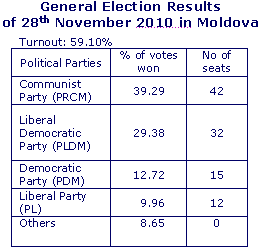 Source: Internet Site: Moldovan Central Electoral Commission http://cec.md/index.php?pag=page&id=43&l=
On the same theme
To go further
Elections in Europe

Helen Levy
—
13 October 2026
Elections in Europe

Helen Levy
—
6 October 2026
Elections in Europe

Helen Levy
—
15 September 2026
Elections in Europe
Helen Levy
—
15 September 2026
The Letter
Schuman
European news of the week
Unique in its genre, with its 200,000 subscribers and its editions in 6 languages (French, English, German, Spanish, Polish and Ukrainian), it has brought to you, for 15 years, a summary of European news, more needed now than ever
Versions :